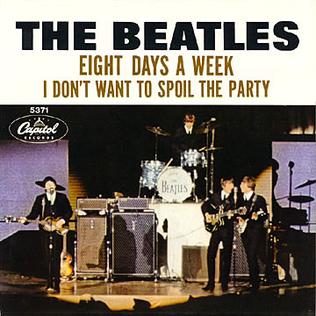
Those who have known me know that, though I do not often speak of musicians nowadays, growing up I was (and am always) a huge Beatles fan. In the year of my birth, 1965, they released one of their many classic recordings, "Eight Days a Week". However, the reader will have to read along in order to discover the significance of "8" and the Sunday Sabbath. I hope the read will be informative and motivating of positive action.
The question often arises, which day the Sabbath for Christians is. If we were to answer this question based solely on practice, then the answer would be "either the seventh day of the week or the first day, depending on the Christian Church." Certainly Christians were distinguished from the first century AD on by their observance of a Sunday Sabbath, but many Jewish Christians adhered or returned to a Saturday Sabbath (along with other aspects of the Mosaic Law), and in recent centuries many Christians have come to believe that the Sabbath should have remained on the Seventh day of the week. A careful examination of the issue is warranted.
Point 1: The Light of Day One vs. The Lights on the Fourth Day
The Book of Genesis records the Creation of the earth and its atmosphere, "heaven", in six periods called days. Genesis, chapter 1:3-5, begins the creative periods:
And God said, Let there be Light [Hebrew "'Or"]:
and there was Light.
And God saw the Light, that it was good:
and God divided the light from the darkness.
And God called the Light day,
and the darkness He called night.
And the evening and the morning were Day One.
Now the Hebrew language has a word for "first", but what is used here in Genesis 1:5 is "Day One" rather than the phrase "first day". All other days have ordinal numbers, "second day", "third day", "fourth day", etc. In English "Day One" is simply a synonym for "First Day". The same relationship is true in Hebrew, although the Hebrew construction allows for another understanding that is not admitted by the English construction. In Hebrew "Day One" can also be understood as "Day of (the) One". In order to convey a possessive relationship in English "of" would have to be employed. In Hebrew the two words are simply juxtaposed and the first noun is understood as belonging to the second, hence "Day of (the) One" is an allowable reading.
It should be noted that the "Light" of Day One is special. This "Light" ["'Or"] is separated from the darkness, and God sees the Light alone, not the darkness, as "good". In the narrative of Genesis 1, "Light" ["'Or"] appears on Day One, but the sun, moon and stars shine through the atmosphere for the first time on the Fourth Day. It should be noted that although in English the same word is employed for both types of light with the only difference being singular vs. plural, light : lights, in Hebrew the two types of light are denoted by different words: (Genesis 1:14)
And God said,
Let there be lights [moroth] in the firmament of the heaven to divide the day from the night:
and let them be for signs,
and for seasons,
and for days,
and for years.
Scholars often point out what they deem to be an inherent incongruity in the Genesis narrative. On the third day all manner of plant life is made to grow, yet the sun, the primary source of nourishment for plant life, does not appear until the fourth day. However, there is a deeper teaching here, namely, that all plant life did enjoy the benefits of illumination, though that illumination came from a "Light" source powerful enough to separate Day from Night. That Light that lit the world from Day One on was "'Or". On the Fourth Day the normal illuminating function was carried by the sun, moon and stars, collectively referred to by the plural noun "moroth". As a side note, Genesis 1:3-5 may very well be the origin of the expression "Light of the World". As another side note, the Egyptians believed that the night represented death, and the new day represented resurrection. The same symbolism was later employed by the Israelites.
The prophet Isaiah foretold the day that the Prince of Peace would make His appearance in Galilee. (Isaiah 9:2)
(2) The people that walked in darkness have seen a great Light [Hebrew 'Or]: they that dwell in the land of the shadow of death, upon them hath the Light ['Or] shined.
It is noteworthy that even Isaiah, in describing the Advent of the Prince of Peace on earth, calls Him the Light, "'Or", the very same Light that appeared on Day One of Creation. This relationship between Genesis 1:3-5 and Isaiah is somewhat lost in translation, again, because in English "Light" [from the Hebrew 'Or] is identical to "light" [from the Hebrew "moroth"].
Point 2: The Seventh Day Commemorating The Completion of God's Work
As the Genesis narrative continues we see God "resting" on the Seventh Day. (Genesis 2:1-3)
Thus the heavens and the earth were finished,
and all the host of them.
And on the seventh day God ended His works which He had made;
and He rested on the Seventh Day from all His works which He had made.
And God blessed the Seventh Day,
and sanctified it: because in it He had rested from all His works
which God created and made.
First of all, translations usually read that God "ended his work". The Hebrew text, however, reads "works", and thus I see no need to deviate from the text.
The Book of Genesis is silent as to what significance in practice the Seventh Day had for early worship among the sons of Adam. Presumably the early Saints worshiped God on the Seventh Day, at least, I am willing to suppose that this may have been the case. But in point of fact, the first overt references to separating this day, the Seventh Day, from the rest of the days of the week, in order to use this day for expressing one's devotion to God, comes with the Law given to Moses. (Exodus 20:8,11)
Remember the Sabbath Day, to keep it holy.
Six days shalt thou labour, and do all thy works:
But the Seventh Day is the Sabbath of the LORD thy God:
in it thou shalt not do any work...
For in six days the LORD made heaven and earth, the sea
and all that in them is,
and rested the Seventh Day;
wherefore the LORD blessed the Sabbath Day,
and hallowed it.
It is interesting to note that God completed His works in six days and rested the following day. God also realizes that man is engaged in his own works, labors, and man will rest on the seventh day, not from having completed his works, but in honor of God's completing the creation of the earth and atmosphere and filling the earth with flora, fauna and the human family of (initially the great patriarch and matriarch) Adam and Eve. It is noteworthy that the Mosaic Sabbath was to celebrate God's completion of the creation of the world.
Point 3: Who Exactly Was Under the Law to Observe the Sabbath?
One often overlooked detail is that God commanded Israel to keep the Sabbath day, Israel and Israel alone: (Exodus 31:12-17)
And the LORD spake unto Moses, saying,
Speak thou also unto the children of Israel, saying,
Verily my sign between me and you throughout your generations;
that ye may know that I am the LORD that doth sanctify you.
Ye shall keep the Sabbath therefore;
for it is holy unto you:
every one that denieth it shall surely be put to death:
for whosoever doeth any work therein,
that soul shall be cut off from among his people.
Six days may work be done;
but in the seventh is the Sabbath of rest,
holy to the LORD:
whosoever doeth any work in the Sabbath day,
he shall surely be put to death.
Wherefore the children of Israel shall keep the Sabbath,
to observe the Sabbath throughout their generations,
for an eternal covenant.
It is a sign between me and the children of Israel for ever:
for in six days the LORD made heaven and earth,
and on the seventh day He stopped, and breathed.
Here we see that the Lord commanded the children of Israel to keep the Sabbath Day, the Lord stated that the seventh day commemorated His resting just after His six days of works, and the Lord added that Sabbath Day observance is a perpetual covenant. The sign between the Lord and Israel is that Israel would mark the Day that the Lord stopped or completed the creation of this earth/atmosphere and "breathed".
An often overlooked detail in the issue of Sabbath Day observance is that it was Jesus Christ who created this earth, its atmosphere, and filled them with life, and Jesus assisted His Father in preparing the world for Adam and Eve. (John 1:3)
(3) All things were made by him;
and without him was not any thing made that was made.
The Seventh Day was, in essence, the day to commemorate Jesus Christ's completion of His great pre-mortal mission, that of creating this earth and making it inhabitable for humanity.
God the Father was the One who commanded, but it was Jesus Christ who came and performed the works of creation according to the will of The Father. Now, bearing in mind the great purpose of the Seventh Day Sabbath (to commemorate God's, that is, Jesus' completion of His works), notice what Isaiah says shall be said in that day, a future day of revelation that will follow a period in which The LORD had hid his face and not spoken to mankind (Isaiah 12:1-6):
(1) And in that day thou shalt say, O LORD, I will praise thee: though thou wast angry with me, thine anger is turned away, and thou comfortedst me.
(2) Behold, God is my salvation; I will trust, and not be afraid: for the LORD JEHOVAH is my strength and my song; he also is become my salvation.
(3) Therefore with joy shall ye draw water out of the wells of salvation.
(4) And in that day shall ye say, Praise the LORD, call upon his name, declare his doings among the people, make mention that his name is exalted.
(5) Sing unto the LORD; for he hath done excellent things: this is known in all the earth.
(6) Cry out and shout, thou inhabitant of Zion: for great is the Holy One of Israel in the midst of thee.
Notice the often overlooked detail, that in that day we shall speak of the things The Lord has done, for Jehovah has become our salvation. If God, Jesus, completed his work on the sixth day, how is it that in a future day we would sing and declare of what Jehovah, Jesus, has done as He has become our salvation? Isaiah is clear, namely, that it is because The Holy One of Israel will have been in our midst, even Jesus Christ, the Son of God. The Messiah was to come and do great works of salvation among the children of men, namely atone for the sins of the world and rise from the dead, and in that day we would commemorate the things He had just done.
Point 4: The First and The Seventh Days Bear Relationship in Worship
The Law was given to Moses after The Lord used Moses as His servant to deliver His people from 430 years in Egypt, a lengthy time that had seen the Israelites prosper and then be denied rights and property, ultimately being reduced to slavery.
In the Law of Moses or "The Law given to Moses" a celebration of Israel's deliverance out of Egypt was proscribed.
(11) And thus shall ye eat it; with your loins girded, your shoes on your feet, and your feet, and your staff in your hand; and ye shall eat it in haste: it is the LORD's passover.
(12) For I will pass through the land of Egypt this night, and will smite all the firstborn in the land of Egypt, both man and beast; and against all the gods of Egypt I will execute judgment: I am the LORD.
(14) And this day shall be unto you for a memorial; and ye shall keep it a feast to the LORD throughout your generations; ye shall keep it a feast by an ordinance for ever.
(15) Seven days shall ye eat unleavened bread; even the first day ye shall put away leaven out of your houses: for whosoever eateth leavened bread from the first day until the seventh day, that soul shall be cut off from Israel.
(16) And in the first day there shall be an holy convocation, and in the seventh day there shall be an holy convocation to you; no manner of work shall be done in them, save that which every man must eat, that only may be done of you.
The Passover thus was to be initiated by an holy convocation on the first day as well as concluded with an holy convocation on the seventh day. Though this factor may be legitimately seen simply as the collective convening and concluding of the celebration, it is interesting that the covenant people were to celebrate collectively on the first and seventh days, as if to demonstrate the significance of these days for worship.
Fifth Point: Jeremiah Points to a New Covenant and Isaiah Speaks of Rejected Sabbaths
Jeremiah was not just a great Old Testament prophet, he was the prophet who had the unenviable task of presiding over the apostasy and subsequent captivity of Judah. Notice what Jeremiah had to say of the rebellions of the House of Israel (at that time the defunct Northern Kingdom) and Judah (the soon to be captive nation) in Jeremiah 31:31-36:
(31) Behold, the days come, saith the LORD, that I will make a new covenant with the house of Israel, and with the house of Judah:
(32) Not according to the covenant that I made with their fathers in the day that I took them by the hand to bring them out of the land of Egypt; which my covenant they brake, although I was an husband unto them, saith the LORD:
(33) But this shall be the covenant that I will make with the house of Israel; After those days, saith the LORD, I will put my law in their inward parts, and write it in their hearts; and will be their God, and they shall be my people.
(34) And they shall teach no more every man his neighbour, and every man his brother, saying, Know the LORD: for they shall all know me, from the least of them unto the greatest of them, saith the LORD: for I will forgive their iniquity, and I will remember their sin no more.
(35) Thus saith the LORD, which giveth the sun for Light ['Or] of His day [or "for Light by Day"], and the decreeth the moon and of the stars for Light ['Or] of night, which divideth the sea when the waves thereof roar; The LORD of hosts is his name:
(36) If those decrees depart from before me, saith the LORD, then the seed of Israel also shall cease from being a nation before me forever.
The prophet Jeremiah spoke of a day when The Lord would establish a new covenant with the House of Israel, and The Lord said that He was the One who had given the sun, moon and stars for Light ['Or]. Notice the departure from the word "moroth" which was the term used in Genesis to describe the physical luminaries of the sun, moon and stars. Here the sun, moon and stars are given to shine for the Light as a symbol of the Lord's decrees. Jeremiah pointed out that The Lord stated that if Israel would depart from those decrees of His, Israel would cease to be a nation. Do take notice that when The Lord mentioned "day" He said that the sun was given for Light ['Or] of His Day. Follow the logic: If The Lord has a Light ['Or] of His Day, and that Light ['Or] was known to have appeared on Day One, that would imply that Day One has the significance of being The Lord's Day. More on this point will follow.
The prophet Isaiah records The Lord rejecting the worship including Sabbaths of apostate Israel:
(11) To what purpose is the multitude of your sacrifices unto me? saith the LORD: I am full of the burnt offerings of rams, and the fat of fed beasts; and I delight not in the blood of bullocks, or of lambs, or of he goats.
(12) When ye come to appear before me, who hath required this at your hand, to tread my courts?
(13) Bring no more vain oblations; incense is an abomination unto me; the new moons and sabbaths, the calling of assemblies, I cannot away with; it is iniquity, even the solemn meeting.
(14) Your new moons and your appointed feasts my soul hateth: they are a trouble unto me; I am weary to bear them.
The most immediate application of this passage is that it is the vain observance of the Lord's ordinances is displeasing to Him. It is curious that The Lord would do away with the Sabbaths (and other ordinances) as a response to Israel's disobedience.
Sixth Point: The Son of God Rose on the First Day.
It is a matter of common knowledge to Christians that the Son of God was crucified on a Friday, the sixth day, just before the Jewish Sabbath, and early on the morning of Sunday, the First day, Day One, He rose from the dead. (Matthew 28:1-6)
(1) In the end of the sabbath, as it is began to dawn toward the first day of the week, came Mary Magdalene and the other Mary to see the sepulchre.
(2) And, behold, there was a great earthquake: for the angel of the Lord descended from heaven, and came and rolled back the stone from the door, and sat upon it.
(3) His countenance was like lightning, and his raiment white as snow.
(4) And for fear of him the keepers did shake, and became as dead men.
(5) And the angel answered and said unto the women, Fear not ye: for I know that ye seek Jesus, which was crucified.
(6) He is not here: for His is risen, as He said, Come, see the place where The Lord lay.
Who lay in the sepulchre only to rise on Sunday morning, the third day after His crucifixion? The Lord did. Notice that detail that often gets overlooked, namely, that it was The Lord who rose on that day.
Just prior to The Savior's death the Apostle John recorded the Savior uttering the following words as He agonized on the cross: (John 19:30)
(30) When Jesus therefore had received the vinegar, he said, It is finished:
And he bowed his head, and gave up the ghost,
The significance of this utterance is seldom considered: "It is finished." When was the last time Deity had ever declared a work to be finished or ended? It was in reference to the works of creation which God had done in six days, during six creative "days" of work: "And on the seventh day God ended his works which he had made; and he rested on the seventh day from all his work which he had made." And notice the parallel: God ended His works of creation on the sixth day then "rested" during the entire seventh day. Consequently the seventh day became the Hebrew Sabbath, the day to remember that God rested on this day. Jesus, The Lord, finished His great work of the Atonement on Sixth Day, Friday by "giving up the ghost", "breathing out", then Jesus rested in Paradise during the entire Seventh Day. This demonstrates the great culmination of the Mosaic Sabbath. Finally Christ rose on the first day of the week thus breaking the bands of death on Sunday. It was thus on the first day of the week that the Sun of Righteousness rose with healing in His wings. (Malachi 4:2)
(2) But unto you that fear my name shall the Sun of Righteousness arise with healing in his wings; and ye shall go forth, and grow up as calves of the stall.
Jeremiah stated, though the affirmation is usually lost in translation, that the LORD gave the Sun for Light ['Or] of His Day. After Jesus's death on the cross and His rest in Paradise fulfilled the very object and aspirations of the Mosaic Law, Jesus rose as the Sun rises, in Resurrection.
The Mosaic Law, replete with animal sacrifices of unblemished male firstborns, all done for "atonement" of sins, saw its great climax when The Son of God was sacrificed for sin and laid to rest in a grave, to rest on the Seventh Day. The Savior's Resurrection was now the heralding of the New Covenant and Jeremiah prophesied would come with the Sun being given for Light of His, The Lord's, Day, as you will see shortly.
Notice that not only did The Lord rise from the dead on the First Day, it was on the First Day, Sunday, that He appeared to His Apostles, and that Sunday became the day of gathering for the Apostles: (John 20:1,19,26)
(1) The first day of the week cometh Mary Magdalene early, when it was yet dark, unto the sepulchre, and seeth the stone taken away from the sepulchre.
(19) Then the same day at evening, being the first day of the week, when the doors were shut where the disciples were assembled for fear of the Jews, came Jesus and stood in the midst, and saith unto them, Peace be unto you.
(26) And after eight days [in Middle Eastern reckoning "after 8 days", but in Western European reckoning "in seven days/one week later"] again his disciples were within, and Thomas with them: then came Jesus, the doors being shut, and stood in the midst, and said, Peace be unto you.
Thus the Resurrected Lord fulfilled the prophecy that the Son of God would rise from the dead as He, the Light of the world, arose. The Lord then made His first two appearances to His disciples in two separate gatherings that both took place on the first day of the week.
The pattern continued, that is, of gathering together on the First Day: (Acts 20:7)
(7) And upon the first day of the week, when the disciples came together to break bread, Paul preached unto them, ready to depart on the morrow; and continued his speech until midnight.
Notice that it was on the first day of the week that the disciples were meeting together to break bread. This practice, that of holding the sacrament on the first day of the week, is very significant. Why? Because the sacrament represents the sacrifice of the body and blood of the Son of God for the remission of sins in the New Covenant: (Matthew 26:26-28)
(26) And as they were eating, Jesus took bread, and blessed it, and brake it, and gave it to the disciples, and said, Take, eat; this is my body.
(27) And he took the cup, and gave thanks, and gave it to them, saying, Drink ye all of it;
(28) For this is my blood of the New Covenant, which is shed for many for the remission of sins.
Now, the King James reads "this is my blood of the new testament", but the Greek source text reads, "this is my blood of the new covenant." This is fulfillment of the prophecy in Jeremiah that a new covenant would be instituted. Again, this development is significant because the Saturday Sabbath was instituted with the Law given to Moses; now that The Lord who declared Himself to be The Lord of the Sabbath (Matthew 12:8) instituted the New Covenant, a New Sabbath followed suit. Notice the parallels: The Lord gave the Mosaic Law after leading Israel out of bondage in Egypt. Now The Lord gave the New Covenant after delivering Israel and indeed the whole world from sin. It is important to remember that the law of the Sabbath has not been revoked, but the purpose of it, which had been to remember the completion of the Lord's work, advanced from the Creation alone to the great act of Redemption, in particular the Resurrection.
Seventh Point: A Lost New Testament Book and Historical Writings Confirm the Sunday Sabbath
The average Christian and layman, for that matter, is unaware that the oldest versions of The New Testament had additional books. The Codex Sinaiticus, created between AD 330-380 may very well be the oldest New Testament, and it had books after The Book of Revelation. Now, I say that the Codex Sinaiticus had "additional" books, mainly because these books were removed from subsequent copies of The New Testament, but I should rather write that our New Testaments lack the complete repertoire that had originally been there in the earliest Codices (Sinaiticus and Alexandrinus). My point in raising this issue is not to open a debate on the merits of the early decision to remove these books. I would, however, draw the reader's attention to The Epistle of Barnabas, believed to have been written by the Apostle Barnabas. He, Barnabas, treated the issue of the Sunday Sabbath with Apostolic authority: (Epistle of Barnabas 12:9-10)
(9) Lastly, he [referring to "The Lord"] saith unto them: Your new moons and your sabbaths I cannot bear them. Consider what he means by it; the sabbaths, says he, which ye now keep are not acceptable unto me, but those which I have made; when resting from all things I shall begin the eighth day, that is, the beginning of the other world.
(10) For which cause we observe the eighth day with gladness, in which Jesus rose from the dead; and having manifested himself to his disciples, ascended into heaven.
Here we have an Apostle of The Lord declaring that the "eighth" day was Sabbath of The Lord after His resurrection. Moreover, it is here, in this deleted New Testament epistle that an Apostle recorded The Lord declaring the "eighth day", (Sunday-1, Monday-2, Tuesday-3, Wednesday-4, Thursday-5, Friday-6, Saturday-7, Sunday-8) to be His Sabbath. I have on occasion heard people ask, "Where in The Bible does The Lord ever declare Sunday to be His Sabbath?" Well, in the original New Testament, The Lord made this bold declaration of the "eighth" day being His Sabbath, and an Apostle affirmed their Apostolic obedience to this decree. It should be noted that for the ancient Hebrews the number 8 denoted covenants, in particular the covenant of baptism. (1 Peter 3:20-21)
(20) Which sometime were disobedient, when once the longsuffering of The God waited in the days of Noah, while the ark was a preparing, where few, that is, eight souls were saved by water.
(21) The like figure whereunto even baptism doth also now doth save us (not the putting away of the filth of the flesh, but the answer of a good conscience toward God,) by the resurrection of Jesus Christ;
(22) Who is gone into heaven, and is on the right hand of The God; angels and authorities and powers being made subject unto him.
Notice that the figure of "eight" not only signified God's saving of the faithful few in Noah's Ark, but also our baptisms which symbolize the Resurrection. As pointed out in The Epistle of Barnabas, "eight" was the symbol of the Day of Resurrection.
But there is yet another record of early date, this time one that was never included in The New Testament canon, although many early Christians revered it as scripture. Ignatius, an early church father believed to have been a close associate of the Apostles, wrote an epistle to the Saints living in Magnesia. In chapter 3:1-3 Ignatius treated the issue of The Lord's Day:
(1) Be not deceived with strange doctrines; nor with old fables which are unprofitable. For if we still continue to live according to the Jewish law, we do confess ourselves not to have received grace. For even the most holy prophets lived according to Christ Jesus.
(2) And for this cause were they persecuted, being inspired by his grace, to convince the unbelievers and disobedient that there is one God who has manifested himself by Jesus Christ his son; who is his eternal word, not coming forth from silence, who in all things pleased him that sent him.
(3) Wherefore if they who were brought up in these ancient laws came nevertheless to the newness of hope: no longer observing sabbaths, but keeping the Lord's day in which also our life is sprung up by him, and through his death, whom yet some deny.
Now, lest anyone be too quick to discount the citations from The Epistle of Barnabas and The Epistle to the Magnesians, we may do well to take notice of a little known detail. In the Law of Moses The Lord commanded feast days as well. One of these feasts was The Feast of Tabernacles. This feast day was unique not only because it involved every family sitting in its own booth, oriented toward the Temple, but because this feast day had two Sabbath Days, one on the "first day" and another on the "eighth day" of the feasts: (Leviticus 23:39)
(39) Also in the fifteenth day of the seventh month, when ye have gathered in the fruit of the land, ye shall keep a feast unto the LORD seven days: on the first day shall be a sabbath, and on the eight day shall be a sabbath.
Thus there may be yet another precedent for a Sunday Sabbath inasmuch as the Two Sabbaths of the Feast of Tabernacles were on its first and eighth days which may have symbolic reference to the coming first/eighth day Sabbath of the New Covenant.
Eighth Point: The Book of Mormon Marks The Death of the Savior as the Point of Fulfillment of the Mosaic Law.
After the Savior pronounced the words "It is finished" and gave up the ghost, He went to Paradise, the abode of the righteous dead, just as He said He would (Luke 23:43):
(43) And Jesus said unto him, Verily I say unto thee, Today shalt thou be with me in paradise.
It was from there, Paradise, that Jesus spoke to the more righteous Nephites, those who had been spared the prophesied destructions that would follow His death: (3 Nephi 9:15-19)
(15) Behold, I am Jesus Christ the Son of God. I created the heavens and the earth, and all things that in them are. I was with the Father from the beginning. I am in the Father, and the Father in me: and in me hath the Father glorified his name.
(16) I came unto my own, and my own received me not. And the scriptures concerning my coming are fulfilled.
(17) And as many as have received me, to them have I given to become the sons of God; and even so will I to as many as shall believe on my name, for behold, by me redemption cometh, and in me is the law of Moses fulfilled.
(18) I am the light and the life of the world. I am Alpha and Omega, the beginning and the end.
(19) And ye shall offer up unto me no more the shedding of blood; yea, your sacrifices and your burnt offerings shall be done away, for I will accept none of your sacrifices and your burnt offerings.
Notice how these two witnesses are so complimentary to each other? On the Cross, on Friday, The Lord, while suffering for the sins of the world stated, "It is finished", and then rested in Paradise. This act was the culmination of the Law of Moses. The Book of Mormon: Another Testament of Jesus Christ, restores another great teaching and confirmation of what we can deduce from The New Testament: The Death of Jesus not only marked the culmination of The Law of Moses, it marked the fulfillment of that Law.
As the Nephites (The Lord's covenant people among the ancient Amerindians) did not totally understand the expression that the Law of Moses was fulfilled, The Savior clarified this matter when, after His ascension into heaven, He visited the Nephites: (3 Nephi 15:4-9)
(4) Behold, I say unto you that the law is fulfilled that was given unto Moses.
(5) Behold, I am he that gave the law, and I am he who covenanted with my people Israel; therefore, the law in me is fulfilled, for I have come to fulfill the law; therefore it hath an end.
(6) Behold, I do not destroy the prophets, for as many as have not been fulfilled in me, verily I say unto you, shall all be fulfilled.
(7) And because I said unto you that old things have passed away, I do not destroy that which hath been spoken concerning things which are to come.
(8) for behold, the covenant which I have made with my people is not all fulfilled; but the law which was given unto Moses hath an end in me.
(9) Behold, I am the law, and the light. Look unto me, and endure to the end, and ye shall live; for unto him that endureth to the end will I give eternal life.
Thus we see clearly that The Lord Jesus Christ fulfilled the Law of Moses when He died on the cross and that He offered a new Law, a New Covenant, when He rose from the dead.
Ninth Point: The Sabbath Accepted by The Lord to Be a Day of Revelation.
The prophet Isaiah taught the great importance of the fast. This passage often receives much attention among the Latter-day Saints. But are we aware that Isaiah connected the fast to Sabbath-day observance? (Isaiah 58: 5-14) This point is critically important because to that people whose Sabbath Day is accepted of The Lord, He would reveal Himself, and that people would experience much restoration.
(5) Is it such a fast that I have chosen? a day for a man to afflict his soul? is it to bow down his head as a bulrush, and to spread sackcloth ashes under him? wilt thou call this a fast, and an acceptable day to The LORD?
(6) Is not this the fast that I have chosen? to loose the bands of wickedness, to undo the heavy burdens, and to let the oppressed go free, and that ye break every yoke?
(7) Is it not to deal thy bread to the hungry, and that thou bring the poor that are cast out to thy house? when thou seest the naked, that thou cover him: and that thou hide not thyself from thine own flesh?
(8) Then shall thy Light ['Or] break forth as the morning, and thine health shall spring forth speedily: and thy righteousness shall go before thee; the glory of the LORD shall be thy rereward.
(9) Then shalt thou call, and the LORD shall answer: thou shalt cry, and he shall say, Here I am. If thou take away from the didst of thee the yoke, the putting forth of the finger, and speaking vanity;
(10) And if thou draw out thy soul to the hungry, and satisfy the afflicted soul; then shall thy Light ['Or] rise in obscurity, and thy darkness be as the noonday.
(11) And the LORD shall guide thee continually, and satisfy thy soul in drought, and make fat thy bones: and thou shalt be like a watered garden, and like a spring of water, whose waters fail not.
(12) And they that shall be of thee shall build the old waste places: thou shalt raise up the foundations of many generations; and thou shalt be called, The repairer of the breach, The restorer of paths to dwell in.
(13) if thou turn away thy foot from the Sabbath, from doing thy pleasure on my holy day; and call the Sabbath a delight, the holy of the LORD, honorable: and shalt honour him, not doing thine own ways, nor finding thine own pleasure, nor speaking thine own words:
(14) Then shalt thou delight thyself in the LORD; and I will cause thee to ride upon the high places of the earth, and feed thee with the heritage of Jacob thy father: for the mouth of the LORD hath spoken it.
The Lord, speaking through the prophet Isaiah, promises great blessings of the personal revelation of The Lord, of hearing His voice and being led by Him in imagery not accidentally mirroring the way The Lord delivered Israel from Egypt. The Lord says that the Light, "'Or" shall dawn upon this people who fast as He proscribed. Then The Lord clarifies that this fast observance is linked to Sabbath-day observance. This day if acceptable to The Lord will be met with incredible restoration of what was had anciently and great soaring in the high places of the earth, which is doubtless a reference to the Temple.
Now, after the Resurrection of The Savior a new term for the day of worship arose, but the term was not without great precedent in the Law of Moses: The Lord's Day. We saw earlier how the apocryphal Epistle to the Magnesians, identified The Lord's Day as the first day of the week. There are numerous other ancient references to Sunday as The Lord's Day. Notice, though, that The New Testament book, The Book of Revelation, was received on The Lord's Day: (Revelation 1:10-11)
(10) I was in the Spirit on the Lord's day, and heard behind me a great voice, as of a trumpt,
(11) Saying, I am Alpha and Omega, the first and the last: and, What thou seest, write in a book, and send it unto the seven churches which are in Asia; unto Ephesus, and unto Smyrna, and unto Pergamos, and unto Thyatira, and unto Sardis, and unto Philadelphia, and unto Laodicea.
Certainly the revelation that John received on The Lord's Day very much concurs with Isaiah's description of the blessings for fasting and sabbath day observance are.
Tenth Point: The Matter of Which Day, Saturday or Sunday, Was Resolved by The Lord via Modern Revelation.
But ultimately how will the matter of which day is The Lord's Sabbath, Saturday or Sunday, be resolved? I put it to the reader, not by studying the Word of God alone, but from hearing from Him. On 7 August, 1831, the prophet Joseph Smith received a revelation directly from The Lord. This became Section 59 of The Doctrine and Covenants of The Church of Jesus Christ of Latter-day Saints. Notice the language of The Lord and how amazingly it concurs with what He said anciently: (D&C 59: 3-4, 9-14)
(3) Yea, blessed are they whose feet stand upon the land of Zion, who have obeyed my gospel; for they shall receive for their reward the good things of the earth, and it shall bring forth in its strength.
(4) And they shall also be crowned with blessings from above, yea, and with commandments not a few, and with revelations in their time--they that are faithful and diligent before me.
(9) And that thou mayest more fully keep thyself unspotted from the world, thou shalt go to the house of prayer and offer up thy sacraments upon my holy day;
(10) For verily this day is a day appointed unto you to rest from your labors, and to pay thy devotions unto the Most High;
(11) Nevertheless, thy vows shall be offered up in righteousness on all days and at all times;
(12) But remember that on this, the Lord's day, thou shalt offer thine oblations and thy sacraments unto the Most High, confessing thy sins unto thy brethren, and before the Lord.
(13) And on this day thou shalt do none other thing, only let thy food be prepared with singleness of heart that thy fasting may be perfect, or in other words, that thy joy may be full.
(14) Verily, this is fasting and prayer, or in other words, rejoicing and prayer.
It is a matter of historical record that 7 August 1831 fell on a Sunday. Thus we have The Lord's own declaration that Sunday is The Lord's Day, His day of rest.
The reader is, obviously, at liberty to reach such conclusions as concur with their own reason and judgment. However, I ask only one thing: That the reader remember that what I have shared is actually textual.
And God said, Let there be Light [Hebrew "'Or"]:
and there was Light.
And God saw the Light, that it was good:
and God divided the light from the darkness.
And God called the Light day,
and the darkness He called night.
And the evening and the morning were Day One.
Now the Hebrew language has a word for "first", but what is used here in Genesis 1:5 is "Day One" rather than the phrase "first day". All other days have ordinal numbers, "second day", "third day", "fourth day", etc. In English "Day One" is simply a synonym for "First Day". The same relationship is true in Hebrew, although the Hebrew construction allows for another understanding that is not admitted by the English construction. In Hebrew "Day One" can also be understood as "Day of (the) One". In order to convey a possessive relationship in English "of" would have to be employed. In Hebrew the two words are simply juxtaposed and the first noun is understood as belonging to the second, hence "Day of (the) One" is an allowable reading.
It should be noted that the "Light" of Day One is special. This "Light" ["'Or"] is separated from the darkness, and God sees the Light alone, not the darkness, as "good". In the narrative of Genesis 1, "Light" ["'Or"] appears on Day One, but the sun, moon and stars shine through the atmosphere for the first time on the Fourth Day. It should be noted that although in English the same word is employed for both types of light with the only difference being singular vs. plural, light : lights, in Hebrew the two types of light are denoted by different words: (Genesis 1:14)
And God said,
Let there be lights [moroth] in the firmament of the heaven to divide the day from the night:
and let them be for signs,
and for seasons,
and for days,
and for years.
Scholars often point out what they deem to be an inherent incongruity in the Genesis narrative. On the third day all manner of plant life is made to grow, yet the sun, the primary source of nourishment for plant life, does not appear until the fourth day. However, there is a deeper teaching here, namely, that all plant life did enjoy the benefits of illumination, though that illumination came from a "Light" source powerful enough to separate Day from Night. That Light that lit the world from Day One on was "'Or". On the Fourth Day the normal illuminating function was carried by the sun, moon and stars, collectively referred to by the plural noun "moroth". As a side note, Genesis 1:3-5 may very well be the origin of the expression "Light of the World". As another side note, the Egyptians believed that the night represented death, and the new day represented resurrection. The same symbolism was later employed by the Israelites.
The prophet Isaiah foretold the day that the Prince of Peace would make His appearance in Galilee. (Isaiah 9:2)
(2) The people that walked in darkness have seen a great Light [Hebrew 'Or]: they that dwell in the land of the shadow of death, upon them hath the Light ['Or] shined.
It is noteworthy that even Isaiah, in describing the Advent of the Prince of Peace on earth, calls Him the Light, "'Or", the very same Light that appeared on Day One of Creation. This relationship between Genesis 1:3-5 and Isaiah is somewhat lost in translation, again, because in English "Light" [from the Hebrew 'Or] is identical to "light" [from the Hebrew "moroth"].
Point 2: The Seventh Day Commemorating The Completion of God's Work
As the Genesis narrative continues we see God "resting" on the Seventh Day. (Genesis 2:1-3)
Thus the heavens and the earth were finished,
and all the host of them.
And on the seventh day God ended His works which He had made;
and He rested on the Seventh Day from all His works which He had made.
And God blessed the Seventh Day,
and sanctified it: because in it He had rested from all His works
which God created and made.
First of all, translations usually read that God "ended his work". The Hebrew text, however, reads "works", and thus I see no need to deviate from the text.
The Book of Genesis is silent as to what significance in practice the Seventh Day had for early worship among the sons of Adam. Presumably the early Saints worshiped God on the Seventh Day, at least, I am willing to suppose that this may have been the case. But in point of fact, the first overt references to separating this day, the Seventh Day, from the rest of the days of the week, in order to use this day for expressing one's devotion to God, comes with the Law given to Moses. (Exodus 20:8,11)
Remember the Sabbath Day, to keep it holy.
Six days shalt thou labour, and do all thy works:
But the Seventh Day is the Sabbath of the LORD thy God:
in it thou shalt not do any work...
For in six days the LORD made heaven and earth, the sea
and all that in them is,
and rested the Seventh Day;
wherefore the LORD blessed the Sabbath Day,
and hallowed it.
It is interesting to note that God completed His works in six days and rested the following day. God also realizes that man is engaged in his own works, labors, and man will rest on the seventh day, not from having completed his works, but in honor of God's completing the creation of the earth and atmosphere and filling the earth with flora, fauna and the human family of (initially the great patriarch and matriarch) Adam and Eve. It is noteworthy that the Mosaic Sabbath was to celebrate God's completion of the creation of the world.
Point 3: Who Exactly Was Under the Law to Observe the Sabbath?
One often overlooked detail is that God commanded Israel to keep the Sabbath day, Israel and Israel alone: (Exodus 31:12-17)
And the LORD spake unto Moses, saying,
Speak thou also unto the children of Israel, saying,
Verily my sign between me and you throughout your generations;
that ye may know that I am the LORD that doth sanctify you.
Ye shall keep the Sabbath therefore;
for it is holy unto you:
every one that denieth it shall surely be put to death:
for whosoever doeth any work therein,
that soul shall be cut off from among his people.
Six days may work be done;
but in the seventh is the Sabbath of rest,
holy to the LORD:
whosoever doeth any work in the Sabbath day,
he shall surely be put to death.
Wherefore the children of Israel shall keep the Sabbath,
to observe the Sabbath throughout their generations,
for an eternal covenant.
It is a sign between me and the children of Israel for ever:
for in six days the LORD made heaven and earth,
and on the seventh day He stopped, and breathed.
Here we see that the Lord commanded the children of Israel to keep the Sabbath Day, the Lord stated that the seventh day commemorated His resting just after His six days of works, and the Lord added that Sabbath Day observance is a perpetual covenant. The sign between the Lord and Israel is that Israel would mark the Day that the Lord stopped or completed the creation of this earth/atmosphere and "breathed".
An often overlooked detail in the issue of Sabbath Day observance is that it was Jesus Christ who created this earth, its atmosphere, and filled them with life, and Jesus assisted His Father in preparing the world for Adam and Eve. (John 1:3)
(3) All things were made by him;
and without him was not any thing made that was made.
The Seventh Day was, in essence, the day to commemorate Jesus Christ's completion of His great pre-mortal mission, that of creating this earth and making it inhabitable for humanity.
God the Father was the One who commanded, but it was Jesus Christ who came and performed the works of creation according to the will of The Father. Now, bearing in mind the great purpose of the Seventh Day Sabbath (to commemorate God's, that is, Jesus' completion of His works), notice what Isaiah says shall be said in that day, a future day of revelation that will follow a period in which The LORD had hid his face and not spoken to mankind (Isaiah 12:1-6):
(1) And in that day thou shalt say, O LORD, I will praise thee: though thou wast angry with me, thine anger is turned away, and thou comfortedst me.
(2) Behold, God is my salvation; I will trust, and not be afraid: for the LORD JEHOVAH is my strength and my song; he also is become my salvation.
(3) Therefore with joy shall ye draw water out of the wells of salvation.
(4) And in that day shall ye say, Praise the LORD, call upon his name, declare his doings among the people, make mention that his name is exalted.
(5) Sing unto the LORD; for he hath done excellent things: this is known in all the earth.
(6) Cry out and shout, thou inhabitant of Zion: for great is the Holy One of Israel in the midst of thee.
Notice the often overlooked detail, that in that day we shall speak of the things The Lord has done, for Jehovah has become our salvation. If God, Jesus, completed his work on the sixth day, how is it that in a future day we would sing and declare of what Jehovah, Jesus, has done as He has become our salvation? Isaiah is clear, namely, that it is because The Holy One of Israel will have been in our midst, even Jesus Christ, the Son of God. The Messiah was to come and do great works of salvation among the children of men, namely atone for the sins of the world and rise from the dead, and in that day we would commemorate the things He had just done.
The Law was given to Moses after The Lord used Moses as His servant to deliver His people from 430 years in Egypt, a lengthy time that had seen the Israelites prosper and then be denied rights and property, ultimately being reduced to slavery.
In the Law of Moses or "The Law given to Moses" a celebration of Israel's deliverance out of Egypt was proscribed.
(11) And thus shall ye eat it; with your loins girded, your shoes on your feet, and your feet, and your staff in your hand; and ye shall eat it in haste: it is the LORD's passover.
(12) For I will pass through the land of Egypt this night, and will smite all the firstborn in the land of Egypt, both man and beast; and against all the gods of Egypt I will execute judgment: I am the LORD.
(14) And this day shall be unto you for a memorial; and ye shall keep it a feast to the LORD throughout your generations; ye shall keep it a feast by an ordinance for ever.
(15) Seven days shall ye eat unleavened bread; even the first day ye shall put away leaven out of your houses: for whosoever eateth leavened bread from the first day until the seventh day, that soul shall be cut off from Israel.
(16) And in the first day there shall be an holy convocation, and in the seventh day there shall be an holy convocation to you; no manner of work shall be done in them, save that which every man must eat, that only may be done of you.
The Passover thus was to be initiated by an holy convocation on the first day as well as concluded with an holy convocation on the seventh day. Though this factor may be legitimately seen simply as the collective convening and concluding of the celebration, it is interesting that the covenant people were to celebrate collectively on the first and seventh days, as if to demonstrate the significance of these days for worship.
Fifth Point: Jeremiah Points to a New Covenant and Isaiah Speaks of Rejected Sabbaths
Jeremiah was not just a great Old Testament prophet, he was the prophet who had the unenviable task of presiding over the apostasy and subsequent captivity of Judah. Notice what Jeremiah had to say of the rebellions of the House of Israel (at that time the defunct Northern Kingdom) and Judah (the soon to be captive nation) in Jeremiah 31:31-36:
(31) Behold, the days come, saith the LORD, that I will make a new covenant with the house of Israel, and with the house of Judah:
(32) Not according to the covenant that I made with their fathers in the day that I took them by the hand to bring them out of the land of Egypt; which my covenant they brake, although I was an husband unto them, saith the LORD:
(33) But this shall be the covenant that I will make with the house of Israel; After those days, saith the LORD, I will put my law in their inward parts, and write it in their hearts; and will be their God, and they shall be my people.
(34) And they shall teach no more every man his neighbour, and every man his brother, saying, Know the LORD: for they shall all know me, from the least of them unto the greatest of them, saith the LORD: for I will forgive their iniquity, and I will remember their sin no more.
(35) Thus saith the LORD, which giveth the sun for Light ['Or] of His day [or "for Light by Day"], and the decreeth the moon and of the stars for Light ['Or] of night, which divideth the sea when the waves thereof roar; The LORD of hosts is his name:
(36) If those decrees depart from before me, saith the LORD, then the seed of Israel also shall cease from being a nation before me forever.
The prophet Jeremiah spoke of a day when The Lord would establish a new covenant with the House of Israel, and The Lord said that He was the One who had given the sun, moon and stars for Light ['Or]. Notice the departure from the word "moroth" which was the term used in Genesis to describe the physical luminaries of the sun, moon and stars. Here the sun, moon and stars are given to shine for the Light as a symbol of the Lord's decrees. Jeremiah pointed out that The Lord stated that if Israel would depart from those decrees of His, Israel would cease to be a nation. Do take notice that when The Lord mentioned "day" He said that the sun was given for Light ['Or] of His Day. Follow the logic: If The Lord has a Light ['Or] of His Day, and that Light ['Or] was known to have appeared on Day One, that would imply that Day One has the significance of being The Lord's Day. More on this point will follow.
The prophet Isaiah records The Lord rejecting the worship including Sabbaths of apostate Israel:
(11) To what purpose is the multitude of your sacrifices unto me? saith the LORD: I am full of the burnt offerings of rams, and the fat of fed beasts; and I delight not in the blood of bullocks, or of lambs, or of he goats.
(12) When ye come to appear before me, who hath required this at your hand, to tread my courts?
(13) Bring no more vain oblations; incense is an abomination unto me; the new moons and sabbaths, the calling of assemblies, I cannot away with; it is iniquity, even the solemn meeting.
(14) Your new moons and your appointed feasts my soul hateth: they are a trouble unto me; I am weary to bear them.
The most immediate application of this passage is that it is the vain observance of the Lord's ordinances is displeasing to Him. It is curious that The Lord would do away with the Sabbaths (and other ordinances) as a response to Israel's disobedience.
Sixth Point: The Son of God Rose on the First Day.
It is a matter of common knowledge to Christians that the Son of God was crucified on a Friday, the sixth day, just before the Jewish Sabbath, and early on the morning of Sunday, the First day, Day One, He rose from the dead. (Matthew 28:1-6)
(1) In the end of the sabbath, as it is began to dawn toward the first day of the week, came Mary Magdalene and the other Mary to see the sepulchre.
(2) And, behold, there was a great earthquake: for the angel of the Lord descended from heaven, and came and rolled back the stone from the door, and sat upon it.
(3) His countenance was like lightning, and his raiment white as snow.
(4) And for fear of him the keepers did shake, and became as dead men.
(5) And the angel answered and said unto the women, Fear not ye: for I know that ye seek Jesus, which was crucified.
(6) He is not here: for His is risen, as He said, Come, see the place where The Lord lay.
Who lay in the sepulchre only to rise on Sunday morning, the third day after His crucifixion? The Lord did. Notice that detail that often gets overlooked, namely, that it was The Lord who rose on that day.
Just prior to The Savior's death the Apostle John recorded the Savior uttering the following words as He agonized on the cross: (John 19:30)
(30) When Jesus therefore had received the vinegar, he said, It is finished:
And he bowed his head, and gave up the ghost,
The significance of this utterance is seldom considered: "It is finished." When was the last time Deity had ever declared a work to be finished or ended? It was in reference to the works of creation which God had done in six days, during six creative "days" of work: "And on the seventh day God ended his works which he had made; and he rested on the seventh day from all his work which he had made." And notice the parallel: God ended His works of creation on the sixth day then "rested" during the entire seventh day. Consequently the seventh day became the Hebrew Sabbath, the day to remember that God rested on this day. Jesus, The Lord, finished His great work of the Atonement on Sixth Day, Friday by "giving up the ghost", "breathing out", then Jesus rested in Paradise during the entire Seventh Day. This demonstrates the great culmination of the Mosaic Sabbath. Finally Christ rose on the first day of the week thus breaking the bands of death on Sunday. It was thus on the first day of the week that the Sun of Righteousness rose with healing in His wings. (Malachi 4:2)
(2) But unto you that fear my name shall the Sun of Righteousness arise with healing in his wings; and ye shall go forth, and grow up as calves of the stall.
Jeremiah stated, though the affirmation is usually lost in translation, that the LORD gave the Sun for Light ['Or] of His Day. After Jesus's death on the cross and His rest in Paradise fulfilled the very object and aspirations of the Mosaic Law, Jesus rose as the Sun rises, in Resurrection.
The Mosaic Law, replete with animal sacrifices of unblemished male firstborns, all done for "atonement" of sins, saw its great climax when The Son of God was sacrificed for sin and laid to rest in a grave, to rest on the Seventh Day. The Savior's Resurrection was now the heralding of the New Covenant and Jeremiah prophesied would come with the Sun being given for Light of His, The Lord's, Day, as you will see shortly.
Notice that not only did The Lord rise from the dead on the First Day, it was on the First Day, Sunday, that He appeared to His Apostles, and that Sunday became the day of gathering for the Apostles: (John 20:1,19,26)
(1) The first day of the week cometh Mary Magdalene early, when it was yet dark, unto the sepulchre, and seeth the stone taken away from the sepulchre.
(19) Then the same day at evening, being the first day of the week, when the doors were shut where the disciples were assembled for fear of the Jews, came Jesus and stood in the midst, and saith unto them, Peace be unto you.
(26) And after eight days [in Middle Eastern reckoning "after 8 days", but in Western European reckoning "in seven days/one week later"] again his disciples were within, and Thomas with them: then came Jesus, the doors being shut, and stood in the midst, and said, Peace be unto you.
Thus the Resurrected Lord fulfilled the prophecy that the Son of God would rise from the dead as He, the Light of the world, arose. The Lord then made His first two appearances to His disciples in two separate gatherings that both took place on the first day of the week.
The pattern continued, that is, of gathering together on the First Day: (Acts 20:7)
(7) And upon the first day of the week, when the disciples came together to break bread, Paul preached unto them, ready to depart on the morrow; and continued his speech until midnight.
Notice that it was on the first day of the week that the disciples were meeting together to break bread. This practice, that of holding the sacrament on the first day of the week, is very significant. Why? Because the sacrament represents the sacrifice of the body and blood of the Son of God for the remission of sins in the New Covenant: (Matthew 26:26-28)
(26) And as they were eating, Jesus took bread, and blessed it, and brake it, and gave it to the disciples, and said, Take, eat; this is my body.
(27) And he took the cup, and gave thanks, and gave it to them, saying, Drink ye all of it;
(28) For this is my blood of the New Covenant, which is shed for many for the remission of sins.
Now, the King James reads "this is my blood of the new testament", but the Greek source text reads, "this is my blood of the new covenant." This is fulfillment of the prophecy in Jeremiah that a new covenant would be instituted. Again, this development is significant because the Saturday Sabbath was instituted with the Law given to Moses; now that The Lord who declared Himself to be The Lord of the Sabbath (Matthew 12:8) instituted the New Covenant, a New Sabbath followed suit. Notice the parallels: The Lord gave the Mosaic Law after leading Israel out of bondage in Egypt. Now The Lord gave the New Covenant after delivering Israel and indeed the whole world from sin. It is important to remember that the law of the Sabbath has not been revoked, but the purpose of it, which had been to remember the completion of the Lord's work, advanced from the Creation alone to the great act of Redemption, in particular the Resurrection.
Seventh Point: A Lost New Testament Book and Historical Writings Confirm the Sunday Sabbath
The average Christian and layman, for that matter, is unaware that the oldest versions of The New Testament had additional books. The Codex Sinaiticus, created between AD 330-380 may very well be the oldest New Testament, and it had books after The Book of Revelation. Now, I say that the Codex Sinaiticus had "additional" books, mainly because these books were removed from subsequent copies of The New Testament, but I should rather write that our New Testaments lack the complete repertoire that had originally been there in the earliest Codices (Sinaiticus and Alexandrinus). My point in raising this issue is not to open a debate on the merits of the early decision to remove these books. I would, however, draw the reader's attention to The Epistle of Barnabas, believed to have been written by the Apostle Barnabas. He, Barnabas, treated the issue of the Sunday Sabbath with Apostolic authority: (Epistle of Barnabas 12:9-10)
(9) Lastly, he [referring to "The Lord"] saith unto them: Your new moons and your sabbaths I cannot bear them. Consider what he means by it; the sabbaths, says he, which ye now keep are not acceptable unto me, but those which I have made; when resting from all things I shall begin the eighth day, that is, the beginning of the other world.
(10) For which cause we observe the eighth day with gladness, in which Jesus rose from the dead; and having manifested himself to his disciples, ascended into heaven.
Here we have an Apostle of The Lord declaring that the "eighth" day was Sabbath of The Lord after His resurrection. Moreover, it is here, in this deleted New Testament epistle that an Apostle recorded The Lord declaring the "eighth day", (Sunday-1, Monday-2, Tuesday-3, Wednesday-4, Thursday-5, Friday-6, Saturday-7, Sunday-8) to be His Sabbath. I have on occasion heard people ask, "Where in The Bible does The Lord ever declare Sunday to be His Sabbath?" Well, in the original New Testament, The Lord made this bold declaration of the "eighth" day being His Sabbath, and an Apostle affirmed their Apostolic obedience to this decree. It should be noted that for the ancient Hebrews the number 8 denoted covenants, in particular the covenant of baptism. (1 Peter 3:20-21)
(20) Which sometime were disobedient, when once the longsuffering of The God waited in the days of Noah, while the ark was a preparing, where few, that is, eight souls were saved by water.
(21) The like figure whereunto even baptism doth also now doth save us (not the putting away of the filth of the flesh, but the answer of a good conscience toward God,) by the resurrection of Jesus Christ;
(22) Who is gone into heaven, and is on the right hand of The God; angels and authorities and powers being made subject unto him.
Notice that the figure of "eight" not only signified God's saving of the faithful few in Noah's Ark, but also our baptisms which symbolize the Resurrection. As pointed out in The Epistle of Barnabas, "eight" was the symbol of the Day of Resurrection.
But there is yet another record of early date, this time one that was never included in The New Testament canon, although many early Christians revered it as scripture. Ignatius, an early church father believed to have been a close associate of the Apostles, wrote an epistle to the Saints living in Magnesia. In chapter 3:1-3 Ignatius treated the issue of The Lord's Day:
(1) Be not deceived with strange doctrines; nor with old fables which are unprofitable. For if we still continue to live according to the Jewish law, we do confess ourselves not to have received grace. For even the most holy prophets lived according to Christ Jesus.
(2) And for this cause were they persecuted, being inspired by his grace, to convince the unbelievers and disobedient that there is one God who has manifested himself by Jesus Christ his son; who is his eternal word, not coming forth from silence, who in all things pleased him that sent him.
(3) Wherefore if they who were brought up in these ancient laws came nevertheless to the newness of hope: no longer observing sabbaths, but keeping the Lord's day in which also our life is sprung up by him, and through his death, whom yet some deny.
Now, lest anyone be too quick to discount the citations from The Epistle of Barnabas and The Epistle to the Magnesians, we may do well to take notice of a little known detail. In the Law of Moses The Lord commanded feast days as well. One of these feasts was The Feast of Tabernacles. This feast day was unique not only because it involved every family sitting in its own booth, oriented toward the Temple, but because this feast day had two Sabbath Days, one on the "first day" and another on the "eighth day" of the feasts: (Leviticus 23:39)
(39) Also in the fifteenth day of the seventh month, when ye have gathered in the fruit of the land, ye shall keep a feast unto the LORD seven days: on the first day shall be a sabbath, and on the eight day shall be a sabbath.
Thus there may be yet another precedent for a Sunday Sabbath inasmuch as the Two Sabbaths of the Feast of Tabernacles were on its first and eighth days which may have symbolic reference to the coming first/eighth day Sabbath of the New Covenant.
Eighth Point: The Book of Mormon Marks The Death of the Savior as the Point of Fulfillment of the Mosaic Law.
After the Savior pronounced the words "It is finished" and gave up the ghost, He went to Paradise, the abode of the righteous dead, just as He said He would (Luke 23:43):
(43) And Jesus said unto him, Verily I say unto thee, Today shalt thou be with me in paradise.
It was from there, Paradise, that Jesus spoke to the more righteous Nephites, those who had been spared the prophesied destructions that would follow His death: (3 Nephi 9:15-19)
(15) Behold, I am Jesus Christ the Son of God. I created the heavens and the earth, and all things that in them are. I was with the Father from the beginning. I am in the Father, and the Father in me: and in me hath the Father glorified his name.
(16) I came unto my own, and my own received me not. And the scriptures concerning my coming are fulfilled.
(17) And as many as have received me, to them have I given to become the sons of God; and even so will I to as many as shall believe on my name, for behold, by me redemption cometh, and in me is the law of Moses fulfilled.
(18) I am the light and the life of the world. I am Alpha and Omega, the beginning and the end.
(19) And ye shall offer up unto me no more the shedding of blood; yea, your sacrifices and your burnt offerings shall be done away, for I will accept none of your sacrifices and your burnt offerings.
Notice how these two witnesses are so complimentary to each other? On the Cross, on Friday, The Lord, while suffering for the sins of the world stated, "It is finished", and then rested in Paradise. This act was the culmination of the Law of Moses. The Book of Mormon: Another Testament of Jesus Christ, restores another great teaching and confirmation of what we can deduce from The New Testament: The Death of Jesus not only marked the culmination of The Law of Moses, it marked the fulfillment of that Law.
As the Nephites (The Lord's covenant people among the ancient Amerindians) did not totally understand the expression that the Law of Moses was fulfilled, The Savior clarified this matter when, after His ascension into heaven, He visited the Nephites: (3 Nephi 15:4-9)
(4) Behold, I say unto you that the law is fulfilled that was given unto Moses.
(5) Behold, I am he that gave the law, and I am he who covenanted with my people Israel; therefore, the law in me is fulfilled, for I have come to fulfill the law; therefore it hath an end.
(6) Behold, I do not destroy the prophets, for as many as have not been fulfilled in me, verily I say unto you, shall all be fulfilled.
(7) And because I said unto you that old things have passed away, I do not destroy that which hath been spoken concerning things which are to come.
(8) for behold, the covenant which I have made with my people is not all fulfilled; but the law which was given unto Moses hath an end in me.
(9) Behold, I am the law, and the light. Look unto me, and endure to the end, and ye shall live; for unto him that endureth to the end will I give eternal life.
Thus we see clearly that The Lord Jesus Christ fulfilled the Law of Moses when He died on the cross and that He offered a new Law, a New Covenant, when He rose from the dead.
Ninth Point: The Sabbath Accepted by The Lord to Be a Day of Revelation.
The prophet Isaiah taught the great importance of the fast. This passage often receives much attention among the Latter-day Saints. But are we aware that Isaiah connected the fast to Sabbath-day observance? (Isaiah 58: 5-14) This point is critically important because to that people whose Sabbath Day is accepted of The Lord, He would reveal Himself, and that people would experience much restoration.
(5) Is it such a fast that I have chosen? a day for a man to afflict his soul? is it to bow down his head as a bulrush, and to spread sackcloth ashes under him? wilt thou call this a fast, and an acceptable day to The LORD?
(6) Is not this the fast that I have chosen? to loose the bands of wickedness, to undo the heavy burdens, and to let the oppressed go free, and that ye break every yoke?
(7) Is it not to deal thy bread to the hungry, and that thou bring the poor that are cast out to thy house? when thou seest the naked, that thou cover him: and that thou hide not thyself from thine own flesh?
(8) Then shall thy Light ['Or] break forth as the morning, and thine health shall spring forth speedily: and thy righteousness shall go before thee; the glory of the LORD shall be thy rereward.
(9) Then shalt thou call, and the LORD shall answer: thou shalt cry, and he shall say, Here I am. If thou take away from the didst of thee the yoke, the putting forth of the finger, and speaking vanity;
(10) And if thou draw out thy soul to the hungry, and satisfy the afflicted soul; then shall thy Light ['Or] rise in obscurity, and thy darkness be as the noonday.
(11) And the LORD shall guide thee continually, and satisfy thy soul in drought, and make fat thy bones: and thou shalt be like a watered garden, and like a spring of water, whose waters fail not.
(12) And they that shall be of thee shall build the old waste places: thou shalt raise up the foundations of many generations; and thou shalt be called, The repairer of the breach, The restorer of paths to dwell in.
(13) if thou turn away thy foot from the Sabbath, from doing thy pleasure on my holy day; and call the Sabbath a delight, the holy of the LORD, honorable: and shalt honour him, not doing thine own ways, nor finding thine own pleasure, nor speaking thine own words:
(14) Then shalt thou delight thyself in the LORD; and I will cause thee to ride upon the high places of the earth, and feed thee with the heritage of Jacob thy father: for the mouth of the LORD hath spoken it.
The Lord, speaking through the prophet Isaiah, promises great blessings of the personal revelation of The Lord, of hearing His voice and being led by Him in imagery not accidentally mirroring the way The Lord delivered Israel from Egypt. The Lord says that the Light, "'Or" shall dawn upon this people who fast as He proscribed. Then The Lord clarifies that this fast observance is linked to Sabbath-day observance. This day if acceptable to The Lord will be met with incredible restoration of what was had anciently and great soaring in the high places of the earth, which is doubtless a reference to the Temple.
Now, after the Resurrection of The Savior a new term for the day of worship arose, but the term was not without great precedent in the Law of Moses: The Lord's Day. We saw earlier how the apocryphal Epistle to the Magnesians, identified The Lord's Day as the first day of the week. There are numerous other ancient references to Sunday as The Lord's Day. Notice, though, that The New Testament book, The Book of Revelation, was received on The Lord's Day: (Revelation 1:10-11)
(10) I was in the Spirit on the Lord's day, and heard behind me a great voice, as of a trumpt,
(11) Saying, I am Alpha and Omega, the first and the last: and, What thou seest, write in a book, and send it unto the seven churches which are in Asia; unto Ephesus, and unto Smyrna, and unto Pergamos, and unto Thyatira, and unto Sardis, and unto Philadelphia, and unto Laodicea.
Certainly the revelation that John received on The Lord's Day very much concurs with Isaiah's description of the blessings for fasting and sabbath day observance are.
Tenth Point: The Matter of Which Day, Saturday or Sunday, Was Resolved by The Lord via Modern Revelation.
But ultimately how will the matter of which day is The Lord's Sabbath, Saturday or Sunday, be resolved? I put it to the reader, not by studying the Word of God alone, but from hearing from Him. On 7 August, 1831, the prophet Joseph Smith received a revelation directly from The Lord. This became Section 59 of The Doctrine and Covenants of The Church of Jesus Christ of Latter-day Saints. Notice the language of The Lord and how amazingly it concurs with what He said anciently: (D&C 59: 3-4, 9-14)
(3) Yea, blessed are they whose feet stand upon the land of Zion, who have obeyed my gospel; for they shall receive for their reward the good things of the earth, and it shall bring forth in its strength.
(4) And they shall also be crowned with blessings from above, yea, and with commandments not a few, and with revelations in their time--they that are faithful and diligent before me.
(9) And that thou mayest more fully keep thyself unspotted from the world, thou shalt go to the house of prayer and offer up thy sacraments upon my holy day;
(10) For verily this day is a day appointed unto you to rest from your labors, and to pay thy devotions unto the Most High;
(11) Nevertheless, thy vows shall be offered up in righteousness on all days and at all times;
(12) But remember that on this, the Lord's day, thou shalt offer thine oblations and thy sacraments unto the Most High, confessing thy sins unto thy brethren, and before the Lord.
(13) And on this day thou shalt do none other thing, only let thy food be prepared with singleness of heart that thy fasting may be perfect, or in other words, that thy joy may be full.
(14) Verily, this is fasting and prayer, or in other words, rejoicing and prayer.
It is a matter of historical record that 7 August 1831 fell on a Sunday. Thus we have The Lord's own declaration that Sunday is The Lord's Day, His day of rest.
The reader is, obviously, at liberty to reach such conclusions as concur with their own reason and judgment. However, I ask only one thing: That the reader remember that what I have shared is actually textual.