Sunday, March 13, 2016

The Redemption of My Dead


On Sunday, January 10, 2016, I made an important though grief-filled decision: To fly out to be by my father's side until his passing.

My father, Rigoberto Marvin Esquivel, had had a powerful stroke. He had probably suffered the stroke on Friday, 8 January, and he lay unconscious until my baby sister, following an inspired prompting, sent the police to do a security check on him. There he lay, by his bed. The prognosis at this point, though not particularly good, still left some hope of recovered ability, though with considerable deficits. Due to inclement weather my trip out to him became a trek that lasted just under twenty-four hours.


Every encounter with my father was touching, tender and tearful. It was hard to see him this way, especially in the midst of a second, third, possibly later even fourth or fifth stroke. But despite all these misfortunes, the good fortune of having my father conscious, full of the memory of the people he loved, and the things he loved, was touching. I will always remember how he peered through his physical decline to light up in unexpected delight when he saw me as I cupped his gentle, bristly face on Monday, January 11. He had expected not to see me because of distance and costs. I decided to bear this burden as one final honor for my father. He deserved all the comfort I could give him.

Monday was hard. Tuesday was harder. Wednesday was hard. I was feeling the emotional drain. I would weep as I held his face, stroked his hair, held his hand. The prognoses were bad, and it was clear his demise was eminent, unless we overrode his wishes, but then only to prolong his decline by months if not by weeks. I am grateful for the influence of God through His Spirit. Only His assurance could give peace of mind at agreeing to usher one's father to the point of passing.

On Thursday I began wondering where my Lord was in all this. I had felt numb, very numb, and in an emotionally expressed torpor. I did read Scripture, and I did pray, but without relish or relief. On Thursday I decided to turn to God in greater earnest: I prayed that He would give me peace and show me guidance, but mostly give me peace. It was at this point that a clear indication came to my mind: "Take your father's Bible, his well-loved and well-worn Bible, and read to him from it." I did. To my surprise my father lit up in delight. I read to him from the Gospel of John.

On Friday my older sister, in many regards knowing our father best, said, "He really likes the Psalms." She even knew which ones. This my father really enjoyed. It was here that the next clear thought came to me: "I will show you a Scripture on the Redemption of the Dead in The Bible." Immediately my mind rallied with curiosity and expectation. On Saturday I had the idea to share the readings, in Spanish, so now Olga and Rene were reading too. No passage on the Redemption of the Dead was coming to my understanding as of yet, but I waited patiently.

On Sunday, January 17, 2016, I arose with a clear idea in my mind, as if I had dreamed of it, as if it had been spoken to me, as though my ears still bore the sensation: "I will show you a Scripture on the Redemption of the Dead in The Old Testament." Now I was really intrigued. As before we siblings read to our Father, Olga leading the readings--being the eldest carries with it certain honors and duties. Though not the next oldest I read next. Knowing that my father loved the Psalms and seeing how much comfort and enjoyment Olga's Psalm selections brought him, I searched randomly for a Psalm that sounded soothing at this point. Randomly reading the first verses of various Psalms my eyes were snared by the opening line of Psalm 107: "O give thanks unto The Lord, for He is good: for His goodness endureth for ever." "Yes," I decided, "This would be the one."

The reading went comfortably until I hit verses 10-16. It was here that my understanding was lifted and I began almost gasping at every verse; it was here that I realized, perceiving the underlying Hebrew, that this passage was dealing with the Redemption of the Dead.

  • 107:10 Such as sit in darkness and in shadow-death, being bound in affliction and iron;
  • 107:11 Because they had rebelled against the words of El, and had contemned the counsel of The Most High.
  • 107:12 Therefore He subjected their heart to bitter labor; they had stumbled, and there was none to help.
  • 107:13 Then they cried to Jehovah in their distresses, and He saved them.
  • 107:14 He led them out of darkness and shadow-death, and their chains He broke away.
  • 107:15 Let them thank Jehovah for His grace and His wonderful deeds unto the sons of Adam.
  • 107:16 For He breaketh down the gates of bronze, and the bars of iron He cutteth through.
I was amazed. As I stood I turned to my brother and asked him to read, and I said to him, "This is about the Redemption of the Dead! I will show you later."

I stood in the narrow space between my father's bed and his neighbor's bed, and I shifted so that my brother could come by. Then, in an instant, I no longer saw the room at St. Francis Pavilion where my father lay slowly dying. Nor did I see anyone who was accompanying me, my brother Rene, sister Olga, beloved sister-in-law Angie. I was on elevated ground, standing on what seemed to be a knoll or rise covered in gravel or shards of rock. I faced downward at what was either the slope into a cave or a depression. All around there was thick, silvery dark fog, the kind one sees in San Francisco between 8-9 in the morning. Out of the depression or cave, I could not fathom which, there were about, I am guessing, 20 men. They were all Hispanic, all male, all dressed in street clothes of somber grey tones or dark colors, all seeming to be about 30 years of age. Though young in age they did not seem young because the expressions they bore were of the utmost gravity. They were coming toward me in roughly a triangular formation with a point man in the lead, the triangular formation fashioned from the point man back. They were all talking to me, but not with their mouths, with their minds. And curiously enough, I could understand them all simultaneously. I took them all in and, though I did not recognize them, I sensed familiarity with them: They were my dead, my men, men of my family. It was then that I really focused on the face of the point man, and it was his face, his intense gaze, that I focused on. I then contrived to recognize him, but not from life, from a photograph of when he was in his early thirties: It was my beloved maternal grandfather!


As my grandfather came closer to me he said two words, and he said them three times, but each time understanding flooded my mind and filled my understanding with such vividness that I thought he had spoken those words to me, though in reality he had uttered two words to me.
  • "I believe." And I understood with vividness that he was telling me, "I believe in Jesus Christ, that He is my Redeemer and my Savior. I have repented of my sins."
  • "I believe." And I understood with vividness that he was telling me, "I believe that Joseph Smith was a prophet of God, that through him God restored His Church. I believe in the Restoration of the Gospel."
  • "I believe." And I understood with vividness that he was telling me, "Do the work for me. Redeem my soul. Release me from this prison." Here I felt the urgency of his soul, as if he had with passion pleaded to "Get me out of here!"
Nestor Francisco Guadamuz Miranda had been a wonderful grandfather. He had loved us grandchildren and supported us throughout our entire lives. When my parents divorced, when I was age seven, and my mother had to work as a secretary and raise four kids alone, I marveled that she could provide for all our needs including sending all four of us to private schools, all on what had to be a meager salary. It was not until I grew into maturity that I realized that the numbers had not added up. Indeed they had not. It was Nestor Guadamuz, my maternal grandfather, and Josefa Mercedes Lopez de Guadamuz, my maternal grandmother, who had seen to the monetary shortfalls with quiet and selfless assistance. He was a wonderful grandfather (and she a wonderful grandmother), and I could not have asked for better.


Yet Nestor had made some mistakes, terrible mistakes. As it happened, he was born into a society where these mistakes were more common, sanctioned in certain dark circles, encouraged, enjoyed. Later in life, much later, I suspect, he grew ashamed, pained, but rather than admit, rather than confess to those he had hurt, rather than bearing the humiliation of asking for forgiveness, and rather than sustaining the shock and disgrace of loosing face, (and such a disclosure would have brought with it a lot of pain), he hardened his heart in Atheism. Now, I am not suggesting that Atheism is an escape from culpability, only that some may use Atheism this way. I suspect that my grandfather and his brothers had rallied around a denial of God as a way of assuaging their conscience. After all, if there is no God, then why repent or even feel guilt? What would be the point?  

Through this all I suspected that my grandfather actually did believe in God, and at times he let on that the curious way events would line up for his good just when it seemed like there was no hope and doom was inevitable would lead him to say, "There must be a God above." Then he would erase the notion calling it foolishness.

I suspect that the reason Nestor was such a great grandfather was mainly that he was a good man and he derived joy from caring for his kindred, and many, many others. Still, for him, charity began at home. He had it in him, I believe, to be an Abraham.

But there was another reason Nestor was so good, and this one saddens me to say it: He was attempting to make up for the mistakes he had made and the hurt he had inflicted. In part Nestor was attempting to undo his sins through enormously loving generosity to his grand-kids. But as often as these acts of providing and caring, largely sincerely from love, though with the underlying aim of making up for past wrongs, led him to consider that God might live, he pushed the notion aside. I rather believe the impulse here was fear of the need to repent, and rather than follow the call he felt to cry to God for assistance, he recoiled in denial. And this it what it had led to. 

Anyhow, the vision. Yes, I had seen a vision. There is no doubt in my mind that I saw this event. I should add, as I saw it, and it lasted maybe only five seconds, but with the impression that time somehow slowed down and maybe even stood still, astonishment in me grew into something like fear. Not knowing or understanding what I was seeing I shook my head as one does a snow globe, as if to knock my perception back into order, and in an instant the vision was gone, and I was again in my father's shared room at St. Francis Pavilion. Immediately I understood what I had seen, and I turned to my brother, he who had once been quite the Temple-work aficionado, "Did we ever do the work for Abuelito [Grand-dad/our maternal grandfather]?" Immediately his eyes widened and he gasped, "No! We never did!" I resolved to do just that, to redeem him. I had to repent myself, and I did so on my knees. I have been a member of The Church of Jesus Christ of Latter-day Saints for over 31 years, and I had neglected my dead. But not any more. I have committed to redeeming my dead, in particular those of my dead men who rebelled against the words of El and contemned His counsel, but have cried out to Jehovah who can break down the gates of shadow-death and cut the bars and the chains and save them.
Thus was the Gospel preached to those who had died in their sins, without a knowledge of the truth, or in transgression, having rejected the prophets.
These were taught faith in God, repentance from sin, vicarious baptism for the remission of sins, the gift of the Holy Ghost by the laying on of hands,
And all other principles of the Gospel that were necessary for them to know in order to qualify themselves that they might be judged according to men in the flesh, but live according to God in the spirit.
And so it was made known among the dead, both small and great, the unrighteous as well as the faithful, that redemption had been wrought through the sacrifice of The Son of God upon the cross. (Doctrine and Covenants 138:32-35)
As I recall this singular event (truly, the very first such encounter), I have understood some important points:
  • We choose our destiny by our deeds, our thoughts, words, actions, including the decision to repent and keep the commandments of God.
  • The Father does not literally beat us, or thrust us into fire, but it is our own heart that cannot deny the evil we have done, the pain we have inflicted, the trust we violated, and when all earthly cares are gone, our heart will grieve and crush in anguish for the wrongs we did...because we are children of God, and deep within our spiritual nature is a love of light and goodness, and an abhorrence of evil. 
  • It is folly to deny the Atonement. The good acts we do can fill us with light, or rather invite the Light of The Lord into us, but not a single act of kindness or generosity or selflessness atones for any past sins or wrongs. We cannot atone for our own sins; suffering the consequences is not an act of atonement. Not even a life of devotion to one's little ones will atone for sins. There is One Savior and Redeemer, and He alone Atoned for the sins of the world: Jehovah, Jesus Christ, The Messiah, The Son of God. 
  • Suffering for sins is tragic. Embracing the Atonement releases us from the burden of sin and makes salvation possible.
  • The Lord takes into consideration our circumstances. He knows that some are born into loving homes where they are raised in tenderness, faith, and ushered along a path of utmost righteousness, while others are born into circumstances where a parent is absent or given to abandon, where wrong examples entice fragile minds with evils. Yes, we can still rise above these sins, but when people cave in to the blood and sins of their generation, the rebellious still answer for their actions, but if they call on their Redeemer even from shadow-death or spirit prison, He will hear their cries...and no bets are off the table. Exaltation and eternal life are still possible.
  • As we the living assist our dead, compensating for their current inability to enter these covenants the only way it is possible, in a mortal body, (you see, there are covenants we make as premortal spirits, and there are covenants we must make during our mortal probation), we become saviors on Mount Zion. When we come before the judgment bar of The Great Jehovah, Jesus Christ, there will not be a higher eternal life for those who, like me, accepted the Gospel in mortality [presuming I and others endure to the end; I am working on this; it is a work in progress], or a lower eternal life for those who, like my grandfather, came to believe while in spirit prison. No, there will be one eternal life, and if anything, I will hoist my dead above me, for it is my grandfather's right and honor to preside over me, and I accept his presidency. I understand now what may have been meant by "the first shall be last and the last shall be first." Yes, the proud shall be humbled and the humble shall be exalted. As I redeem my dead, I being the first to accept the Restoration in my line, I take those of my dead who later join and, by doing their work for them, lift them above me to preside over me. So I do not raise my throne up, rather, I hoist their throne above mine. And this is how it should be. Let the child honor father and mother. This is the eternal order. This is life as it should be.
The vision was precisely what I needed to get me through the pain of the coming days. My father's condition began worsening even more quickly, but through it all he was alert, awake, alive. He continued astonishing me in particular with the ardent love he felt for my beloved sister-in-law, Angela "Angie" Esquivel. Her voice, whether by speech or song, would stir him, and he would raise his left arm and swing it while she sang old-time Baptist spirituals to him. But we were watching his demise, and though these moments should have been crushing, somehow, having seen my kindred dead, confirmed to me that this whole life event, and the Gospel message itself, the Restoration including the great work of the Temple, is true, is actually real. And this realization swallowed up the pain I otherwise would have felt. 

On Monday, January 18, I resolved that I needed to tell my father something about the vision. I felt the urgency. I told him, "Daddy, you're going to see Don Nestor ["Don" is a title of respect, 'lord']. He has changed. He is not going to be the way you knew him in life. He has changed. He is a believer now." My dad's eye widened. "He will tell you that he believes now, that he believes in Jesus Christ." Tuesday, January 19, my brother and I, as the men of the family, as men, realized what my sisters had not, that dad was in denial about his own death. Yes, he was an enormous man of faith. I saw his Bibles, worn out in study. In one Bible had used a straight edge to place an ink line after every single verse of The Bible from beginning to end. I knew what this meant: He wanted to be absolutely sure that he had read every single verse in that Holiest of Books; my father wanted to be able to stand before His Maker, His Redeemer, and say, "Lord, I read every single word in your Book, and I tried to live by your words of life." Yet my father was also human, and fear set in, and he was in denial. So, as the sons, we told him, "Dad, you're passing. It is okay. We will be with you to the very moment." My father, it seemed, panicked. He started trying to lift himself from the bed, flailing his left leg and arm, weakly, gesturing anguish and tears. I felt so sad for him, and my brother and I tried to comfort him. Had he been able I think he would have jumped up and run down the hall screaming. We all have our moments of fear, or panic, and it is often our loved ones, be they children or dear friends, who lift us up. My sisters, not knowing what had transpired, called the nurses thinking my father somehow to have gotten agitated.

On Wednesday, January 20, Dad was much more relaxed. He had come to terms. It was evident. It was obvious. He was at peace now, and I believe he was ready. So it was here that I continued the previous day's conversation: "Dad, I really need to tell you something. I feel I need to say this. Death is an instant. Snap, and you're there. When you pass you will see family and friends you have not seen in years, in many years. You will also see family you have only ever heard of. And you will see family you have never even heard of. You will see your beloved "Mamita" ['Momma'], but she will not be the way you remembered her when she passed or in her final years. We saw her as a wonderful elderly woman. When you see her again you will see her young, gallant, appearing to be about age 30. All spirits appear to be about this age." He raised his eyebrow. "And Dad, the Gospel is preached among spirits. The Gospel is preached there." He raised his eyebrow again. I wanted to say more, so much more, but I did not want to overwhelm him. What I wanted to say was, "Dad, Abuelito will share the Restoration of the Gospel with you, and when he tells you how he came to believe and be redeemed, you will believe, at long last, you will believe it too." Instead I felt to trust in The Lord's timing for this. It was going to happen soon enough.

My beloved earthly father passed away on the morning of Thursday, January 21, 2016, in the embrace and tears of his youngest child, my beloved sister Rita.


We stood by his earthly remains until the fine gentlemen from the mortuary service respectfully carried them away. Then my bosom buddy twin, Rene, and his lovely wife Angela, set out for an important errand that would take them hours, the remainder of the day. Rita needed to return to her children, and my dear older sister Olga and I remained.

I told Olga that I did not feel like returning to my dad's house just yet. I wanted to be in nature. I wanted time alone just to walk and decompress. Like it or not, this is stress, and nature can bring relief. We chose Twin Peaks. Though I was born and raised in San Francisco, I had never ascended Twin Peaks on my own. We went, we rode, we walked, we strode, together, and alone. This was curative.


But even after a couple of hours up there, a session above the city, in the clouds, I was not ready to return home. I suggested we go out and eat, and she suggested Italian Village. All my life I had somehow managed to be ignorant of the fact that San Francisco has an Italian sector called Italian Village. We were blessed to find great parking, and we happened upon a charming restaurant called, Pinocchio's. We ordered our food and, as we waited, sitting at a cute table for two, by the window with a view onto the adorable street and shops, I looked at Olga. She was looking sad, somber, and I could tell she was in her thoughts, in her realm of pensive feeling. I felt for her. I pondered myself, "My father just died hours ago. I should be heart-broken. I should be so sad. Yet, I feel happy, not overjoyed that he is dead, but I saw my grandfather, and I know that there is life beyond. I know that the Restoration is true. And for reasons I can't put my finger on, I feel buoyed up, and at peace. Yes, I feel at peace."


At this instant my eyes caught a glimpse, a momentary vista. I saw my father, dressed in white, in a place of white light, so white and so bright that I saw no ground, no trees, nothing but white light. There he stood, dressed in bright white light, surrounded by a numberless concourse of people dressed in white robes, full of bright white light. Everyone was pressing closer to my father, surrounding him, speaking to him with their minds. I perceived that they were sending him great love, overwhelming joy, and my father was overwhelmed with joy. I have never seen him so happy, and happy was the word. He was so happy he was laughing. I perceived that the closest ring of people around him were family he had not seen in years, followed by family he had only ever heard of, followed by throngs of family he had never even heard of. And everyone was overjoyed to see him join them in this world of light. They loved him, and he has never felt so happy.

Since this brief glimpse I have understood so much:
  • When we die, instantly all connections to property, status, money, prominence, station, title, are gone, gone and of absolutely no value.
  • What we have is light and love, the good we did, the love we showed, in particular, the love of our Lord.
  • My father was a fine cabinet maker, but a man of humble status and modest means. Yet he followed his Lord to the best of his understanding and ability, and his lifelong devotion to God had led him to a joyous state of light and love. And he now experiences joy and happiness. 
And I can only trust that there is so much more yet to be experienced. My mind could hardly take in what I saw; any higher degree would have produced a mental white out, as in a snow storm, but one in which the light is so intense my mortal mind simply cannot perceive it. I will perform the work for my father on the 21st or 22nd or 23rd of January, 2017. As soon as approval for his name comes, on the day it arrives, I will have his vicarious baptism, initiatories, and endowment performed.

And what did I learn here? That the Gospel of Jesus Christ is true! The Gospel was restored through Joseph Smith! This is not just an assertion, we Saints did not self-induce this belief, but we have grasped and latched onto the very Truth herself. 

On 30 January, 2016, via the Columbus Temple of The Church of Jesus Christ of Latter-day Saints, Nestor Francisco Guadamuz Miranda was redeemed from the shadow of death. His grandson, c'est moi, had the honor of being baptized for him, confirmed a member of The Church of Jesus Christ of Latter-day Saints, ordained an Elder, of receiving his washing and anointing, and receiving his endowment. Now he, too, has entered light. He now has begun his own ministry to preach with power and authority. He had it in him to be an Abraham, and he will now become an Abraham, "exalted father", and rule and reign above me. And as I wrote, my grandfather and my father will preside over me in the eternities, and I embrace their presidency over me. This is how it should be.

You may think me crazy. You may think me too given to religious thought, so much so that I imagined things. You may think I have lied or practiced creative composition. Or you may recognize truth in what I have written. However you see it, this much I can say, this is actually textual, at least on this page.


Follow-up, Friday, 10 February 2017:

As much as I had anticipated the date of my father's passing (in order to perform his saving ordinances), I allowed worldly cares, none nefarious, but all of less than eternal import, to distract me. Then I fell ill, bad cold, but deemed it appropriate to wait so as not to infect the elderly servants of The Lord.

Finally the morning of Friday, February 10, 2017, a thought crossed my mind: "Call the Temple and ask whether you could join in on a session for baptisms for the dead." I was thinking that maybe a youth group might be in attendance and I could join in. It was a long shot, I thought.

But no. I was informed that the Columbus Ohio Temple reserves Friday nights, 6:30-7:30 PM for walk-in baptisms for the dead, for folks in my very situation. Interesting.

When I arrived everything started falling into place. I myself was able to stand in for my father and be immersed, washed, for him. Then I was able to jump into the tail end of the Initiatory Session and receive the Melchizedek Priesthood for him as well as his Initiatories. The Temple workers were aglow at the prospect of assisting me to do the work for my Dad.

Then, as I had decided, I would defer the honors of performing my Dad's Endowment to my brother. That would mean a delay of several months, but I thought the payoff of bestowing that honor on my brother was worth the wait. I had said nothing to anyone at the Temple of getting my father's Endowment at that time, but an excited Temple worker came and, all aglow, informed me that  I could make the 8 PM Endowment session.

What to do? I thought of just quietly departing, or at least stepping out to make a call to him and ask for his input. I did not want to wrest this honor from my twin, in particular because he had been very close to my father his whole life. I love my father and always loved him, but my twin had a connection. At this moment a clear understanding came to my mind: "He (your father) needs his endowment now for the ministry." And I understood that my father needed to receive his endowments now in order to get prepared for the work of the ministry. So I proceeded to get my father his Endowment.

The next day, Saturday, in the midst of Scripture study, another understanding came to me: The myriads of righteous ancestors that I saw surrounding my father, among them all, or among all who have departed to gather unto them, there has been not a single person, not one, who departed prepared to preach to them. But now my father, after having fought the good fight and overcome so much adversity, with personal experience of redemption via the Atonement, devotion to the Word of God, and proven faith, faith ready to expand exponentially, my father was the one person of our family lines' descendants who would be in the position of preaching to the ancestors with power and might and of convincing them to believe, and not just to believe, truly to change and live in the spirit as though they had been Abraham or Isaac or Jacob. My father, and I want to believe, my grandfather, can team up like  Alma and Amulek,and preach the Gospel to all of my descendants. The great work of The Lord is accelerating.

No one's story ends at death. The best is yet to come!


Friday night, 10 February 2017, 10 PM, 
just minutes after receiving the Endowment 
(and Initiatories and Vicarious Baptism) 
for my father. 
The Lord does indeed bind 
the children to the fathers and
the fathers to the children.
Now my father can assume his rightful place
presiding over me for all eternity.

Sunday, March 6, 2016

Signs and Afflictions


I made my decision to choose The Father. This decision was the pivotal point of my life. That resolve aside I have supported my decision by suppressing feelings, avoiding feelings, numbing my feelings. A friend of mine, a dear friend, told me not to hide from my feelings, but to face them squarely, and not to fear the implications, but to choose and move forward with resolve.

This facing up has proven challenging. But there has been a curious development: Friends have opened up, quite out of the blue, and shared their experiences. I have somewhat vicariously experienced their life choices through their frankness seeing what drew them, what they find rewarding, and what they sacrificed. In interesting ways each friend, all to varying degrees from different spiritual walks of life, was a ministering angel to me. The final result is that I was able to say, though this profession of determination came through some tribulation, that in my case, all other admittedly comforting options notwithstanding, I choose The Lord as my Rock, my Husband, my Maker, The Holy One of Israel (Isaiah 54:5), and His House is where I choose to be (Psalm 122:1).

I am certain I am not the only one who has to ignore emotion, turn away from allure, opt not to respond to feelings. There is something Jesus said, and in various ways through various individuals often repeated; it comes to mind now (Matthew 25:34-36):
  • 34: Then shall the King say unto them on his right hand, Come, ye blessed of my Father, inherit the kingdom prepared for you from the foundation of the world:
  • 35: For I was an hungered, and ye gave me meat: I was thirsty, and ye gave me drink: I was a stranger, and ye took me in:
  • 36: Naked, and ye clothed me: I was sick, and ye visited me: I was in prison, and ye came unto me.
It was poignant for me to come upon an example of The Lord doing this Himself, that is, visiting the sick, the afflicted. The visitation touched me, but more potent for me was the manner in which this visitation first affected His people. (Exodus 4:28-31)
  • 28: And Moses told Aaron all the words of Jehovah who had sent him, and all the signs which He had commanded him.
  • 29: And Moses and Aaron went and gathered together all the Elders of the sons of Israel:
  • 30: And Aaron spake all the words which Jehovah had spoken unto Moses, and did the signs before the people.
  • 31: And the people believed: and when they heard that Jehovah had visited the sons of Israel, and that He looked upon their affliction, then they bowed their heads and worshiped. 
I have been searching for that spirit of comfort and peace. I felt peace in the Temple, and I felt properly oriented as I prayed (that is, this was the right thing to do), there, in that holy house. It never fails to surprise me that when I turn to The Lord in prayer, and I study His word, He reaches out to me. I cannot dwell on why all of this affects me the way it does, but I will point out the words, the beautiful words, namely, that Moses repeated the words Jehovah had told him, along with "the signs" that Jehovah had commanded (given by commandment) to him to Aaron; then Moses and Aaron together called the Elders of the sons of Israel together, and Aaron rehearsed the words to them, the words that Jehovah had commanded Moses, only here Aaron not having been present when Jehovah spoke exercised faith; and when Aaron "did the signs" before this people, then this people believed, and what they believed, had not seen, but believed nonetheless, was that Jehovah had visited His people in their afflictions. 

My faith is where I choose to be. I may waiver, I may stumble, I may err in ignorance, and I may falter in foolishness, but I wash in the waters of the Atonement, because no matter the twists and turns of my path, I cannot help myself ultimately in being much happier with my Lord than without Him, happier closer to Him than merely not distant. 

And His House is real. My earthly father said this often, and although he did not realize the full import of these words, I will see to it that one year after his passing he knows the full import:

I was glad when they said unto me: Let us go into the House of The Lord. (Psalm 122:1)

And so I choose this path:

  • Brethren, shall we not go on to so great a cause? Go forward and not backward. Courage, brethren; and on, on to the victory! Let your hearts rejoice, and be exceedingly glad... 
  • Let us, therefore, as a church and a people, and as Latter-day Saints, offer unto The Lord an offering in righteousness; and let us present in His holy temple...a book containing the record of our dead, which shall be worthy of all acceptation. (Doctrine and Covenants 128:22,24) 
Wish all the best.

James

Wednesday, January 20, 2016

Exodus: Now It Begins


I read Genesis through, in Hebrew, and found it to be a rich and beautiful witness of The Father and His Son, and The Holy Ghost. I have been eager to begin my study of Exodus in order to discover its treasures for myself.

I am in favor of the Word of God defining its own usage. This usage is amazing, and because of details the translators have seen as extraneous, the full power is not seen in translations. What I have read is must-share:

Exodus 3:1-7

1: Now Moses kept the flock of Jethro, his father in law, priest of Midian: and he led the flock to the backside of the desert, and came to [there are three ways to read the following words, "a Mountain of The Elohim", referring to "The Father", "a Mountain of The Gods", referring to The Father and The Son, or "the Mountain of Elohim", referring to The Son or The Father], Horeb [a place of dryness due to heat, might imply heat from God's glory].

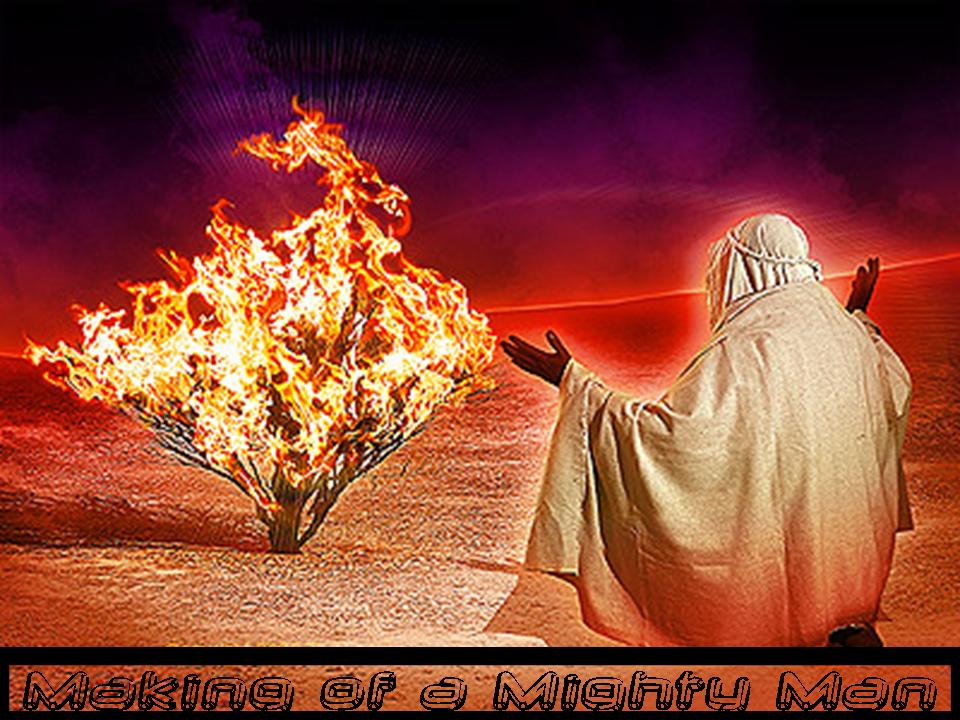
2: And Angel Jehovah [NB: Jehovah is introduced as an Angel/Messenger] appeared unto him in flames of fire out of the midst of a bush: and he looked, and behold, the bush burned with fire, and the bush was not consumed.

3: And Moses said, I will now turn aside in order to see this great sight, why the bush is not burned up.

4: And when Jehovah saw that he turned aside to see, Elohim called unto him out of the midst of the bush, and said, "Moses, Moses". And he said, "Here am I."

5: And He said: "Draw not nigh hither: Put off thy shoes from off thy feet, for the place upon which thou standest [there are two ways to read what follows: "grounds of (the) Holy One" or  "holy ground"].

6. Moreover He said, "I AM Elohim of thy fathers, Elohim of Abraham, Elohim of Isaac, and Elohim of Jacob." And Moses covered his face, for he was afraid [there are two ways to read what follows: "to look upon The Elohim", meaning, afraid to look at "The Father",  or "to look upon The Gods", meaning, afraid to look upon Elohim and Jehovah together: The Gods].

7: And Jehovah said, "I have surely seen the affliction of my people which are in Egypt, and have heard their cry by reason of their taskmasters; for I know their sorrows.

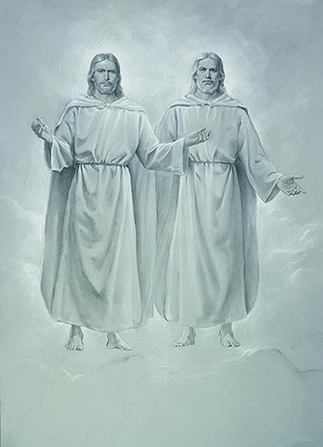
It is astonishing. Both The Father and The Son, Elohim and Jehovah, came to Moses, in a sacred place in nature that functioned as a Temple. The Father spoke first, calling Moses by name, and then either He identified Himself as God of his fathers, or The Son identified Himself as God of his fathers. Then Jehovah clearly adresses Moses at that point.

It is interesting to notice how Jehovah, The Son, functions as Messenger, "Angel", to Elohim. At the time of the falling away of Adam's posterity it was Jehovah who was present to see mankind's corruption. At the Tower of Babel it was Jehovah who came down to witness it, and smite it. It was Jehovah who conversed with the (minimum) three other angels who would ascend and descend the staircase leading from the Temple, the Conduit to Heaven, down to earth, in Jacob's great vision on the Temple. And here it is Jehovah who, after Elohim's introduction to Moses (remember, Moses' faith was relatively new), addressed him as having witnessed the afflictions on the ground.

And speaking of ground, I love how The Father called His place, "grounds of (the) Holy One". I remember what The Lord told Joseph Smith on December 25, 1832, with regards to latter-day calamities: "Wherefore, stand ye in holy places, and be not moved, until the day of the Lord come; for behold, it cometh quickly, saith the Lord. Amen." (Doctrine and Covenants 87:8)

These pasages in The Bible truly come alive. And what do I learn here from? That God lives, that Jesus is The Christ, that Joseph Smith actually really did see Them, for the parallels to Joseph Smith's First Vision are astounding, especially in light of the fact that the Bible translations perhaps unintentionally melded the facts into a narrative that seems to presents One God appearing to Moses whereas the Hebrew clearly shows Two Gods appearing to Moses. Both Gods, Elohim and Jehovah, The Father and The Son, addressed the hopeful human who sought Them out, Both are glorious, and The Son does the will of The Father. Marvelous. I really needed this at this time. What a way to greet the dawn of this day.

Surely I understand that readers are at liberty to interpret these passages in other ways. But however you choose to read these words, do bear in mind that what I have shared here today is actually textual.

Sunday, January 3, 2016

If Ye Shall Call Me Father


One thing I have not quite mastered is brevity. I will attempt it here. Many Christians believe that it was only during and since the time of Jesus' mortal ministry that God was addressed as "Father." I will share a few insights for the reader to contemplate.

First, a simple grammar lesson. In Hebrew if two nouns are combined, the first of the pair could be seen as belonging to the second, as in "Ben Elohim", literally 'Son God', but in English we would say "Son of God". However, do note that the functional word "of" is explicitly stated in English. In Hebrew it is implied. Therefore "Ben Elohim" in Hebrew can mean either 'Son of God' or 'Son God', as in "the Son who is a God".

Genesis 49:25 (King James Version)
Even by the God of thy father, who shall help thee; and by the Almighty, who shall bless thee with blessings of heaven above, blessings of the deep that lieth under, blessings of the breasts, and of the womb:
There is an alternative way of reading the exact same words in Hebrew, but there is also something that the translators leave out:
Because of El [God] thy Father, for He helpeth thee and the Almighty, and blesseth thee with the blessings of heaven above, blessings of deep lying below, blessings of breasts and of womb.
Two things stand out: (1) That the same words may be read not as "God of thy father" but as "God thy Father"; (2) that this God who helps Joseph also helps the Almighty. Now, this latter point, that El, God, blesses the Almighty is undeniable in the Hebrew. In Biblical Hebrew the accusative marker "et" was placed before the direct object of the verb. Confusing? Okay, grammar typically is not a subject that gets most hearts pumping faster, except out of exacerbation. Let me show you from Genesis 1:1:
In council Elohim had fashioned "et" the heavens and "et" the earth.
Or in the King James Version:
In the beginning God created "et" the heavens and "et" the earth.

See how the Hebrew "et" marks the object of the verb? Well, Genesis 49:25 clearly, unequivocally states "God thy Father, for He helpeth thee and "et" the Almighty." I suspect the reason the translators phrased this as "and by the Almighty who shall bless thee" is because the translators, believing Medieval Trinitarian notions, could not fathom how "El" would help "Shaddai", 'Almighty', when they believed that "El" 'God' and "Shaddai" 'Almighty' were the same person. In this context, "El" is "The Father" and "Shaddai", 'Almighty' is "The Son".

Bearing in mind that "El", 'God' is possibly referred to here as "God thy Father", consider both Jeremiah 3:4
Wilt thou not from this time cry unto me, My Father, thou art the Guide of my youths?
 and Malachi 2:10:
Have we not all One Father? Hath not One El ['God'] created us? Why do we deal treacherously every man against his brother, by profaning the covenant of our fathers?
The New Testament was compiled in the fourth century AD. At that time there was an agreement among the various factions that worked on the canon that if one Christian region held certain books to be Scripture, but the council in Nicea could not unanimously approve that particular book, the Book could be included in New Testaments to be used in that particular region. By the year AD 400 the extra books were ordered literally to be pulled off the beautifully crated New Testament tomes. One version, the Alexandrinus, a fourth century New Testament, still has 1 Clement included in The New Testament. Here is 1 Clement 4:11:
Say unto the children of my people, though your sins should reach from earth to heaven; and though they shall be redder than scarlet, and blacker than sackcloth: yet if ye shall turn to Me with all your heart, and shall call Me Father, I will hearken to you, as to a holy people. 
It is hard to fathom that such a beautiful Scripture could have been lost to Christendom.

Jesus taught us how to pray: "Our Father, which art in heaven, hallowed be thy name." (Matthew 6:9) Now, when our Lord Jesus agonized on the cross, He cried out to His Father. Bearing in mind the relationship between the terms "El", 'God', and "Father", consider now His actual words, Matthew 27:46:
And about the ninth hour Jesus cried with a loud voice, saying, "Eli, Eli, lama sabachthani? that is to say, My God, My God, why hast thou forsaken me? 
The difference between "El" and "Eli" is that the -i suffix which means "my" is added to the noun at the end. So "Eli" literally means 'God-my', though in English we say "My God". The passages I have shared should be sufficient to show that prior to the Babylonian Captivity the Hebrews understood "El", 'God', to be our Father, and the Hebrews would refer to "El" as "Father." When The Son came to earth He taught us to pray to our Father that very way, "Our Father". So is it not surprising to see that The Book of Mormon: Another Testament of Jesus Christ, continues the very practice known in The Bible prior to the Babylonian captivity, that of calling "God" as "Father"? 2 Nephi 31:11-12:
(11) And The Father said: Repent ye, repent ye, and be baptized in the name of My Beloved Son. (12) And also, the voice of The Son came unto me, saying: He that is baptized in my name, to him will The Father give The Holy Ghost, like unto Me; wherefore, follow Me, and do the things which ye have seen Me do.
I will wrap up with those moving words from The Lord as He hung, battered and humiliated, being mocked, Luke 23:34 
Then said Jesus, Father, forgive them; for they know not what they do.
and the great observation of the Prophet Abinadi, whose name actually means "My Father is Present", Mosiah 15:8-9:
(8) And thus God breaketh the bands of death, having gained the victory over death; giving The Son power to make Intercession for the children of men--(9) Having ascended into heaven, having the bowels of mercy; being filled with compassion towards the children of men; standing betwixt them an justice; having broken the bands of death, taken upon Himself their iniquity and their transgressions, having redeemed them, and satisfied the demands of justice.
Abinadi gave his life for the witness that God, The Father, gained the victory over death by empowering and sending God, The Son, to earth, to perform the great Intercession or Atonement. Notice how Jacob, in Genesis 49:25 said that El, God, would help Joseph and Shaddai?  Well, in The Book of Mormon, Mosiah 3:5 an angel declared to King Benjamin the following:
For behold, the time cometh, and is not far distant, that with power, The Lord Omnipotent who reigneth, who was, and is from all eternity to all eternity, shall come down from heaven among the children of men, and shall dwell in a tabernacle of clay, and shall go forth amongst men, working mighty miracles, such as healing the sick, raising the dead, causing the lame to walk, the blind to receive their sight, and the deaf to hear, and curing all manner of disease.
What is beautiful about this verse, among so many things, is that King Benjamin reports that "The Lord Omnipotent" shall come down. Well, "Shaddai" in Hebrew gets translated to English as "Almighty", but English also uses the French version, "Omnipotent" from time to time. So here we have yet another correspondence between the Hebrew Bible and The Book of Mormon: Another Testament of Jesus Christ. How ever did this come about?

Now, I realize that no one is obligated to see these scriptures as I have laid out. Certainly alternative explanations abound as to what the Hebrew implies, why 1 Clement was removed from The New Testament, why The Book of Mormon states what it does. How ever you, the careful reader, choose to interpret these passages, do bear in mind what a living Apostle, Elder Scott, stated, "We talk to God through prayer; He most often communicates back to us through His written Word." Also bear in mind that everything I shared with you, even if you arrive at a different conclusion, is actually textual.

Sunday, December 6, 2015

Ask Thee A Sign


There was an occasion, I suspect one of several such, where certain of the Scribes (transcribers and interpreters of Scripture, according to their philosophical views) and the Pharisees (teachers of rigid, extra-scriptural philosophical overlays on The Law of Moses, precursors to modern Rabbis) made a request of Jesus (Matthew 12:38-42):
38: "...Master, we would seek a sign from thee. 39: But [Jesus] answered and said unto them, An evil and adulterous generation seeketh after a sign; and there shall no sign be given to it, but the sign of the prophet Jonas: 40: For as Jonas was three days and three nights in the whale's belly; so shall The Son of Man be three days and three nights in the heart of the earth. 41: The men of Nineveh shall rise in judgment with this generation, and shall condemn it: because they repented at the preaching of Jonas; and, behold, a greater than Jonas is here. 42: The queen of the south shall rise up in the judgment with this generation, and shall condemn it: for she came from the uttermost parts of the earth to hear the wisdom of Solomon; and, behold, a greater than Solomon is here.
Even as a child I grasped the lesson, or a lesson, from this encounter: That to ask Deity to dazzle the proud, the recalcitrant, the unwilling, with displays of visual wonderment, in order for them to believe, is a reflection of the private, inner transgression of Divine law on the part of the solicitors. The Father, The Lord, talks to His children. He speaks to us on our level, which always includes having His servants, those who have already turned to Him and discovered the Truth from Him directly, share that message with others. Perhaps you noticed that the only "signs" Jesus gave these Scribes and Pharisees were two previous examples, both in scripture, of a member of the Covenant of Abraham (Jonah, Solomon) sharing the Word, the Wisdom, of God, with those outside the covenant, the people of Nineveh and the Queen of the South. In one case God sent His messenger to the outsiders, (Jonah), and in another the outsider took it upon herself to seek out The Lord's servant. In both instances the message was conveyed person-to-person. In both cases the Savior's mission was foreshadowed, death and resurrection in the example of Jonah being swallowed up and then emerging three days later, the woman from the world coming unto the Anointed King of Israel, in the example of the Queen of the South.

But, if it is an "evil and adulterous generation that seeketh after a sign", why did The Lord have Isaiah offer Ahaz the opportunity to ask a sign of Him? (Isaiah 7:9-14)

9: And the head of Ephraim is Samaria, and the head of Samaria is Remeliah's son. If ye will not believe, surely ye shall not be established. 10: Moreover The Lord spake again unto Ahaz, saying, 11: Ask thee sign from with The Lord thy God; ask it either in the depth, or in the height above. 12: But Ahaz said, I will not ask, neither will I tempt The Lord. 13: And he said, Hear ye now, O house of David; Is it a small thing for you to weary men, but will ye weary my God also? 14: Therefore The Lord Himself shall give you a sign; Behold, a virgin shall conceive, and bear a Son, and shall call His name Immanuel.
This is yet another case where reading the source language text opens the reader to greater understanding. I will give a more careful rendering from the source Hebrew with one correction from the Great Isaiah Scroll from Qumran:
9: And the head of Ephraim is Samaria, and the head of Samaria is Remeliah's son. If ye will not believe, surely ye shall not be firm. 10: Moreover Jehovah spake again unto Ahaz, saying, 11: Ask for thyself a sign from with Jehovah thy Elohim; make a deep request or raise it overhead. 12: But Ahaz said, I will not ask, neither will I test Jehovah. 13: And he said, Hear ye now, O house of David; Is it a small thing for you to weary men, but will ye weary my Elohim also? 14: Therefore Jehovah Himself shall give you a sign; Behold, a virgin shall conceive, and bear a Son, and shall call His name Immanuel.
This is yet another case where reading the source language text opens the reader to a firmer understanding. Here I will make the steps clear.

  1. Isaiah tells Ahaz that to be firm (made firm, established), one must believe (have faith). Clearly Ahaz neither believes nor is firmly established.
  2. So Jehovah speaks to Ahaz, via Isaiah, and invites Ahaz, not simply to ask for a sign, but to ask a sign for himself from and with Jehovah his Elohim, The Lord his God, Heavenly Father. I will repeat as the point is powerful: The Son, Jehovah, told Ahaz to ask a sign for himself from/with his Heavenly Father. This request could only be made one way: Prayer. This is precisely the message Jesus, Jehovah, The Son of God, continued to reaffirm during His mortal ministry: "After this manner therefore pray ye, Our Father which art in Heaven..." (Matthew 6:9), "Ask, and it shall be given you; seek, and ye shall find; knock, and it shall be opened unto you" (Matthew 7:7). The phrasing in Hebrew is precise: "Make a deep request or raise it overhead." And if prayer is to be perceived in this, then the request Ahaz was invited to make would be deep inside himself, a private prayer, or raised overhead, vocal prayer, or perhaps a prayer regarding something deep (perhaps personal) or high overhead (regarding something divine). 
  3. Ahaz responds with stony indifference: "I will not ask", that is, "I will not ask from/with Jehovah my Elohim, My Heavenly Father", nor will I "put Jehovah's invitation to the test." Well if this is not the age-old and yet freshest cut answer from the lips of homo sapiens, "I do not believe in the message of Scripture nor will I pray to my Father in Heaven to know it, no matter what it is purported that His Son calls me to do."
  4. So Jehovah (the Masoretes, Rabbinic scribes, made several changes to the Holy Texts, and this is one), yes the Lord, but not merely "Adonai" as our Hebrew source text reads but Jehovah per the Great Isaiah Scroll from Qumran, Jehovah, The Son of Jehovah our Elohim, proceeds to give Ahaz a sign, and the sign is, contrary to how we may be tempted to see this from a modern perspective (that is, "the first time this was declared or made known"), a reaffirmation of the message of Scripture. That is, the words "A virgin shall conceive, and bear a Son, and shall call His name Immanuel ['With us is El/God]" was a rehearsal of what had already been declared. After all, from the beginning we were told that the "seed of the woman" shall bruise the head [plan] of the serpent, and in Scripture only men have seed [semen], woman bear fruit [fetus], but here "the seed of the woman", that is, the Virgin Conception, would prevail (Genesis 3:15). And we were told of The Son, "Thou art my Son; this day have I begotten thee," (Psalm 2:7), whom we would have to kiss (honor, welcome) or "perish from the way" (Psalm 2:12). And when Jehovah appeared to Jacob and identified Himself as, "Jehovah, Elohim of Abraham thy father, and Elohim of Isaac", and further told Jacob, "I am with thee", Jacob named that place "Beth-El", the House of El, the House of God (Genesis 28:13,15,17), almost as if to say, "Immanu-El" 'With us is El'. So the sign that Jehovah, The Son of God, sent to Ahaz via Isaiah was a reaffirmation of previously received Scripture...just as Jesus later did during His mortal ministry.
There are two points I would draw the reader's mind to: (1) the sign we are to seek from and with God is a confirmation of the present oral witness of His authorized servants and a confirmation of Scripture, and (2) that confirmation is to be sought from God, The Father, and with God, The Father, via prayer.

And if I may belabor the point just one more time, consider this promise that appears in the final chapter of The Book of Mormon: Another Testament of Jesus Christ (Moroni 10:3-5):
3: Behold, I [Moroni] would exhort you that when ye shall read these things [The Book of Mormon], if it be wisdom in God that ye should read them, that ye would remember how merciful The Lord hath been unto the children of men, from the creation of Adam [via The Bible Record] even down until the time that ye shall receive these things [poss. down to your own family history], and ponder it in your hearts. 4: And when ye shall receive these things, I would exhort you that ye would ask God, The Eternal Father, in the name of Christ, if these things are not true; and if ye shall ask with a sincere heart, with real intent, having faith in Christ, he will manifest the truth of it unto you, by the power of The Holy Ghost. 5: And by the power of The Holy Ghost ye may know the truth of all things.
Well, well, well. We have here an incredible convergence of harmonious truth in Moroni's promise. To test what you have read from The Book of Mormon, to know whether it is true, the entire Tome, ponder [read, consider, remember] The Bible too, but also consider how merciful The Lord has been to your own family, and ponder all of this (The Book of Mormon, The Bible, your own family history) in your heart. Then actually ask The Father, in the name of Christ, for a confirmation, a most holy sign we might say, but a sign "from and with The Lord our God", and if truly sincere and intent on obeying that answer, we will receive it by the power of The Holy Ghost. 

This is the same message The Lord has always, ever, singularly and without deviation given. The reader is free to take from this as he or she deems correct. But at least bear one thing in mind: Everything I have cited, the passages at least, are actually textual.


Sunday, November 8, 2015

Then and Now


What does one make of this? 

August 1916: The Father and The Son

In August of 1916 The First Presidency of The Church of Jesus Christ of Latter-day Saints clarified the relationship between our Heavenly Father and Jesus Christ via an official statement, "The Father and The Son", specifically speaking, the First Presidency clarified what our Latter-day usage of the sacred name-titles they bear would be:
Scriptures embodying the ordinary signification--literally that of Parent--are too numerous and specific to require citation. The purport of these scriptures is to the effect that God the Eternal Father, whom we designate by the exalted name-title "Elohim", is the literal Parent of our Lord and Savior Jesus Christ, and of the spirits of the human race...Jesus Christ is the Son of Elohim both as spiritual and bodily offspring; that is to say, Elohim is literally the Father of the spirit of Jesus Christ and also of the body in which Jesus Christ performed His mission in the flesh...That Jesus Christ, whom we also know as Jehovah, was the executive of the Father, Elohim, in the work of creation...
Thus the relationship, if it had not already been made very clear in the Restoration (and indeed it had been), now the doctrine was explicitly laid out, namely, that we Latter-day Saints refer to The Father by His exalted name-title in Hebrew, "Elohim", and Jesus Christ, His Only-Begotten in the flesh, was also "Jehovah", His First-Born in the spirit. 

Two By Two

The issue of Hebrew usage is very interesting because both titles, Elohim and Jehovah, are applied to both The Father and The Son. Why? Because The Son, by doing the will of His Father in Heaven perfectly, was exactly like His Father, and His Father therefore gave Him all that He had. The same promise of eternal life and exaltation is held out to all people. 

To see the name-title Elohim used in Hebrew for both The Father and The Son one may consider Genesis 1:6-7:
And Elohim said, Let there be a firmament in the midst of the waters, and let it divide the waters from the waters. And Elohim made the firmament, and divided the waters which were under the firmament from the waters which were above the firmament: and it was so.
These passages are so familiar we may not catch what is there. In verse six Elohim commanded that there be a firmament. Then in verse seven Elohim proceeded to make the firmament. I put it to the reader that The Father, Elohim, did not command Himself to make the firmament, nor did He obey Himself. He commanded His Son to make the firmament (the creation in its entirety as well, though the firmament is but a single instance), and as The Son was doing the will of The Father for The Father's objectives, The Son bore The Father's Title, "Elohim".

Consider Genesis 41:32:
And for that the dream was repeated unto Pharaoh twice; it is because the word [or "thing"] is decreed by The Elohim and The Elohim is hastening to do it.
Well, well, well, what do we have here? We again see Elohim, here with the definite article, The Elohim, 'The God', the Presiding Elohim. In this passage the prophet Joseph describes how The Elohim had decreed the periods of plenty and famine twice to Pharaoh by dream, and then, perhaps more interesting still, Joseph describes The Elohim hurrying to do it, or rather, that The Elohim is on the point or verge of executing the decree. Again, The Son does the will of The Father, and therefore The Father bestowed His title on Him.

And the same is seen with the title, Jehovah, 'Existent', as in Genesis 18:17,19:
And Jehovah said, Shall I hide from Abraham that which I do? For I know him, that he will command his children and his household after him, and they shall keep the way of Jehovah, to do justice and judgment; that Jehovah may bring upon Abraham that which He hath spoken of him.
These two verses are powerful. We see Jehovah speaking in the first person, "I"--"Shall I hide"--and as Jehovah continues in the first person--"I know"--Jehovah then speaks of Jehovah in the third person, "they shall keep the way of Jehovah"...that "Jehovah may bring"...that which "He hath spoken". The Jehovah who is addressing Abraham directly is Jehovah, The Son of Elohim. It then appears that the Jehovah that Jehovah The Son referred to was Jehovah His Father. Elohim bears the title "Jehovah" and placed it on His Son because His Son did His will in all things. 

Pattern One

Though the usage of the name-titles Elohim and Jehovah could seem confusing let us consider the earliest usages. In the first instance of Deity acting and making addresses The Father is called Elohim and The Son is called Jehovah:
(Genesis 1:1) In a beginning Elohim created the heavens and the earth.
(Genesis 1:26) And Elohim said, Let us make man in our image, after our likeness...
(Genesis 1:28) And Elohim blessed them, and Elohim said unto them, Be fruitful, and multiply, and replenish the earth, and subdue it...
(Genesis 3:22) And Jehovah Elohim said, Behold, the Adam is become as one of us...
(Genesis 3:23) Therefore Jehovah Elohim sent the Adam forth from the garden...
 (Genesis 4:6) And Jehovah said unto Cain, Why art thou wroth? And why is thy countenance fallen?
What we see in the earliest usage is that The Father was called "Elohim" first, then later "Jehovah Elohim" (translated to English as "The Lord God"). It was Elohim, The Father, who laid out the plan for creation, Elohim presided, and initially, before Adam and Eve fell, it was Elohim, The Father, Himself who addressed Adam and Eve, "The Adam", directly, face to face, without any intermediary. After the fall of Adam it was "Jehovah" who addressed mankind directly. So in the earliest usage "Elohim" is The Father and "Jehovah" is The Son, in their direct communications with mankind. It is worth noting, though, that along with Jehovah as an Intermediary, The Father does again address mankind directly, which is a topic for another post.

Greece the Transmission

In the centuries immediately preceding Jehovah's birth as Jesus Christ, that is, Elohim's Son's birth as Jesus Christ, and in the centuries that followed, Holy Writ came to be translated to Greek and in some instances penned in Greek autographs. Eventually Greek speakers settled upon a pattern of translating the name Jehovah as "o Kyrios" 'The Lord' or even solely as "Kyrios" '(the) Lord'. Greek speakers rendered the name-title Elohim as "o Theos" 'The God'. 

The New Testament was compiled in the fourth century AD, and when it was first bound into tomes the various Christian churches that had been forged into a union named The Roman Catholic Church under Emperor Constantine could not agree on contents of the New Testament canon. The 27 books we now have in The New Testament were eventually agreed upon, but there were other sacred books that were not universally accepted. It appears that the initial solution was to allow different Christian centers (cities) to have their regionally accepted books included in the back of the sacred volume. In this way New Testaments differed by contents from Christian center to Christian center. (It is worth noting that this variation continues to this day with the Armenian, Ethiopic and possibly the Georgian New Testaments being larger in content and, until fairly recently, the Aramaic/Syriac New Testament being shorter, which would be a topic for another blog post.) By the start of the fifth century AD in the west at least those extra books were removed from the canon. Here is an excerpt from The Epistle of Barnabas, a book purported to have been written by the Apostle Barnabas, which epistle was preserved in arguably the oldest surviving New Testament volume, The Sinaiticus: Epistle of Barnabas: 5:5-9:
(5) And furthermore, my brethren: if The Lord submitted to suffer for our souls, even though He is The Lord of the whole world, to whom The God said at the foundation of the world, "Let us make man according to our image and likeness," how is it, then, that He submitted to suffer at the hand of men? Learn! (6) The prophets, receiving grace from Him, prophesied about Him. But He Himself submitted, in order that He might destroy death and demonstrate the reality of the resurrection of the dead, because it was necessary that He be manifested in the flesh. (7) Also, He submitted in order that He might redeem the promise to the fathers and--while preparing the new people for Himself--prove, while He was still on earth, that after He has brought about the resurrection He will execute judgment. (8) Furthermore, by teaching Israel and performing extraordinary wonders and signs, He preached and loved them intensely. (9) And when He chose His own Apostles who were destined to preach His gospel (who were sinful beyond all measure in order that He might demonstrate that "He did not come to call the righteous, but sinners), then He revealed Himself to be God's Son.
In this citation (as throughout the work) Jesus Christ is referred to as "The Lord", God's Son; Jesus' Father is called "The God". The underlying Hebrew for this usage would be calling Jesus Christ "Jehovah", Elohim's Son, and calling Jesus' Father "The Elohim", The God who directed Jehovah in the work of creation and The God who sent Jehovah to suffer for the sins of the world.

What to Make of This?

The question I posed at the outset was "what is one to make of this?" Of what specifically? Of the fact that anciently, in the Hebrew records, The Father bore the name-titles "Elohim" and "Jehovah" and that The Father bestowed both on His Son, but that in particular The Father did bear the name-title "Elohim" and His Son bore the name-title "Jehovah". I mean to say, is it not interesting that in the earliest accounts written in Hebrew The Father is called Elohim and His Son is called Jehovah, that this usage becomes extremely clear and succinct in the early Apostolic era, the time while Christ's Church was still founded on the basis of living Apostles, and then that some 1700 years later when living prophets and Apostles are once again on the earth through The Church of Jesus Christ of Latter-day Saints the very same clarity of title usage, The Father as Elohim and Jesus as Jehovah, suddenly reappears? How is it that the earliest usage was restored in the first-century Apostolic era, and then after 1700 years of loss the same initial usage is yet again restored via the First Presidency statement, "The Father and The Son"? The reader is left to ponder that for him or herself. To me the answer is obvious: Whenever God calls Apostles and Prophets God reveals His true identity, titles, and relationship to His Son to His living oracles. This is why the relationship was clear under Moses, the clarity was restored under the first-century Apostles, and then the clarity was again restored under Joseph Smith culminating in 1916's "The Father and The Son" (by Joseph Smith's successor-Prophets and Apostles). Certainly the reader is free to make of this what he or she will, but the citations speak for themselves, and they are actually really quite textual.

Have a great day!

Sunday, October 25, 2015

I Am Adam


I have stated before that, as a linguist, I see great value in defining words by their usage. Said more plainly, "any word's meaning is to be seen largely in how the word is used."

Adam 

The first mention of "Man" we have in the scriptural accounts as handed down to the world is found in Genesis 1:26: (From the Hebrew)
And Elohim said, "Let Us make Man in shape of Us, as a likeness of Us." 
Here God, "Elohim" per the Hebrew, gives us the clearest definition of "Man", and certainly the first clear definition in all scripture: "Man is a being shaped like Elohim as a likeness (or similitude) of Elohim". Said more plainly, "Man physically looks like Elohim, by shape and members, and Man has attributes or characteristics that are similar to Elohim."

To be more precise in who Elohim (God) is, in Genesis 1:1 we read the following:
In a beginning Elohim created the heavens and the earth.
Then in verse two we read as follows:
And the earth was without form, and void, and darkness upon the face of the deep. And Spirit Elohim moved upon the face of the waters.
The Hebrew "Ruakh Elohim" literally reads 'Spirit Elohim'. Though the translation adds a definite article the and a functional preposition of, "The Spirit of God", the Hebrew construction conveys a powerful meaning, namely, that "Spirit Elohim" ('The Spirit of God') was contrasted to "Elohim" ('God') by the fact that Spirit Elohim (The Spirit of God) was a Spirit only. Therefore, "Elohim" or "God" is Embodied; He has a tangible body of flesh and bones.

But there was another Being present, One who was also called "Elohim", just like His Father, only this Elohim was as yet a Spirit only, just as Spirit Elohim (The Spirit of God) was. We see this Elohim creating under the command of His Father. In verses 6 and 7:
And Elohim said, let there be a firmament in the midst of the heavens...
And Elohim made the firmament... 
Notice how Elohim (God) commands, and then Elohim obeys. God did not command Himself; God commanded His Son, and His Son obeyed Him in all things.

Also, when Adam fell, Elohim The Father says something very interesting: (Genesis 3:22)
 Behold, the Adam is become as One of Us...
So I ask the question, like which "One"? Adam, embodied, had now gained a knowledge of good and evil through his own experience, while in a body. These factors (body, life, experience via choice) now made the Adam (humanity, which at this point was Adam and Eve as a couple) like unto "One" of the Elohim. When these observations are taken in their totality it becomes evident that when Elohim The Father said, "Let us make Adam in our image" that (a) Adam was shaped like God, (b) Adam had attributes like God, and (c) just like Elohim The Father, Adam had both a body and a spirit.

Adam Plus

Most people who have even a passive acquaintance with The Bible associate the name "Adam" with the first man. But God said more than "shape" and "likeness". (Genesis 1:26)
In the image of Elohim created He him, male and female created He them.
Man, "Adam" denotes both genders. This is an often overlooked point, but more astonishing still, the narrative goes on to describe God's joining Adam (the first man) to Eve (the first woman) in matrimony by His authority in a special Garden established as a place where His Presence was revealed in great glory. Bear in mind that this union took place before death entered human experience, so the matrimony was indefinite ("eternal"), "Be fruitful, and multiply, and fill the earth, and subdue it: and have dominion (or 'lord over') over the fish of the sea, and over the fowl of the air, and over every living thing that moveth upon the earth". (Genesis 1:28) Thus, per usage, "Adam" means "husband and wife together", and if with this point in mind, that "Adam" per the Hebrew denotes a married couple, we return to what we have already seen, that "Adam" was made both "in shape or image" of Elohim "as a likeness or similitude" of Elohim, as "male and female", we are actually being told, in the very beginning of the Scriptural record, that God The Father is a Married Man. That is, God The Father is One with His Wife, might we say, "God The Mother". Our terminology is more tender than that, though, for we refer to God The Father as "Heavenly Father" and His Wife as "Heavenly Mother", our Heavenly Parents.

All Are Adam

The Scriptural account adds one further expansion or application of the word Adam: "Adam" means "mankind" collectively: (Genesis 6:3)
And Jehovah said, My Spirit shall not always plead in Adam...
In Hebrew all mankind is collectively known as "Adam" or as "the Adam" (with the definite article the). This usage demonstrates that God equates all people collectively as "Adam", the two children He bore to life and later joined in matrimony in the Garden. This usage also demonstrates that God treats each individual as "Adam", His firstborn son on earth. It may be with this affirmation in mind that holy prophets have said the following things about humanity:

  1. (Genesis 4:6-7) "And Jehovah said unto Cain, Why art thou wroth? And why is thy countenance fallen [i.e. 'very sad']? If thou doest well shalt thou not be exalted? 
  2. (Malachi 2:10) Have we not all One Father? Hath not One God created us?...
  3. (Acts 10:34) "Then Peter opened his mouth, and said, Of a truth I perceive that God is no respecter of persons."
  4. (2 Nephi 26:33) "For none of these iniquities come of The Lord; for He doeth that which is good among the children of men; and he doeth nothing save it be plain unto the children of men; and He inviteth them all to come unto Him and partake of His goodness; and He denieth none that come unto Him, black and white, bond and free, male and female; and He remembereth the heathen; and all are alike unto God, both Jew and Gentile." 
  5. (Alma 24:14) "And the great God has had mercy on us, and made these things known unto us that we might not perish; yea, and He has made these things known unto us beforehand, because he loveth our souls as well as He loveth our children; therefore, in His mercy He doth visit us by His angels, that the plan of salvation might be made known unto us as well as unto future generations."
  6. (Moses 6:64-66,68) "And it came to pass when The Lord had spoken with Adam, our father, that Adam cried unto The Lord, and was carried down into the water, and was brought forth out of the water. And thus he was baptized, and The Spirit of God descended upon him, and thus he was born of the Spirit, and became quickened in the inner man. And he heard a voice out of heaven, saying: Thou art baptized with fire, and with The Holy Ghost. This is the record of The Father, and The Son, from henceforth and forever. Behold, thou art one in me, a son of God; and thus may all become my sons. Amen."
Certainly I could cite more passages, but these suffice to show that God loves all His children the same. He offers us the same eternal opportunities and the same mercy. Neither gender, color, age, era, nationality or beliefs persuade The Father to see His children any other way than as all alike to Him.

I Am Adam

In conclusion, though much more can be said on these topics, I certainly do not claim to have a right to compel anyone to adopt these views. I am simply sharing the teachings of the Holy Scriptures. But I will say this, knowing who I am, a son of God, equated by Him to His first earthly son, Adam, means that God offers me the same redemption and the same blessings as He offered His first earthly Adam. I am an Adam too. This means I have it in me both to utilize my strength to do good and to open myself up to more of God's strength to do good. I am much more than one among the billions: I am Adam. The reader may similarly find great truth in the Scriptures or may differ as to interpretation. However one wishes to take this I only ask that you bear in mind that the passages I shared, at least, are actually textual.