Saturday, August 6, 2016

Why I Chose. Why I Stay.


I have thought long and hard about sharing this. This is personal, but alternative messages are having such sway that I want the Truth to triumph. Only sharing will accomplish this.

In 2011 I hit a low point. You see, I am gay. I am homosexual. I am a Latter-day Saint. I love The Church of Jesus Christ of Latter-day Saints, but I could no longer expend the colossal force needed to deny my own feelings, to suppress my very nature, to continue starving my own needs. This was a dark time. I had made mistakes. I was suffering the consequences. The people who were charged with assisting me were in actual fact botching my case up. My shepherds, with one beautiful exception, were driving me away. I was now not only gay, but gay and having to bear the added burdens of others' disapproval, disdain, distaste. And in the midst of these afflictions, my passions burned for release.

It was a rainy early fall night. I was driving home. It had taken all of my energy not to pursue same sex liaison, and as I drove I pondered how my resolve to remain in The Church, in the Covenant, had dropped from a solid 100% to 51% stay vs. 49% leave. As I pondered, my resolve balanced precariously at 50/50. I had to confess to myself that by the morning my resolve to depart would exceed the 50% mark. I considered the physical ecstasy that would be mine within hours, except for one thing. I thought to myself with a mix of concern and consternation:


"What about all the people, in particular the young people, I had always told to be faithful, to rely on The Lord, that He would help them no matter what? What would I say when they saw my example? Would I want them to follow my example? But how could I justify caving in to homosexual temptation and yet insist that they resist heterosexual temptation? Also, what would I say to the one shepherd who had been putting such trust in me, who was responding to that invisible Hand of guidance, to help me, unbeknownst to anyone else?"

In this moment, as I drove along the wet streets, lights glistening on the pavement, I heard a voice. I heard this voice not with my ears, but with my mind. Yet, this was the clearest sound I had ever heard. In fact, I felt my eardrums relax even as this voice came over my mind with incredible clarity. I could still hear the peeling sound of rubber tires over wet pavement, my turn signal, other cars passing by, but this voice came across with amazing clarity, and tenderness, such sweet tenderness.

Immediately I recognized Who it was that was speaking to me: It was Heavenly Father. Later, as I pondered how it was that I recognized a voice I had never heard, I realized how--from reading the Scriptures. Somehow by reading them with earnest I had come to know the voice of God. He spoke tenderly, with great concern:


"James, what's the matter?"

I responded with words weighed down by grief:


"Father, I'm not doing too well."

Heavenly Father responded with enormous tenderness, His syllables lengthening somewhat in His concern:


"Tell me why?" 

But here I soured. I realized that all my life I had been running scared. All my life I had been terrified to admit that everything that I had been taught about God and gays was that He hated fags, that He gloried only in destroying them, and that I was one of them. I had tried so hard for decades to suppress myself, to change myself, to transform into someone else, a heterosexual me. But all of this had failed. I had failed. I was less than a good member of my Church, and I was teetering in my resolve. So I spoke:


"You wanna know why? I'll tell you why!"

And I told. I do not ever remember making a list of every sexual sin I wanted to enjoy, but apparently I had, because I started rattling the list off. I caught myself out even as I continued speaking: "Dude, what are you doing? You're telling God the most un-Godly things." But as I thought I considered how it was that I was going to get rejected on Judgment Day anyway because I could not do the one thing God expected of me: To stop being gay. So, I reasoned, every box on the list of requirements for my departure has been checked except for the last one, "Rejected of God". I will force His hand now. I will shock God with the revelation of what is in my heart, and when He booms His rejection at me, I will depart, slipping away onto the plane of the night, joining the darkness, becoming the being I was born to be: Wanton, lascivious and free.

When I finished the very explicit list of gay sexual acts I was burning to experience, I gripped my steering wheel, confident of the crack of thunder or explosive outrage of an offended God. I was certain I knew what He would say, for I had run it through my mind on many occasions: "I am God. Man of Holiness is my name. And you come to me with these filthy, disgusting, repugnant acts. You're a returned missionary, Temple married no less. I have told you such things about the Scriptures, and you come to me with this!"

The only thing I could never fathom was what the actual words of severance would be. As I braced myself for His peal of wrath, I told myself not to cry as He cut me off, but I knew I would cry. 

Here Heavenly Father spoke. He said two words, two softly spoken words. I was struck by the words, by their simplicity, but also by the tone in which He spoke them. At the same time an image was coming to my mind, mind you, I did not see anything except what was before me: Wet pavement, roadside lamps, the customary lights of night traffic. Yet somehow His words evoked an image in my mind. The image was of His face. He had a tender expression: His eyes were half closed, moist, and He had a thin smile, curling slightly to the side. There was kindness in His expression, and a patient tone, though with a soft sense of melancholy:


"I know."


I was taken aback. I could hardly string two words together: 


"Wait, you? 
Wait, God knows. 
Wait, what does? 
Wait, I mean." 


What I was trying to say, but could not put out coherently was more like this: 


"You know? 
And you're not angry? 
What does this mean? 
I thought you hated these acts, 
hated those who performed them, 
and yet you're not angry?
What does this mean?" 


I had said many times, "God knows everything, even the thoughts of our heart," but I had only paid lip service to that idea. In reality I had thought that my inner temptations and thoughts, and even many of my acts, had been secret, so it astonished me to hear from The Father that He actually knew what I had been going through, what I had been thinking. 

When He resumed speaking His voice took on a twinge of an emotion that surprised me as I had never imagined that I would hear it in Deity: Vulnerability. I do not know how else to describe the sound other than to say that it reminded me of the situation where, for example, a young schoolboy--nerdy, shy--is in love with a beautiful girl. He has to declare his love to her; he cannot not tell her, and yet he knows she'll reject him. And still he is hopeful against all odds that she might reciprocate. Still, facing reality his voice begins to crack, and his face takes on a silly sort of smile, the look and texture of which immediately precede heartbreak, or rather, accompany the first splitting tensions of heartbreak. It was in this manner that The Father spoke two words to me, it was this expression His image had as it came to my mind. He said two words, and these two words so stunned me that my mind went immediately blank from astonishment. He said:


"Choose Me." 


I was silent. No thoughts. No response. I was absolutely astonished and left speechless. Then He spoke again, and the twinge of vulnerability swelled to tearfulness:


"I will be your Man."


In reality the word He used that I recorded here and have reported as "Man" was some other word, some word I immediately understood, did not actually know, but seemed to recall upon hearing it. The word was not from English, it seemed. The word raced across my mind leaving a trace of understanding but an inability to utter, repeat or convey. Maybe He said "Adam" from Hebrew, or some other word, but I understood the word more or less to be "Man", though it would have been hard even in the moment to explain in English. My impression was that I did not have power to utter it. 

Word aside, the statement was so astonishing that I was shocked back into speech, and I gasped: 


"What?!"


Before I could continue, He spoke again, and this time He was so choking back tears that His voice was audibly breaking up. The Father, God Almighty, El Shaddai, Elohim, His voice was hoarsely faltering as He choked through tears to plead with me, saying:


"I will fill you."


I realized immediately that His heart was breaking, and the rupture was caused by the actions I was about to undertake. More to the point, I was shocked. For decades, literally for decades, I had feared being rejected by God. Now God had turned the tables on me: It was I who was rejecting Him, casting Him away by actions I was contemplating, was on the verge of committing. His plea seemed at once laughable, as how could choosing God compete with let alone resolve the physical ecstasy I was about to enjoy? But the tears He was choking back touched my heart, and I did not have the heart to break His heart. With that lightning-fast rapidity with which the mind is capable of processing, as I began to speak, I knew I was giving it all up: I would never know gay sex, gay love, gay relationships, my gay promised land. I was giving all of that up for Him because He asked it of me. I shuffled these words out:


"Okay. Okay. Okay."


Silence ensued. Suddenly horrifying clarity came over me. My situation, my life, my actions, every detail that had not seemed so bad as I raced out of the Gospel, now that I had executed an unanticipated 180 degree about-face immediately took on a different appearance. Things were worse than ever before, and I was scared. In fear I spoke up again:


"Father, I'm in trouble, and I don't know what to do."


The Father spoke to me again, and this time His voice was strong, magisterial, the voice of a Man who would command and would be neither disobeyed nor delayed. He said:


"Thou hast chosen Me, 
so rely on Me. 
I will resolve this. 
I will resolve this, 
and it will be between Me and you. 
Thou hast chosen Me,
so rely on Me.
I will resolve this."


I was somewhat relieved, but fear still coursed though me. I shuffled out my speech again:


"Okay. Okay. Okay."


As I recall, this was on a Thursday night. By Saturday I was battling gay passion and fearful I could fall. I knelt and asked The Father for a sign, not a sign for consuming my lusts on, but a confirmation, something to relieve my battle, something to give me hope. The next day, Sunday, I met with the Bishop, and He told me that this situation I was in had gone on long enough. He was going to move for its speedy end. He spoke with determination. For months I had been trying everything possible to make my predicament budge, and yet my obstacles stood like the monoliths arranged in Stonehenge. I had bloodied my limbs trying to budge them, and had made no progress. This failure had led to my despair, and despair had played a huge part in my looming departure from the Church. Now, before my eyes, I saw a monolith start lurching forward, and in a slow and heavy crest it fell into another monolith, and like a domino effect, one obstacle after another fell until I was renewed, restored, reborn. 

I have had my ups and downs. Seldom is a life struggle all victories from one point on. But I had begun winning key battles, still losing others, almost losing some, but through the Atonement of Jesus Christ, I have come back each time. And I can look the mortal shepherd whom my Eternal Shepherd sent me in the eye and say, "I have tried, in Jesus I have tried, and through and with Jesus, I have overcome." I imagine that is what Judgement Day will be like too.

So when people ask me, why,  "Why do you remain Mormon if you are gay? Why do you stay in The Church of Jesus Christ of Latter-day Saints? Why do you believe?", I tell them the truth:


Because God lives. 
The Father really honestly and truly lives.
He hears prayers.
He answers prayers.
He loves me.
He loves us.
He loves everybody.
He is real.
He is not a figment of imagination.
He is not a myth retold and resold.
He is real.
God actually really exists,
and He is so loving, so tender, so sweet.
He really actually knows the thoughts of our hearts.
He really actually sees each and every one of us.
We can confide anything in Him, and He does not get angry.
And He really does care.
And Jesus really is His Son.


And all my shortcomings notwithstanding--all of them before this encounter, during the encounter, and since the encounter notwithstanding--He loves me, blesses me, and gives me the chance to wash, and wash, and wash again in the blood of His Son through the miracle of repentance, and the miracle of His encouragement to try again to do better. And now that I have put this experience down in writing, I can actually say that my experience is actually textual.


May God bless you for reading this. 

May you bless yourselves by turning to Him. 


Wednesday, August 3, 2016

A Woman of Faith

I will tell, briefly, the story of my great-great-grandmother. As a young girl, impoverished, she sought employment as a maid at about the age of 14 or 15, which was and is common in Central America (and other parts of Latin America). The employers, however, often look at these maidens as little more than ploys for pleasures. Her employer raped her. She then left his employment only to discover that she was carrying a child by him. She chose to keep her baby. Because of her choice, for the rest of her life she bore the snickers, sneers, whispers and suspicions of what had transpired. The ruminations lingered for decades and even in a foreign land long after her mortal remains were laid to rest.

I speak of her and what she did on her path in life. This is not political. This is family. My great-great-grandmother kept her child, a baby girl, my great-grandmother, and raised her daughter to love Jesus, to love God, to strive to keep His commandments. In a country where the dominant Christian church enjoyed exclusive privilege and sanction, my great-great-grandmother chose Evangelical Christianity, with heavy emphasis on loving and living by the Word of God contained in The Holy Bible.

Her daughter grew to marry a man who became a trial of her faith; he was manic depressive, alcoholic, abusive, obtuse, yet she chose to stay, and pray. Gradually he softened, and though it may be said that he, my great-grandfather, seldom if ever lived fully worthy of her love and devotion, his shortcomings never had the lasting effect on their children the way her faith did, my great-grandmother's. My great-grandmother, the child of rape, adored her Savior, and she instilled faith in Him and in His word in all of her children. My grandmother, one of her daughters, likewise found only domestic trials, but when facing raising her children sans any paternal assistance, she chose to rely on The Lord and come to America. She eventually brought my father here, and though my father, in some regards, played out the manic states of his grandfather, my father's heart was eventually softened and comforted by his undying love of The Lord and His Word, a love taught to him by his mother, my grandmother, a love taught to her by her mother, my great-grandmother, a love taught to her by her mother, my great-great-grandmother.

This love of The Lord is the great inheritance of my family. It is a love of The Lord coupled with a love of His word. It is a love that sees us through our seas of often self-inflicted affliction, eventually bringing us to safer shores and peaceful rest.

Someday I will see my great-great-grandmother, and I will hail her as Matriarch of Honor. She, I am certain, now glories in her decision to have her child and love her. And as she, my great-great-grandmother, is joined by descendants filled with the light of the love of their Lord, I am certain she is exalted in the choices she made.

Our world says "women are exalted by their choices." Indeed. woman is exalted by her choices. Let
us choose well remembering that our choices live on, both in this world and beyond.

(Pictured below is my great-grand-mother, the child my great-great-grandmother chose to have, love, and raise unto The Lord.)


Tuesday, July 12, 2016

Till Heaven and Earth Pass


I once heard someone say that we Christians are still bound to the observance of the Law given to Moses because Christ said the following in Matthew 5:18:

18: For verily I say unto you, Till heaven and earth pass, one jot or one tittle shall in no wise pass from the law, till all be fulfilled.

I woke up with this idea on my mind, (among many other thoughts), and as it happened, this very verse came up in my reading. Consider this:

The expression "Till heaven and earth pass" in English seems like a time adverbial phrase, or rather, it is a time adverbial. This is why some people legitimately read this phrase as the expiration date for the Law of Moses. Heaven and earth are still here, so they conclude, so must we observe the Law of Moses.

This phrase stirred my recollection of another phrase, "As The Lord liveth". Now this latter phrase was employed in Scripture as an expression denoting a commitment to accomplishing something with determination as solid as the fact that The Lord lives. It was at this moment that the expression "Till heaven and earth pass" came into greater focus:

Genesis 2:1-2

1: Thus the heavens and the earth were finished, and all the host of them. 
2: And on the seventh day God ended his work which he had made; and he rested on the seventh day from all his work which he had made.

The heavens and earth, (this planet and its atmosphere, this entire biosphere), was what God had created. When He finished this great work of fashioning the earth and atmosphere and planting the flora and fauna, all in stages, various stages, He called His work completed, and He rested.

When Jesus came to the America's He delivered His Sermon on the Mount to the Nephites, His followers and covenant people here. This preaching is recorded in The Book of Mormon: Another Testament of Jesus Christ, 3 Nephi 12. This chapter, 3 Nephi 12, corresponds to Matthew 5, only notice this difference just before Jesus commands all to be perfect.

Matthew 5:46-48:

46: For if ye love them which love you, what reward have ye? do not even the publicans the same?
47: And if ye salute your brethren only, what do ye more than others? do not even the publicans so?
48: Be ye therefore perfect, even as your Father which is in heaven is perfect.

3 Nephi 12:46-48:

46: Therefore those things which were of old time, which were under the law, in me are all fulfilled.
47: Old things are done away, and all things have become гnew.
48: Therefore I would that ye should be perfect even as I, or your Father who is in heaven is perfect.

Jesus declared that all things had become new in Him. As all things had become new in Him, "all things" taken literally as regards this earth would indeed be "heaven and earth and all the host of them". Consequently, not one jot or tittle had passed away from the Law of Moses until the fulfillment took place, the fulfillment, that is, in Him. 

This connection between what in The Bible may appear to be an as yet unreached expiration date, "till heaven and earth pass away", through the witness of The Book of Mormon: Another Testament of Jesus Christ becomes a clear reference to His work, a work Jesus was to fulfill, to end, and then He would declare all old things to be new.

At this moment some may feel to conclude that The Book of Mormon passages have cleverly reworked The Biblical passages. I urge the reader to consider the following:

Matthew 3:15:

15: And Jesus answering said unto him, Suffer it to be so now: for thus it becometh us to fulfill all righteousness. Then he suffered him.

Matthew 5:17:

17: Think not that I am come to destroy the law, or the prophets; I am not come to destroy, but to fulfill.

John 19:30:

30: When Jesus therefore had received the vinegar, he said, It is finished: and he bowed his head, and gave up the ghost.

2 Corinthians 5:17:
Therefore if any man be in Christ, he is a new creature; old things are passed away; behold, all things are become new.

Revelation 21:6:
6: And he said unto me, It is done [Lit: It occurred]. I am Alpha and Omega, the Beginning and the End. I will give unto him that is athirst of the fountain of the water of life freely.

From these Biblical passages we see that Christ came not to destroy the Law and the Prophets (the Scriptures), but to fulfill them. Just prior to His death on the cross He declared "It is finished", referring to the work of Redemption. Christ had yet to rise from the dead, but His Resurrection could only follow His Atonement for the sins of the world. At that precise moment when He had paid for our transgressions, He declared "It is finished". It was in this light that Paul later declared that "all things are become new", and this spiritual renewal will eventually cultimate in the heaven and earth being celestialized (Revelation 21). 

But what of the heavens and earth being new? Outwardly there was no change, so how did the old heaven and earth pass as the renewal occurred? As it happens, among the Hebrews, especially as regards rejoicing over Redemption, the "heavens and earth" were symbolic of angel and man alike:

Deuteronomy 32:1:

1: Give ear, O ye heavens, and I will speak; and hear, O earth, the words of my mouth.

Isaiah 44:23-24:

23: Sing, O ye heavens; for The LORD hath done it: shout, ye lower parts of the earth: break forth into singing, ye mountains, O forest, and every tree therein: for The LORD hath Redeemed Jacob, and glorified Himself in Israel.
24: Thus saith The LORD, thy Redeemer, and He that formed thee from the womb, I am The LORD that maketh all things; that stretcheth forth the heavens alone; that spreadeth abroad the earth by Myself;

Micah 6:1-2:

1: Hear ye now what The LORD saith; Arise, contend thou before the mountains, and let the hills hear thy voice.
2: Hear ye, O mountains, The LORD's controvery, and ye strong foundations of the earth: for The LORD hath a controversy with his people, and He will plead with Israel.

These passages in Deuteronomy, Psalms, and Micah (among others) demonstrate the "heaven and earth" were used symbolically to represent angels and mankind alike. The Redemption of The Lord affected them, us, thus when He declared "It is finished" and later rose from the dead, "all became new", that is, reborn in Him, or through Him all could become redeemed. 

So what may have looked like a clever Book of Mormon maneuvering of a Biblical passage on the duration of the Law of Moses actually fits together perfectly with that passage, that is, "till heaven and earth pass" does not mean "as long as this planet and its atmosphere exist" but "until I have completed the Redemption for angels and man alike". Other passages in The Bible that may not have seemed relevant alone now in light of what Jesus declared unto the Nephites come together in powerful relevance. 

Now, the reader is, as always, at liberty to conclude for themselves. I ask what I always request, that be your conclusions however they may, remember that what I shared with you, at least, is actually textual.

Monday, June 13, 2016

Divine Evidence


I want to share something about how God persuades us to believe in His Truth. Let us look at a few verses from Matthew 12: 38-42:


  • 38: Then certain of the scribes and of the Pharisees answered, saying, Master, we would see a sign from thee.
  • 39: But he answered and said unto them, An evil and an adulterous generation seeketh after a sign; and there shall no sign be given to it, but the sign of the prophet Jonas;
  • 40: For as Jonas was three days and three nights in the whale's belly; so shall The Son of Man be three days and three nights in the heart of the earth.
  • 41: The men of Nineveh shall rise in judgment with this generation, and shall condemn it: because they repented at the preaching of Jonas; and, behold, a greater than Jonas is here.
  • 42: The queen of the south shall rise up in the judgment with this generation, and shall condemn it: for she came from the uttermost parts of the earth to hear the wisdom of Solomon; and, behold, a greater than Solomon is here.

Later Pharisees, perhaps not dissuaded and maybe emboldened by the scribes (experts in the Scriptures), made the same request, Matthew 16: 1-4:

  • 1: The Pharisees also with the Sadducees came, and tempting desired him that he would shew them a sign from heaven.
  • 2: He answered and said unto them, When it is evening, ye say, It will be foul weather: for the sky is red.
  • 3: And in the morning, It will be foul weather to day: for the sky is red and lowring, O ye hypocrites, ye can discern the face of the sky; but can ye not discern the signs of the times?
  • 4: A wicked and adulterous generation seeketh after a sign; and there shall no sign be given unto it, but the sign of the prophet Jonas. And he left them, and departed.

The request for a sign was peculiar; Sadducees and Pharisees had already witnessed events regarding Jesus Christ:

  1. Sadducees and Pharisees had sought out John the Baptist's baptism, and John later declared Jesus to be "The Lamb of God which taketh away the sin of the world": John 1:29.
  2. Pharisees witnessed Jesus casting out a devil: Matthew 9:34.
  3. Pharisees had witnessed Jesus restoring a man's withered hand: Matthew 12:14.

Asking for a "sign" is an ancient expression, and one which finds little if any modern usage. To be specific, we actually do ask the very same question, but we phrase it differently. The modern version of "we would see a sign from thee" (Matthew 12:38) is, "Show me evidence; show me proof."

Show Me Evidence; Show Me Proof

There are interesting ideas contained in those words:

  1. "Show" denotes visual evidence: "Give me something I can see."
  2. "Show", being an imperative, a "command", is an expression of a requirement from the addressee: "You, you the addressee, you show me the evidence".
  3. The solicited "proof" implicitly is what will not so much convince the speaker to believe so much as somehow overcome the speaker's determination to disbelieve.

There is more that is communicated here (and this is one of many instances where our language or chosen expression gives away more about our intentions than we supposed):

When someone who asserts a certain belief in God--that God is accessible, that He is all-knowing, that He answers prayers--says, "Show me visual evidence, show me proof", the speaker is revealing his lack of trust that God could answer his prayers as well as a lack of trust in anything God would reveal to him. To seek for visual evidence or proof, "to seek for a sign", is to discount Divine witness in favor of establishing accuracy in an earthly fashion.

The mindset is not one of searching but one of requiring: "You have to make me believe; you have to dig up the proof; you have not so much to convince me so much as dissuade me from my disbelief." In legal parlance the plaintiff has the burden of proof. Demanding a sign or visual evidence is the equivalent of the plaintiff requiring the defendant to carry the burden of proof ("I will accuse, then you disprove the accusation, if you can; if you can disprove my accusation, I may believe").

The Are Proofs

The Gospel does not come with any requirement that listeners believe unquestionably. In fact, the search for wisdom (great understanding with keen awareness of how to apply knowledge) was extolled as part of the process (vid. "the queen of the South").

There are indeed proofs, and Jesus was clear on this issue:

  1. The proofs Jesus gave were the sign of Jonas and of the Queen of the south, in other words, Scripture. Scripture teaches that God sends messengers and that those who humble themselves (the people of Nineveh) and repent at the words of the messenger, as well as those who, learning that a messenger is revealing wisdom, seek that wisdom out (the Queen of the south), these people come to know the will of God, do the will of God, and experience a mighty change, which change is confirmation to them that The God of Abraham lives and has touched their lives.

But what of discerning the upcoming weather by the sky? Here is an important and often overlooked "proof" that Jesus taught: We can discern Truth by studying the work of God. To use us in our day consider the following:

  1. When the Gospels were written they were not hailed as great literature.
  2. The Gospels were not afforded state sanction and all the honors and protections therein granted.
  3. The Gospels were banned and their copies and as well as their possessors were destroyed.

So many texts received official Roman sanction, their messages were penned on the finest paper by the most learned of scribes, the parchments were housed in the finest libraries and archives, and yet they were lost to the world.

These Holy Records were preserved and brought forth to the modern era. Other works of God, Holy Writs, have likewise prevailed over probability and were brought forth to witness of God's will.

There is much to learn from considering the works that God has done. Jesus essentially asked, "If you can see God's firmament, the sky, and by studying His sky discern tomorrow's weather, whether to expect pleasantries or gloom, why do you refuse to study His work to discern whether the Messenger speaks the Word and Will of God, and judging by that Light, believe the Truth?" More to the point, "You yourselves are willing to discern events from God's handiwork when you want to, so why are you pretending that it is My duty to dissuade you from your own chosen disbelief? If you discern things of minor importance, discern the things of greater importance."

Why Jonah?

But why the sign or proof of Jonah? Why did Jesus not give the Sadducees and Pharisees a sign of Moses, of Isaiah, or even of Abraham or Adam? Why the sign of Jonah?

Herein is a powerful teaching that I will introduce with three questions: 
  1. What does Jonah mean? "Jonah" is the Hebrew word for "dove". 
  2. What is the "dove" a symbol of? The "dove" is a symbol of The Holy Ghost. 
  3. When does the symbol of the "dove" or "The Holy Ghost" appear? After baptism by water.
Take a look at Matthew 3:16, taken from Hebrew Matthew, a document purported to be (not without much controversy) descended from the Hebrew text of The Gospel According to Matthew that anciently was believed to be the original that the Apostle wrote:
  • 16: Immediately when He came up from the waters, the heavens opened unto Him, and He saw The Spirit of Elohim descending like Yonah until it dwelt upon Him.
What was Jesus saying was the proof or sign of the Truthfulness of His message? The witness of The Holy Ghost, a witness that comes by studying God's Word, by pondering on God's Works, by discerning in wisdom, and by following the prompting initiated by faith to believe in Him, to repent of one's sins, to be baptized, and to receive an even fuller confirmatory witness of The Holy Ghost.

Jesus Recognizes Peter's Acceptance of the Witness of The Holy Ghost as Proof

Whereas the Sadducees, Scribes and Pharisees, while having Scripture and while both seeing miracles and receiving numerous first-hand reports, hardened themselves and demanded some other unspecified form of visual proof, "a sign from heaven", [by the way, "a wicked and an adulterous generation" may mean "a people who are breaking their covenant with The Lord, their Maker, their Redeemer, their Husband", as in Isaiah 54:5], Peter accepted the witness of The Holy Ghost, so He saw Jesus, not as others saw Him (a conman or an earlier prophet brought back from the dead or even heaven), but as the Messiah, Matthew 16:16-17:
  • 16: And Simon Peter answered and said, Thou art The Christ, The Son of The Living God.
  • 17: And Jesus answered and said unto him, Blessed art thou, Simon Bar-Yonah: for flesh and blood hath not revealed it unto thee, but my Father which is in Heaven.

The Aramaic expression "Bar-Jona" or "Bar-Yonah" means 'Son of Jonah'. In the immediate sense this means that the name of Peter's father was "Jonah", hence Peter (Simon) was "Simon Bar-Jona", 'Simon son of Jonah'. However, there is another meaning also conveyed in those words, namely, that Peter was "a Son of the Dove" or "born of the Spirit". Indeed the Savior blesses Peter because Peter's faith and conviction that He, Jesus, is The Messiah, The Son of The God of Life, came not "by flesh and blood", but from Heavenly Father. 

The full import of those words is seldom present in discussions of "proof" in our day: The Sadducees, Scribes and Pharisees wanted a mortal ("flesh and blood") to show them visual evidence or proof; Jesus wants us to study Scripture, consider God's Works, seek for wisdom, and receive the witness of the Dove, "Yonah", The Holy Ghost, for His witness comes from our Father Who is in Heaven.

As a side note, the sign of the Yonah or The Spirit of God over baptismal waters was not new. Take the following two instances:
  1. Genesis 8: To determine if, after the cleansing flood (symbolic of the baptism of the earth), the dry ground had again appeared, Noah sent out Yonah, the "dove".
  2. Genesis 1: When the earth was in its primordial condition as matter with water, in a chaotic shape, it was Ruakh Elohim, The Spirit of God, that hovered over the surface of the deep, immediately before The Light of The World, Jesus Christ, shone His glory and ushered in a refashioning of the chaotic matter into a beautiful new earth.
Can We Discern the Signs or Proofs of the Times We Are In?

Consider now the following description of baptism in The Book of Mormon: Another Testament of Jesus Christ, Mosiah 18:13-14:

  • 13: And when he had said these words, The Spirit of The Lord was upon him [Alma, the baptizing servant of The Lord], and he said: Helam, I baptize thee, having authority from the Almighty God, as a testimony that ye have entered into a covenant to serve Him until you are dead as to the mortal body; and may The Spirit of The Lord be poured out upon you; and may He grant unto you eternal life, through the Redemption of Christ, whom He has prepared from the foundation of the world.
  • And after Alma had said these words, both Alma and Helam were buried in the water; and they arose and came forth out of the water rejoicing, [both] being filled with The Spirit.
In the Mood for Discerning?

I will wrap up this post on Divine Evidence with a summary and Scriptural example. I showed several verses in Matthew where our Lord and Savior taught that the proofs or "signs" of Truth are to be had by studying Scripture and emulating its example, by pondering the works of God and discerning future Works of God and wisdom thereby, both of which invite the witness of The Holy Ghost to lead us to faith that He is The Son of The Living God, repentance, baptism, and a greater outpouring of The Spirit. In this light, consider what an ancient prophet, Moroni, wrote of coming to know whether a Work of God, in this case a Tome of ancient Holy Writ, is true:

  • 3: Behold, I would exhort you that when ye shall read these things, if it be wisdom in God that ye shall read them, that ye would remember how merciful The Lord hath been unto the children of men, from the creation of Adam even down until the time that ye shall receive these things, and ponder it in your hearts.
  • 4: And when ye shall receive these things, I would exhort you that ye would ask God, The Eternal Father, in the name of Christ, if these things are not true; and if ye shall ask with a sincere heart, with real intent, having faith in Christ, he will manifest the truth of it unto you by the power of The Holy Ghost.
  • And by the power of The Holy Ghost ye may know the truth of all things.
(Moroni 10:3-5, The Book of Mormon: Another Testament of Jesus Christ)

The reader is invited to ponder what I have presented, and is open always to derive his or her own conclusions. However you come understand the citations, even if you arrive at a different conclusion, do at least remember that the passages I cited, if nothing more, are actually textual.

Sunday, April 24, 2016

Built by the Hands of God


In scripture we read of men building many things: Cities (Moses 7:19, Genesis 4:17), a city and a tower (Genesis 11:4), a Temple to God (1 Kings 8:19). I may be wrong and thus invite correction, but in our King James Translation of The Holy Bible we read of God building only one thing: The family house; the home. (Psalm 127:1,3).

Except The Lord build a house they labour in vain that build it: except the Lord keep the city, the watchman waketh but in vain...Lo, children are an heritage of The Lord; and the fruit of the womb is his reward.

But there is one other act of building of The Lord, and this one is His greatest, and yet the translators translated this right out of our text. How so? The translators translated "make" instead of "build". So what is the difference? The difference is that God made all things, but He built this one, and aside from the later reference to His building "a house" in reference to the family, the first actual reference to "God building" is direct, not conditional, but descriptive of the actual event. If I order the events, it will be obvious why the translators translated as they did, but word choice will have been critical.

Genesis 2:3 And Elohim blessed the seventh day, and sanctified it: because that in it He had rested from all His work which Elohim had created [in Hebrew "create" means 'to purpose, set out to, intend to' and as regards Elohim, for Him to say He will is as real as for Him actually to have done it] to make [this is why in Hebrew it made sense to say "Elohim created to make" because in English that would be "Elohim purposed to make"].

Genesis 1:7 And Eloihm made the firmament...
Genesis 1:16 And Elohim made two great lights, the greater light to rule the day, and the lesser light to rule the night: the stars also.
Genesis 1:25 And Elohim made the beast of the earth after his kind, and cattle after their kind, and every thing that creepeth upon the earth after his kind...
Genesis 1:26 And Elohim said, Let us make man in our image, after our likeness...
Genesis 1:31 And Elohim saw every thing that He had made, and behold, very good...

Later the account is retold with special emphasis on roles. Here we are told, in Genesis 2:7, "And Jehovah Elohim formed the Adam of the dust of the ground, and breathed into his nostrils the breath of life [in Jewish Scripture that was later excluded from The Bible, the "breath of life" is the Priesthood]; and the Adam became a living soul.

Now follow the narrative on Eve, Genesis 2:18,21-22:

And Jehovah Elohim said, Not good for the Adam to be alone. I will make an helper suitable to him.
And Jehovah Elohim caused a deep sleep to fall upon the Adam, and he slept: and He took one of his ribs, and closed up the flesh instead thereof;
And the rib, which Jehovah Elohim had taken from the Adam, made He a woman, and brought her unto the Adam.

Now, although I have been deferring to the Hebrew source text quite a bit already, let me present the reader with what Genesis 2:22 actually says:

And Jehovah Elohim built the rib which He had taken from the Adam to Woman, and He brought her to the Adam.

Is it not interesting that The Lord God later commanded His people to build a Temple, The Lord God later is said to build a "house" meaning 'the family, the home, posterity', but the only being ever to have been built by The Lord God is woman, and her He built to build the family?

I do not ascribe to that verve in my culture of pretending to elevate womankind by deprecating mankind, or to praise women by disparaging men. The Lord works wonderfully: He makes all equal, and yet can assign different roles. He ennobles men, and He ennobles women, and He makes each indispensable to the salvation of His children. 

Well, Sisters, The Lord God built woman, or built "for/to" woman. Either way, this is just plain awesome. Should any feel to disagree with me, by all means, though please bear in mind that what I have written, at least, all differences aside, is actually textual.

Sunday, April 3, 2016

Adam, Male of Perfections, Son


Knowing a couple of foreign languages and having familiarity of and finding affinity with several others gives me some sensitivity to the matter of translation.

Sometimes folks think that converting a message to another language is simply a matter of swapping out words from one language for words of the same meaning in another language. The actual process of translation involves more than merely substituting words. The translator has to convert the structure that the source language used to convey sense to some equivalent structure in the target language. And the translator must choose the style he/she believes captures the tone of the source language message.

Take for instance these three words from Latvian:
Tev piedzims bērns.
Literally the three words mean (to you) (born shall be) (child). How would the translator fashion this to English? Watch five different decisions made depending on the style the translator believes fits the context.
Standard American English:
"You will have a child."
Standard British English (Besides the Above-mentioned Example):
"You shall have a child."
Colloquial American English:
"You're gonna have a baby."
"You're having a baby."
Jacobean Era English:
"Unto thee a child is born."
These examples are not necessarily instances of translator arbitrariness or license, but of the challenge faced by converting sense conveyed in one language and culture to sense conveyed in a different language and culture.

Sometimes a feature that is salient in the source language gets lost, as it were, in the translation process, not through deception or inadvertence, simply because the mechanism of one language differed just enough from that of the target language as to lose the salient feature.

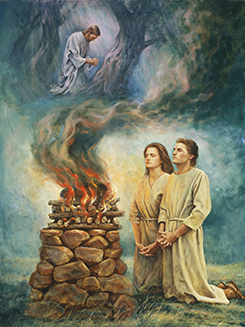
We read the following passage in The Book of Moses, as revealed to Joseph Smith in June-October of 1830 (Moses 5:4-8):

4: And Adam and Eve, his wife, called upon the name of The Lord, and they heard the voice of The Lord from the way toward the Garden of Eden, speaking unto them, and they saw Him not; for they were shut out from His Presence.
5: And He gave unto them commandments, that they should worship The Lord their God, and should offer the firstlings of their flocks, for an offering unto The Lord. And Adam was obedient unto the commandments of The Lord.
6: And after many days an angel of The Lord appeared unto Adam, saying: Why dost thou offer sacrifices unto The Lord? And Adam said unto him: I know not, save The Lord commanded me.
7: And then the angel spake, saying: This thing is a similitude of the sacrifice of The Only Begotten of The Father, which is full of grace and truth.
8: Wherefore, thou shalt do all that thou doest in the name of The Son, and thou shalt repent and call upon God in the name of The Son forevermore.

First of all, thank goodness for the gift of repentance and the Atonement of Jesus Christ which allow a sinner like me to feel hope and bright resolve to do as father and mother Adam and Eve did, to obey God, worshiping together by His Temple, as He commanded, in preparation for the restoration to His Presence. Second, notice how Adam is taught that his obedience to sacrifice is symbolic of the sacrifice of The Only Begotten Son. But also focus on the usage of the name "Adam". To be sure this specific event involved the father and mother of humanity, hence it is only expected to find "Adam" addressed repeatedly here.

Now, I will cite a passage from Leviticus in our ever superb King James Translation, then a more precise translation from the Hebrew. In the instance of the more precise Hebrew translation I will suspend syntactical considerations (rules for putting words together) to allow all to see how Hebrew constructed the thought. From opening words of Moses' great book on Priestly officiation, Leviticus 1:1-5:

1: And The Lord called unto Moses, and spake unto him out of the tabernacle of the congregation, saying,
2: Speak unto the children of Israel, and say unto them, If any man of you bring an offering unto The Lord, ye shall bring your offering of the cattle, even of the herd, and of the flock.
3. If his offering be a burnt offering of the herd, let him offer a male without blemish: he shall offer it of his own voluntary will at the door of the tabernacle of the congregation before The Lord.
4. And he shall put his hand upon the head of the burnt offering; and it shall be accepted for him to make atonement for him.
5. And he shall kill the bullock before The Lord: and the priests, Aaron's sons, shall bring the blood, and sprinkle the blood round about the altar that is by the door of the tabernacle of the congregation.

Now from the Hebrew:

1. And Jehovah called to Moses and spake to him out of the Tent of Meeting, saying:
2: Speak unto the sons of Israel and say unto them: If Adam from among you bringeth forth an offering to Jehovah from the cattle, from the flock, ye shall bring your offering forth.
3. If his burnt offering from the herd is a male of perfections, he shall bring it to the door of the Tent of Meeting, he shall bring it at his pleasure before the face of Jehovah.
4. And he shall lay his hand upon the head of the burnt offering, and it shall be accepted for him to make atonement for him.
5. And he shall kill the son of the herd before the face of Jehovah, and shall bring the sons of Aaron, the priests, the blood and sprinkle the blood on the altar all around, which is the door of the Tent.

The similarities are striking. Both Adam and Moses were commanded to offer sacrifices, both by the door (gate) of the Temple or Tent, both by shedding blood, and (as one reads Leviticus further), both by fire. Adam was told that his sacrifice was in similitude of The Only Begotten Son, and Moses was told to sacrifice the "son of perfections" of the herd, the key words "son" and "perfections" being lost in translation. But also, the Hebrew communicated the idea of  "if any man of you bring an offering" as "if Adam of you brings an offering." So yet again I find in the Hebrew source text confirmation of the truthfulness of what was revealed to Joseph Smith and to me, that is, in my case, that these Holy Writs are true. As I ponder this circumstance the truth becomes so plain, namely, that what The Lord commanded Moses to do would clearly have been what He had always ever commanded His people to do, from the beginning. What was revealed to Joseph Smith as teachings that Moses once received, but were lost, still have their echo in that record of Moses that survives to the present day. However, as the King James Translation did not convey the key concepts of "Adam" or "Son", the only way Joseph Smith could have been so right was to have received this knowledge from The Lord through His Holy Spirit.

There is something more I could say about the idea that "any man" offering sacrifice is referred to as "Adam", but as our British brethren say, "I shan't explain it here". The Temple is the place where I would mention it.

The reader may take these observations to be coincidence, happenstance, insignificant, curious, or confirming of truth. Whatever the reader sees in this, my observations are, in the very least, actually textual.

Sunday, March 20, 2016

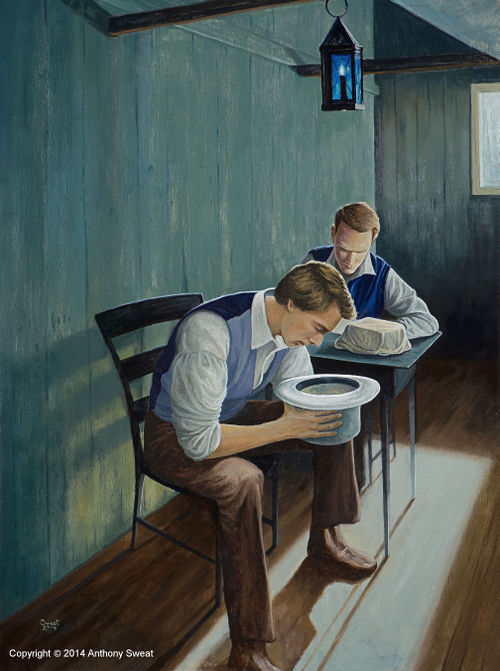
A Biblical Seer Stone


I have encountered statements to the effect that Joseph Smith's claims to prophetic abilities by the use of a "seer stone" are outlandish, if not outright absurd. Some of my fellow Christians who are not Latter-day Saints even express an unwillingness to consider Joseph Smith's usage of a seer stone because such a process is "un-Biblical".

Consider Genesis 28:11-22. Here I will offer a more careful translation from the Hebrew source texts:
  • 11: When [Jacob] reached the place, he stopped there for the sun was set; and he took from the stones of the place, he placed it under his head, and he slept in that place.
  • 12: And he dreamed, and behold! A stairway resting on earth, and the top of it reaching to the heavens. And behold, angels of Elohim ascending and descending on it.
  • 13: And behold! Jehovah standing on top of it; and He said: I am Jehovah, Elohim of Abraham, thy father, and Elohim of Isaac; the land on which thou liest, I shall give it to thee and to thy descendants.
  • 14: And thy descendants shall be like the dust of the earth, and thou shalt spread westward and eastward, northward and southward, and through thee and through thy seed all the families of the earth shall be blessed.
  • 15: And behold! I am with thee, and I shall watch over thee in any land where thou goest, and I shall bring thee back to this land; indeed shall I not leave thee until I shall have done what I promised to do for thee.
  • 16: And when Jacob awoke from his sleep, he said, Surely there is Jehovah in this place, and I knew it not.
  • 17: And he revered and said, How awesome is this place; this is no other than House of Elohim, and this is Gate of the Heavens.
  • 18: And Jacob arose in the morning, and took the stone that he had placed under his head, and stood it up as a pillar, and poured oil on its head.
  • 19: And he named the name of that place Beth El, even though the name of the city was at first Luz.
  • 20: And Jacob made a vow to say, If Elohim shall be with me, and watcheth over me on the way that I am taking, and giveth me food to eat, and clothes to wear,
  • 21: And I return in peace to my father's house [or "my Father's House"], then shall Jehovah be unto me as unto Elohim.
  • 22: And this stone that I set up as pillar shall be House of Elohim, and all Thou givest unto me, its tithe shall I give unto Thee.

This is an amazing experience. Now, knowing this to be obscure unless the reader has experienced tte Temple Endowment, let me summarize some key elements:
  1. Jacob traveled to a place, a sacred place, though he knew not of its sacredness at first.
  2. Of this sacred place he took a stone and placed the stone under his head. Jacob then slept.
  3. With his head on a stone from this sacred place, a sacred stone we may conclude, he experienced a vision.
  4. In this vision Jacob saw angels ascending and descending on a stairway that stood on the earth and reached to the heavens.
  5. When the angels ascended they encountered Jehovah standing on the top, then the angels descended. Though the narrative does not mention any verbal exchange between the angels and Jehovah, the word "mlachim" means 'angels/messengers', so presumably the angels were receiving some message or commission from Jehovah, and presumably the angels were giving report to Jehovah.
  6. We are not told how many angels there were, but by Hebrew grammar there were 3 angels at a minimum. Three angels were the norm for special message deliveries to Abraham, and there may have been 3 angels here too.
  7. Jacob is told that through him and his seed all the "families" of the earth shall be blessed. This session of instruction at the divine conduit to heaven called "House of Elohim" was centered on how Jehovah  would bless and bind families. The binding is real, for unless the families are connected they could not be considered Jacob's seed.
  8. Jacob awakes and realizes that this place is sacred for in it "there is Jehovah". Jacob calls it awesome and, though it was called "Luz", a name that denoted 'crookedness, corruption', Jacob calls this place "House of Elohim" and names this place "House of El" or "Beth El".
  9. Jacob then takes the stone he used for his pillow, the sacred stone from the sacred place, the very stone upon which his head experienced this vision, in the dark of the night, and Jacob anoints the head (i.e. "top") with oil. Though the narrative does not mention "Christ"/"Messiah", the act of anointing made the pillar "anointed", and in Hebrew "anointed" is "Messiah", "Christ".
  10. Jacob calls this Pillar the House of Elohim, and, directing his speech to God, Jacob vows to pay a tithe of all he is given in order to return. Jacob also acknowledges that if Elohim is with him, and gives him food to eat and clothes to wear, both symbols (food/clothes) being recurrent Biblical symbols of officiating in the Temple, then shall Jehovah be to him as to Elohim. 
What we see here has powerful relevance to the Endowment ceremony, though I will pursue this parallel no further. I will pursue two, though. First, is it not interesting that a stone from a sacred place, in effect, a sacred stone, (and the stone's sacredness is evident since the "land" upon which Jacob lay was sacred, see verses 13 and 16), seems to have played a role in opening Jacob's mind to this vision? One may propose that the stone was a mere pillow, though this pillow is later anointed, made "Messiah" or "Christ", and as such this pillar is called the "House of Elohim". If anyone is in search of a precedent for prophet placing his head over a sacred stone in a dark setting and seeing a vision, be that dark setting night or the inside of a hat, one certainly has it here.


Second of all, notice the angels ascending and descending. We are not told what they had to say to their Lord, what The Lord had to say to them, or what they said to Jacob. We might infer that what Jacob was told about all the families of the earth was a message delivered by the angels, but regardless, consider the words of Jesus, the Pillar of the House of Elohim, during His mortal mission. Here Jesus called Nathanael to be an Apostle, and Jesus spoke as though He had already met Nathanael. Nathanael was puzzled since this was his first encounter with Jesus. When Nathanael asked Jesus where they had met, Jesus told him that He had seen Nathanael "under the fig tree". This occasion must have been deeply personal, perhaps one of a particularly special personal prayer, probably to know whether Jesus was The Son of God. It was here that Nathanael exclaimed, "Rabbi, thou art The Son of God; Thou art The King of Israel. Note Jesus' response to Nathanael (John 1:50-51):

  • 50: Jesus answered and said unto him, Because I said unto thee, I saw thee under the fig tree, believest thou? Thou shalt see greater things than these.
  • 51: And He saith unto him, Verily, verily, I say unto thee, Hereafter shalt thou see the heaven opened, and the angels of The God ascending and descending upon The Son of The Man.

Is it not interesting that The Savior promised a man who believed upon His word, believed presumably because the man prepared his heart through prayer, that this man would see greater things than what he had just witnessed: The man would see angels ascending and descending on The Son of The Man.

I shall have to leave it to the reader to discern the significance of these passages. Whether anyone sees in them what I was quickened to perceive is entirely the reader's prerogative. I ask only that, regardless of what I have shared by way of interpretation, the reader bear in mind that the passages at least are actually textual.