Sunday, October 9, 2016

On The Book of Abraham


A few years ago two Elders who were serving in a town north of Columbus, Ohio, approached their Zone Leader with a question. It so happened that their investigator had certain doubts about The Book of Abraham. The Elders did not believe they could adequately respond to his concerns, hence they had turned to their Zone Leader. He in turn referred them to me, and so it was that I came into contact with these Elders.

Immediately I discerned that there was more at stake here than the concerns of a skeptical investigator: The Elder's own testimony was in need of a confirmation, or at least some affirming support. Regardless of what the investigator would do with whatever I would share, my paramount concern was building up my brother's faith.

I will go through this as I did with the Elders and their investigator that night. As it happens, this topic is one I have meant to expound on, and this is not that exposition, but an overview is helpful. What I will share is what I have learned largely on my own, and if anyone has paid any attention to what I share, I do not rely on traditions or other's so-called expertise, but on study as inspired by The Holy Ghost. With this in mind, I will share.

Question 1: Is The Book of Abraham a translation of the Egyptian hieroglyphs, and by translation I mean the American Translators Association definition, where the Egyptian characters or hieroglyphs are simply converted to their usual significations in English?

The answer is no. In fact, The Book of Abraham source scroll is an Egyptian funerary text. When scrutinized this particular copy of an Egyptian funerary text actually has unique features making it peculiar among the myriad of such texts, but the actual source text we have is by and large a common Pagan text which probably dates to the the fourth century AD, give or take a century.

Question 2: But didn't Joseph Smith say it was written by the hand of Abraham?

Yes, Joseph Smith did say that. Bear in mind that "by the hand of" means 'by authority of', and does not obligatory imply that the document is an autograph, that is, "by the hand of" does not necessarily mean, though it may, that Abraham penned this very scroll with his own hand, quill and ink. Let us take some things into consideration. Consider the gold plates upon which Mormon and Moroni etched The Book of Mormon:

  1. The gold plates, actual autographs, were guarded by the power of God.
  2. Moroni handed the plates over to Joseph Smith.
  3. Joseph Smith endured numerous attempts to deprive him of the plates, but never allowed anyone to see them except for 11 other witnesses.
  4. Then Joseph Smith returned the plates to Moroni.
Now compare the scrolls on which The Book of Abraham (Egyptian funerary text) is written:
  1. The scrolls were found, transferred and sold to Joseph Smith by a series of dealers (grave-robbers in the first instance).
  2. Joseph Smith showed the scrolls to just about anyone who inquired about them. It is reported that Joseph would display them at his house, and visitors could examine and handle them.
  3. After The Book of Abraham was translated, Joseph Smith held on to the scrolls. After Joseph's death the scrolls changed hands, were considered lost in the great Chicago fire, but were rediscovered and given to the LDS Church.
  4. The scroll's images were published in their entirety for all to see.
Clearly we see that Joseph Smith treated the scrolls very differently from the gold plates. If actual, bona fide autographs are Sacred items that will be safeguarded by the power of God, as with The Book of Mormon plates, then the actual Book of Abraham scrolls, though doctrinally priceless, were not considered to be of the same spiritual value as the Book of Mormon autograph/plates.

Question 3: So how did Joseph Smith go from an Egyptian Pagan funerary text to a book containing an important revelation given to Abraham?

Joseph Smith saw the scrolls, he saw that they were ancient, that they were Egyptian, and Joseph Smith was stirred to inspiration. As Joseph saw the hieroglyphs Joseph began to discern thoughts, ideas, the very message that Abraham had received and conveyed to his posterity. As Joseph looked at each individual hieroglyph on the scroll, Joseph understood, not what that hieroglyph would eventually be deciphered to mean by later Egyptologists (this was not the concern), but what (and here the revelation takes place) Abraham used that hieroglyph to mean. 

Abraham had received a revelation from God. In that revelation Abraham was taught about the premortal world and creation. Abraham, now having dwelt among the Egyptians, used their writing system to tell his own story. To accomplish this Abraham may have altered the hieroglyphs of his chosen Egyptian text slightly, but in essence Abraham commandeered a Pagan hieroglyphic text as though it were a picture text. Abraham then used the pictures in that text (the hieroglyphs) to tell his own story. More than this, Abraham's descendants continued the practice of using an Egyptian Pagan text's pictures to tell the story of Abraham's vision for almost two thousand years. Let me be clear: It appears that Abraham's descendants continued using the same Egyptian funerary text to tell Abraham's vision, independent of what an educated Egyptian would have read upon seeing the exact same scroll.

I am saying that Joseph Smith, by the gift of God, understood what would have been impossible to grasp otherwise: What an ancient Patriarch and a righteous line of his descendants had reinterpreted Egyptian hieroglyphs to mean, and not to mean in all cases, but to mean for the purpose of relating Abraham's sacred vision.

Question 4: If Joseph Smith got a revelation that restored a long-lost revelation given to Abraham, why did Joseph need the scroll at all? Why not just get the revelation?

Good question. In fact, Joseph Smith had already experienced this very process. In April of 1829, by using the Urim and Thummim, Joseph Smith saw a parchment written by the Apostle John, and Joseph translated the parchment. His translation is now Section 7 in the Doctrine and Covenants.

But as regards a lengthy work, one where Joseph had to work, break, resume, over a period of time (Section 7 is rather brief), a "hard copy" was required. I put it forward for consideration that, as regards getting in the mindset to receive a powerful outpouring of inspiration from God, Joseph Smith was "tactile". That is, that by handling an actual old document and seeing its ancient images, Joseph Smith's mind became more receptive to receiving a great outpouring of the mind of God. I might say, in my own *small* way I am tactile. To connect with a text, to get in "the zone", I have to have the right text. The right text for me is often old, with thick but yellowed pages, heavy and cracked leather cover, and archaic (old and no longer used) script. When I have this type of text I can become engulfed in my reading of the book.

There was another prophet who was tactile. Joseph of old, per Genesis 44:1-5, used a silver cup to divine. Why a silver cup, why not just pray and discern? I put it to the reader that Joseph of old was tactile, that by handling a specific object Joseph of old became more receptive to great outpourings of the Holy Ghost.

Question 5: Realizing that this assertion seems fantastical, how did you arrive at this conclusion?

I arrived in two steps. First of all, there are the Facsimiles. In Facsimile 3 the image numbered 2 is said to be Pharaoh, but when you look at image 2 you will see that what is represented is clearly a woman. In the same Facsimile 3 the images numbered 4 and 5 are said to represent the Prince of Pharaoh and Shulem his (male) servant, but the images are clearly of a man and woman holding hands. Now, either Joseph was unobservant of such details or Joseph was relaying, not what the symbols meant to Egyptians of old and would mean to modern Egyptologists, but what they meant to Abraham and his righteous descendants who kept the sacred story alive by using the hieroglyphs as visual cues or prompts.


I realized (and here my linguistics background came into play) that what we LDS are dealing with in The Book of Abraham scrolls is not a direct translation of what those hieroglyphs normally were used to mean, but rather we LDS are dealing with a modern transcribing of the values that Abraham anciently reassigned to each hieroglyph. Some of these meanings may have been whole ideas, phrases, sentences even.

Question 6: Have you ever heard of The Apocalypse of Abraham?

Let me share something that is relevant. In the 1800's a Russian-born German Protestant theologian, Gottlieb Nathanael Bonwetsch, while searching through medieval manuscripts at a monastery came upon a manuscript written in Church Slavonic and bearing the title "The Apocalypse of Abraham". Having never heard of this book he took an immediate interest, translated the book to German, and published it. 


As much as anyone is able to reconstruct of the history of this book, the following is a sketch:
  1. In the tenth or eleventh century AD, early in Russia's conversion to Eastern Orthodox Christianity, probably itinerant (traveling) monks visiting Constantinople came upon a manuscript, probably in Greek (translation) that, though not in The Bible (a fourth century AD compilation of Holy Writ), was still in use among Greek scribes. This book was called "The Apocalypse of Abraham." 
  2. Though all source Greek texts of The Apocalypse of Abraham have since been lost, these monks translated their Greek text to Slavonic. When the text was read in Russian Churches, the text became enormously popular. Even as The Apocalypse of Abraham fell into obscurity in Europe, the Apocalypse continued enjoying enormous popularity in Russia.
  3. Eventually the Russian Orthodox Church insisted that liturgies (religious worship texts) be drawn primarily from The Bible, and the Apocalypse fell into obscurity. The last copies appear to have been made in the sixteenth century, and from there they stood unused on a monastery shelf, until their rediscovery by Bonwetsch. 
Question 7: So what does The Apocalypse of Abraham tell?

The Apocalypse of Abraham, I wish to be clear, is not The Book of Abraham. In fact, the Apocalypse starts out with a background story of Abraham's upbringing that is not dealt with in The Book of Abraham at all. The Apocalypse has whole interactions between an Angel of God and Abraham that are not described in The Book of Abraham, but whose teachings bear some similarities to what The Book of Abraham teaches. That said, if one reads The Apocalypse of Abraham in its entirety, there are points of enormous interest.
  1. The book explains that Abraham's father, Terah, was a polytheist.
  2. The book explains how Abraham was led, step by step, to shun his father's idolatry and believe in the true and living God. During this process Abraham mentions that he cannot call the earth "god" because the earth itself is subject to the sun.
  3. God sends an Angel to Abraham whose name is "Jah-oh-El", which is Hebrew for "Yahu is El" or 'The Lord is God'. In the Apocalypse the name "Jehovah" is strongly suggested but not printed outright.
  4. Abraham prays to God saying, El-El-El-El "Jah-oh-El", which is the strongest suggestion of saying "Jah-oh-eh" or "Jehovah", though by adding "l" to make "Jahoel" or "Yahu is God", the writer of the Apocalypse avoided using the sacred name of Jehovah.
  5. Abraham is shown that his posterity had lived before and were ordained to be born as the people of God.
  6. In the Apocalypse God has Abraham taken to a fiery world of His. There Abraham looks below his feet and sees a vision of the world at its creation, the Garden of Eden, and the Fall of Adam. As Abraham speaks with God Abraham speaks of this image under his feet as a "picture". 
  7. The Temple and Priesthood are revealed to Abraham in this vision.
For anyone familiar with The Book of Abraham, The Apocalypse of Abraham is fascinating. In The Book of Abraham Facsimile 2 Abraham mentions that the Egyptians called the earth "Jah-oh-eh", which is amazingly similar to "Jahoel". In effect, in Facsimile 2 Joseph records the Egyptians as doing what Abraham discerned he should not: Call the earth "god". Facsimile 2 also states that the Temple and Priesthood were revealed to Abraham. The Book of Abraham goes into detail about the Creation and the premortal lives of the Prophets and all people. 

Question 8: So tell me again, what is this Apocalypse of Abraham?

Some scholars believe that The Apocalypse of Abraham was preserved after the Jewish Temple was destroyed. The belief is that the book once had one or more pictures, the very imagery referred to in the text, but that only the text remained. Scholars believe that one of the "pictures" was round and represented the Creation and humanity. The reader will recall that Facsimile 2 of The Book of Abraham is round and that one of its glyphs represents the four quarters of the earth, at least in the values ascribed by Abraham.

The first version of The Apocalypse of Abraham may have been written in Aramaic, possibly Hebrew, then translated to Greek, and finally to Slavonic. Only the Slavonic texts were preserved (or have been discovered).

Question 9: Have you heard of the discovery of an Egyptian Facsimile similar to Facsimile 1?

Now, thousands of Egyptian papyri that are essentially Facsimile 1 (and 2 and 3) have been found. In and of itself finding another version of Facsimile 1 is no big deal. What was peculiar about this Facsimile is (1) it was found in a Jewish burial in Alexandria, Egypt, and (2) the name "Abraham" was penned anciently beside the figure on the sacrificial altar. 


Question 10: Are there any "proofs" within The Book of Abraham or The Bible itself?

Yes, there are many proofs or interesting correspondences, but I shall limit myself to two that The Lord revealed to me. 

In Abraham 2:25 Abraham asks Sarai, his wife, to say that she is his sister (not untrue, as she was his half-sister). Immediately after this Abraham receives his vision, from Chapter 3 on. From Abraham 4 on Abraham then refers to God in the plural, "The Gods", which in English translation is rendered as "they/the Gods said/called..." The reason the English translation has to phrase plurality as "they (the Gods) said..." is because English has no clearly plural form in the past tense. "He said" is only different from "they said" in the choice of pronoun. In Hebrew not only is the pronoun different but the form or ending of a plural verb is different from a singular verb. "He said" is "amar" but they said is "amru". 

Now, remember that Abraham asks his wife to say that she is his sister, then Abraham receives his vision, and then Abraham refers to Gods in the plural. In The Bible "Elohim" is used as God's Name-Title. Elohim is, technically speaking, plural, but the verbal forms used with Elohim are singular. To use English in a hypothetical example of how Hebrew uses Elohim, we could say "Gods commands you". Here "Gods" is plural in form, but "commands" is singular in form ("he commands" not "they commands"). There is one point in the Torah, the Five Books of Moses, where Elohim is used in the plural, and that is Genesis 20:13. Here Abraham explains that he had asked his wife to say that she was his sister. By this point in The Book of Abraham, Abraham had already received his vision. Abraham then says, in the Hebrew, if we use the same convention or construction as in The Book of Abraham translation, the following:
"And it came to pass, when they, the Gods, caused me to wander from my father's house..."
I have never found a translation of Genesis 20:13 that renders the Hebrew correctly. All the translations write "when God caused me to wander" rather than the more correct (in English): "they, the Gods, caused me..." The only other example of Gods plural in Hebrew is 2 Samuel 7:23, David's dedicatory prayer regarding the Temple. Is it coincidence that the first point in our preserved Hebrew text that "they the Gods" is preserved is in the mouth of Abraham after the point of discussing why he asked his wife to say she was his sister, just as in The Book of Abraham? It is not interesting that the point where Abraham in The Bible refers to Gods Plural is when, per The Book of Abraham, Abraham had received his vision, which is the very point where, in The Book of Abraham, Abraham starts referring to Gods Plural too?

The next is a smaller but more interesting point. In Genesis 18:19 The Lord, while blessing Abraham, says the following:
"For I know him [Abraham], that he will command his children and his household after him, and they shall keep the way of The Lord, to do justice and judgment; that The Lord may bring upon Abraham that which he hath spoken of him." 
(Q11) How exactly could Abraham instruct his children and household after his death to keep the way of The Lord unless there was a written mechanism for preserving those instructions? The existence of a Book of Abraham was not a luxury but a necessity.

As time goes on I will add to this post because there are numerous proofs that support The Book of Abraham, but time is of the essence, so I will allow this somewhat emaciated overview to suffice.

Question 12: So what happened with the Elders when you taught the investigator?

That was interesting. The investigator really thought he had the Elders over a barrel on The Book of Abraham, that scholars had pounded the nails into the coffin, at least as regards Joseph Smith being an inspired translator. When I said that The Book of Abraham was in fact not a literal translation and that the scroll was an Egyptian Pagan text, the one Elder's eyes widened and his face went pale in an expression of horror. But as we walked through these points, step by step, as I did here, the Elder came to life. In the end he was almost overcome by The Spirit of God. He said, as I recall, in a voice nearly consumed by faith, tears, and joy: "My testimony of Joseph Smith is now more powerful than ever. I know he was a prophet of God and that he was inspired to translate The Book of Abraham." I was very pleased. I had been the instrument for helping a good brother strengthen his testimony at a time when conspiring minds, via linguistic shell games and slight of hand, had sought to undermine pure and innocent testimonies such as his.

Conclusion:

So in conclusion it appears that ancient Hebrews would use Egyptian Pagan texts as cues, prompts or talking-points to relate the story of a powerful vision that Abraham received. Especially after the Temple was destroyed, changes were made to the story, and multiple versions may have emerged. One such version may be The Apocalypse of Abraham. When Joseph Smith, through the sacrifice of faithful members, obtained Egyptian papyri and proceeded to reveal a revelation that Abraham had received anciently and which his righteous posterity had continued telling by using Egyptian hieroglyphs as the vehicle for telling the sacred story (reassigning values to the hieroglyphs), Joseph Smith restored an astonishing, some might say absurd yet nevertheless actual and true practice of the ancient covenant people, that is, using an Egyptian Pagan text's hieroglyphs as the vehicle for relating a powerful revelation that Abraham had received. As far as scholars can tell, Jews and Christians continued telling Abraham's story via the Egyptian Pagan texts till about the fourth century AD, which is the approximate age of our LDS Abraham scroll. 

As I always say, fiction is fantastical, but there is nothing stranger than the truth. And this oddity, The Book of Abraham and The Apocalypse of Abraham, is actually textual. 

On The Book of Abraham


A few years ago two Elders who were serving in a town north of Columbus, Ohio, approached their Zone Leader with a question. It so happened that their investigator had certain doubts about The Book of Abraham. The Elders did not believe they could adequately respond to his concerns, hence they had turned to their Zone Leader. He in turn referred them to me, and so it was that I came into contact with these Elders.

Immediately I discerned that there was more at stake here than the concerns of a skeptical investigator: The Elder's own testimony was in need of a confirmation, or at least some affirming support. Regardless of what the investigator would do with whatever I would share, my paramount concern was building up my brother's faith.

I will go through this as I did with the Elders and their investigator that night. As it happens, this topic is one I have meant to expound on, and this is not that exposition, but an overview is helpful. What I will share is what I have learned largely on my own, and if anyone has paid any attention to what I share, I do not rely on traditions or other's so-called expertise, but on study as inspired by The Holy Ghost. With this in mind, I will share.

Question 1: Is The Book of Abraham a translation of the Egyptian hieroglyphs, and by translation I mean the American Translators Association definition, where the Egyptian characters or hieroglyphs are simply converted to their usual significations in English?

The answer is no. In fact, The Book of Abraham source scroll is an Egyptian funerary text. When scrutinized this particular copy of an Egyptian funerary text actually has unique features making it peculiar among the myriad of such texts, but the actual source text we have is by and large a common Pagan text which probably dates to the the fourth century AD, give or take a century.

Question 2: But didn't Joseph Smith say it was written by the hand of Abraham?

Yes, Joseph Smith did say that. Bear in mind that "by the hand of" means 'by authority of', and does not obligatorily imply that the document is an autograph, that is, "by the hand of" does not necessarily mean, though it may, that Abraham penned this very scroll with his own hand, quill and ink. Let us take some things into consideration. Consider the gold plates upon which Mormon and Moroni etched The Book of Mormon:

  1. The gold plates, actual autographs, were guarded by the power of God.
  2. Moroni handed the plates over to Joseph Smith.
  3. Joseph Smith endured numerous attempts to deprive him of the plates, but never allowed anyone to see them except for 11 other witnesses.
  4. Then Joseph Smith returned the plates to Moroni.
Now compare the scrolls on which The Book of Abraham (Egyptian funerary text) is written:
  1. The scrolls were found, transferred and sold to Joseph Smith by a series of dealers (grave-robbers in the first instance).
  2. Joseph Smith showed the scrolls to just about anyone who inquired about them. It is reported that Joseph would display them at his house, and visitors could examine and handle them.
  3. After The Book of Abraham was translated, Joseph Smith held on to the scrolls. After Joseph's death the scrolls changed hands, were considered lost in the great Chicago fire, but were rediscovered and given to the LDS Church.
  4. The scroll's images were published in their entirety for all to see.
Clearly we see that Joseph Smith treated the scrolls very differently from the gold plates. If actual, bona fide autographs are Sacred items that will be safeguarded by the power of God, as with The Book of Mormon plates, then the actual Book of Abraham scrolls, though doctrinally priceless, were not considered to be of the same spiritual value as the Book of Mormon autographs/plates.

Question 3: So how did Joseph Smith go from an Egyptian Pagan funerary text to a book containing an important revelation given to Abraham?

Joseph Smith saw the scrolls, he saw that they were ancient, that they were Egyptian, and Joseph Smith was stirred to inspiration. As Joseph saw the hieroglyphs Joseph began to discern thoughts, ideas, the very message that Abraham had received and conveyed to his posterity. As Joseph looked at each individual hieroglyph on the scroll, Joseph understood, not what that hieroglyph would eventually be deciphered to mean by later Egyptologists (this was not the concern), but what (and here the revelation takes place) Abraham used that hieroglyph to mean. 

Abraham had received a revelation from God. In that revelation Abraham was taught about the premortal world and creation. Abraham, now having dwelt among the Egyptians, used their writing system to tell his own story. To accomplish this Abraham may have altered the hieroglyphs of his chosen Egyptian text slightly, but in essence Abraham commandeered a Pagan hieroglyphic text as though it were a picture text. Abraham then used the pictures in that text (the hieroglyphs) to tell his own story. More than this, Abraham's descendants continued the practice of using an Egyptian Pagan text's pictures to tell the story of Abraham's vision for almost two thousand years. Let me be clear: It appears that Abraham's descendants continued using the same Egyptian funerary text to tell Abraham's vision, independent of what an educated Egyptian would have read upon seeing the exact same scroll.

I am saying that Joseph Smith, by the gift of God, understood what would have been impossible to grasp otherwise: What an ancient Patriarch and a righteous line of his descendants had reinterpreted Egyptian hieroglyphs to mean, and not to mean in all cases, but to mean for the purpose of relating Abraham's sacred vision.

Question 4: If Joseph Smith got a revelation that restored a long-lost revelation given to Abraham, why did Joseph need the scroll at all? Why not just get the revelation?

Good question. In fact, Joseph Smith had already experienced this very process. In April of 1829, by using the Urim and Thummim, Joseph Smith saw a parchment written by the Apostle John, and Joseph translated the parchment. His translation is now Section 7 in the Doctrine and Covenants.

But as regards a lengthy work, one where Joseph had to work, break, resume, over a period of time (Section 7 is rather brief), a "hard copy" was required. I put it forward for consideration that, as regards getting in the mindset to receive a powerful outpouring of inspiration from God, Joseph Smith was "tactile". That is, that by handling an actual old document and seeing its ancient images, Joseph Smith's mind became more receptive to receiving a great outpouring of the mind of God. I might say, in my own *small* way I am tactile. To connect with a text, to get in "the zone", I have to have the right text. The right text for me is often old, with thick but yellowed pages, heavy and cracked leather cover, and archaic (old and no longer used) script. When I have this type of text I can become engulfed in my reading of the book.

There was another prophet who was tactile. Joseph of old, per Genesis 44:1-5, used a silver cup to divine. Why a silver cup, why not just pray and discern? I put it to the reader that Joseph of old was tactile, that by handling a specific object Joseph of old became more receptive to great outpourings of the Holy Ghost.

Question 5: Realizing that this assertion seems fantastical, how did you arrive at this conclusion?

I arrived in two steps. First of all, there are the Facsimiles. In Facsimile 3 the image numbered 2 is said to be Pharaoh, but when you look at image 2 you will see that what is represented is clearly a woman. In the same Facsimile 3 the images numbered 4 and 5 are said to represent the Prince of Pharaoh and Shulem his (male) servant, but the images are clearly of a man and woman holding hands. Now, either Joseph was unobservant of such details or Joseph was relaying, not what the symbols meant to Egyptians of old and would mean to modern Egyptologists, but what they meant to Abraham and his righteous descendants who kept the sacred story alive by using the hieroglyphs as visual cues or prompts.


I realized (and here my linguistics background came into play) that what we LDS are dealing with in The Book of Abraham scrolls is not a direct translation of what those hieroglyphs normally were used to mean, but rather we LDS are dealing with a modern transcribing of the values that Abraham anciently reassigned to each hieroglyph. Some of these meanings may have been whole ideas, phrases, sentences even.

Question 6: Have you ever heard of The Apocalypse of Abraham?

Let me share something that is relevant. In the 1800's a Russian-born German Protestant theologian, Gottlieb Nathanael Bonwetsch, while searching through medieval manuscripts at a monastery came upon a manuscript written in Church Slavonic and bearing the title "The Apocalypse of Abraham". Having never heard of this book he took an immediate interest, translated the book to German, and published it. 


As much as anyone is able to reconstruct of the history of this book, the following is a sketch:
  1. In the tenth and eleventh centuries AD, early in Russia's conversion to Eastern Orthodox Christianity, probably itinerant (traveling) monks visiting Constantinople came upon a manuscript, probably in Greek (translation) that, though not in The Bible (a fourth century AD compilation of Holy Writ), was still in use among Greek scribes. This book was called "The Apocalypse of Abraham." 
  2. Though all source Greek texts of The Apocalypse of Abraham have since been lost, these monks translated their Greek text to Slavonic. When the text was read in Russian Churches, the text became enormously popular. Even as The Apocalypse of Abraham fell into obscurity in Europe, the Apocalypse continued enjoying enormous popularity in Russia.
  3. Eventually the Russian Orthodox Church insisted that liturgies (religious worship texts) be drawn primarily from The Bible, and the Apocalypse fell into obscurity. The last copies appear to have been made in the sixteenth century, and from there they stood unused on shelves in monasteries, until their rediscovery by Bonwetsch.
Question 7: So what does The Apocalypse of Abraham tell?

The Apocalypse of Abraham, I wish to be clear, is not The Book of Abraham. In fact, the Apocalypse starts out with a background story of Abraham's upbringing that is not dealt with in The Book of Abraham at all. The Apocalypse has whole interactions between God and His Angel that are not described in The Book of Abraham, but which bear similarities to what The Book of Abraham teaches. That said, if one reads The Apocalypse of Abraham in its entirety, there are points of enormous interest.
  1. The book explains that Abraham's father, Terah, was a polytheist.
  2. The book explains how Abraham was led, step by step, to shun his father's idolatry and believe in the true and living God. During this process Abraham mentions that he cannot call the earth "god" because the earth itself is subject to the sun.
  3. God sends an Angel to Abraham whose name is "Jah-oh-El", which is Hebrew for "Yahu is El" or 'The Lord is God'. In the Apocalypse the name "Jehovah" is strongly suggested but not printed outright.
  4. Abraham prays to God saying, El-El-El-El "Jah-oh-El", which is the strongest suggestion of saying "Jah-oh-eh" or "Jehovah", though by adding "l" to make "Jahoel" or "Yahu is God", the writer of the Apocalypse avoided using the sacred name of Jehovah.
  5. Abraham is shown that his posterity had lived before and were ordained to be born as the people of God.
  6. In the Apocalypse God has Abraham taken to a fiery world of His. There Abraham looks below his feet and sees a vision of the world at its creation, the Garden of Eden, and the Fall of Adam. As Abraham speaks with God Abraham speaks of this image under his feet as a "picture". 
  7. The Temple and Priesthood are revealed to Abraham in this vision.
For anyone familiar with The Book of Abraham, The Apocalypse of Abraham is fascinating. In The Book of Abraham Facsimile 2 Abraham mentions that the Egyptians called the earth "Jah-oh-eh", which is amazingly similar to "Jahoel". In effect, in Facsimile 2 Joseph records the Egyptians as doing what Abraham discerned he should not: Call the earth "god". Facsimile 2 also states that the Temple and Priesthood were revealed to Abraham. The Book of Abraham goes into detail about the Creation and the premortal lives of the Prophets and all people. 

Question 8: So tell me again, what is this Apocalypse of Abraham?

Some scholars believe that The Apocalypse of Abraham was preserved after the Jewish Temple was destroyed. The belief is that the book once had one or more pictures, the very imagery referred to in the text, but that only the text remained. Scholars believe that one of the "pictures" was round and represented the Creation and humanity. The reader will recall that Facsimile 2 of The Book of Abraham is round and that one of its glyphs represents the four quarters of the earth, at least in the values ascribed by Abraham.

The first version of The Apocalypse of Abraham may have been written in Aramaic, possibly Hebrew, then translated to Greek, and finally to Slavonic. Only the Slavonic texts were preserved (or have been discovered).

Question 9: Have you heard of the discovery of an Egyptian Facsimile similar to Facsimile 1?

Now, thousands of Egyptian papyri that are essentially Facsimile 1 (and 2 and 3) have been found. In and of itself finding another version of Facsimile 1 is no big deal. What was peculiar about this Facsimile is (1) it was found in a Jewish burial in Alexandria, Egypt, and (2) the name "Abraham" was penned anciently beside the figure on the sacrificial altar. 


Question 10: Are there any "proofs" within The Book of Abraham or The Bible itself?

Yes, there are many proofs or interesting correspondences, but I shall limit myself to two that The Lord revealed to me. 

In Abraham 2:25 Abraham asks Sarai, his wife, to say that she is his sister (not untrue, as she was his half-sister). Immediately after this Abraham receives his vision, from Chapter 3 on. From Abraham 4 on Abraham then refers to God in the plural, "The Gods", which in English translation is rendered as "they/the Gods said/called..." The reason the English translation has to phrase plurality as "they (the Gods) said..." is because English has no clearly plural form in the past tense. "He said" is only different from "they said" in the choice of pronoun. In Hebrew not only is the pronoun different but the form or ending of a plural verb is different from a singular verb. "He said" is "amar" but they said is "amru". 

Now, remember that Abraham asks his wife to say that she is his sister, then Abraham receives his vision, and then Abraham refers to Gods in the plural. In The Bible "Elohim" is used as God's Name-Title. Elohim is, technically speaking, plural, but the verbal forms used with Elohim are singular. To use English in a hypothetical example of how Hebrew uses Elohim, we could say "Gods commands you". Here "Gods" is plural in form, but "commands" is singular in form ("he commands" not "they commands"). There is one point in the Torah, the Five Books of Moses, where Elohim is used in the plural, and that is Genesis 20:13. Here Abraham explains that he had asked his wife to say that she was his sister. By this point in The Book of Abraham, Abraham had already received his vision. Abraham then says, in the Hebrew, if we use the same convention or construction, the following:
"And it came to pass, when they, the Gods, caused me to wander from my father's house..."
I have never found a translation of Genesis 20:13 that renders the Hebrew correctly. All the translations write "when God caused me to wander" rather than the more correct (in English): "they, the Gods, caused me..." The only other example of Gods plural in Hebrew is 2 Samuel 7:23, David's dedicatory prayer regarding the Temple. Is it coincidence that the first point in our preserved Hebrew text that "they the Gods" is preserved is in the mouth of Abraham after the point of discussing why he asked his wife to say she was his sister, just as in The Book of Abraham?

The next is a smaller but more interesting point. In Genesis 18:19 The Lord, while blessing Abraham, says the following:
"For I know him [Abraham], that he will command his children and his household after him, and they shall keep the way of The Lord, to do justice and judgment; that The Lord may bring upon Abraham that which he hath spoken of him." 
(Q11) How exactly could Abraham instruct his children and household after his death to keep the way of The Lord unless there was a written mechanism for preserving those instructions? The existence of a Book of Abraham was not a luxury but a necessity.

As time goes on I will add to this post because there are numerous proofs that support The Book of Abraham, but time is of the essence, so I will allow this somewhat emaciated overview to suffice.

Question 12: So what happened with the Elders when you taught the investigator?

That was interesting. The investigator really thought he had the Elders over a barrel on The Book of Abraham, that scholars had pounded the nails into the coffin, at least as regards Joseph Smith being an inspired translator. When I said that The Book of Abraham was in fact not a literal translation and that the scroll was an Egyptian Pagan text, the one Elder's eyes widened and his  face went pale in an expression of horror. But as we walked through these points, step by step, as I did here, the Elder came to life. In the end he was almost overcome by The Spirit of God. He said, as I recall, in a voice nearly consumed by faith, tears, and joy: "My testimony of Joseph Smith is now more powerful than ever. I know he was a prophet of God and that he was inspired to translate The Book of Abraham." I was very pleased. I had been the instrument for helping a good brother strengthen his testimony at a time when conspiring minds, via linguistic shell games and slight of hand, had sought to undermine pure and innocent testimonies such as his.

Conclusion:

So in conclusion it appears that ancient Hebrews would use Egyptian Pagan texts as cues, prompts or talking-points to relate the story of a powerful vision that Abraham received. Especially after the Temple was destroyed, changes were made to the story, and multiple versions may have emerged. One such version may be The Apocalypse of Abraham. When Joseph Smith, through the sacrifice of faithful members, obtained Egyptian papyri and proceeded to reveal a revelation that Abraham had received anciently and which his righteous posterity had continued telling by using Egyptian hieroglyphs as the vehicle for telling the sacred story (reassigning values to the hieroglyphs), Joseph Smith restored an astonishing, some might say absurd yet nevertheless actual and true practice of the ancient covenant people, that is, using an Egyptian Pagan text's hieroglyphs as a vehicle for revealing a powerful revelation that Abraham had received. As far as scholars can tell, Jews and Christians continued telling Abraham's story via the Egyptian Pagan texts till about the fourth century AD, which is the approximate age of our LDS Abraham scroll. 

As I always say, fiction is fantastical, but there is nothing stranger than the truth. And this oddity, The Book of Abraham and The Apocalypse of Abraham, is actually textual. 

Sunday, September 18, 2016

From Top to Bottom: The Rameumptom


I wish to examine the word "Rameumptom" that occurs in The Book of Mormon: Another Testament of Jesus Christ, in the book of Alma, chapter 31:21.
"Now the place was called by them Rameumptom, which, being interpreted, is the holy stand."
I will walk you through this term by way of linguistic analysis.

First, inasmuch as Hebrew appears to have played a role in the liturgical language (language of worship) among the Nephites of The Book of Mormon, I will proceed to analyze the term Rameumptom as though it were derived from a Hebrew or Hebraic source. 

Second, the term "interpret"--"which, being interpreted"--denotes five meanings: 1) to translate or convert from one language to another; 2) to explain or elucidate; 3) to decipher or decode; 4) to construe or take to mean; 5) to define by using synonyms. 

Contrary to what most readers assume, the meaning of "being interpreted" here is not number 1, but number 2, "explain or elucidate". How can anyone tell what meaning of being interpreted is being used here? The answer is quite evident: We are told that the interpretation of Rameumptom is "holy stand". As it happens, proceeding with Hebrew as our language of investigation, the term "holy stand" in Hebrew, depending on what type of stand was involved, might consist of "×¢ַמּוּד" '"amud" 'column; platform; stand' and "×§ָדוֹשׁ" "qadosh" 'holy'. The term Rameumptom contains no recognizable Hebrew word root for "holy" let alone "stand". Thus our first conclusion is that the expression "being interpreted" as used here probably means "being explained". 

Why does it matter whether the term Rameumptom is being translated literally or being explained? Initially it will not matter. We will have to break the term Rameumptom down into its smaller parts and search for their correspondences in Hebrew, again, because for the sake of analysis I am investigating the possibility of a Hebrew source. However, should we succeed in breaking Rameumptom down into smaller parts, our search for correspondences in Hebrew will differ based on whether we expect the parts of Rameumptom literally to mean "holy" and "stand" or to mean something else that in combination conveys the sense of a "holy stand". Most researchers, it seems, have sought for recognizable word roots that denote "holy" and "stand", though to no avail or success.

Why would a term be explained rather than merely translated? Terms are translated when their parts can be converted to a sensible sequence in the target language. Take for example the French expression of "maître de maison". Translated to English this means "master of the house". The French word "maître" means 'master', "de" means 'of', and "maison" means 'house'. No surprises in this translation from French to English.

However, if the word in question would be confusing to understand when its word parts are directly translated, the solution is to convey the sense of the source-language word by way of explanation. Take the French expression "belle-mère". If we translated "belle-mère" precisely as we were lucky enough to do with "maître de maison" we would quite easily get 'beautiful mother'. Indeed, the French word "belle" means 'beautiful' and "mère" means 'mother'. However, "belle-mère" does not actually mean 'beautiful mother' in English. So here we will have to render the interpretation of "belle-mère". As it happens, "belle-mère" means 'mother-in-law'. This is why sometimes we have to interpret rather than simply convert a word to it equivalent parts in the target language.


Morpheme Boundaries

In linguistics, the study of languages as systems, a "morpheme" is a minimal or smallest meaningful unit. Take for example the word doghouse. This word can be broken down or divided into two smaller units, each of which carries a meaning: dog and house. Neither dog nor house can be further subdivided into meaningful parts. Now take the word assumption. English borrowed this word and borrowed its original parts from French, and French drew all the relevant parts from Latin. For this reason this exercise will be clear to us. Let us divide "assumption" into its constituent morphemes (minimal or smallest meaningful parts): assum- 'to take, appropriate' and -tion 'an abstract instance of'. In reality, "assum-" can be further divided to "ad-" 'toward' and "sum" 'take'. When these word parts are strung together, you may have noticed that the combination of the sounds seems to trigger a change, almost like a chemical reaction, such as mixing baking soda with vinegar: ad-sum-tion > assumption. There are other similar examples: "presume:presumption", "redeem:redemption", et al.

Now, do not get concerned. This previous paragraph was as technical as I will get. What I want the reader to appreciate is that, in general, when two word parts meet, sometimes a change in sounds occurs at their point of contact. I also want the reader to appreciate, specifically, that in some languages (not in all), when the sound m meets t, as the speaker transitions from making the sound of m, which is made by pressing both lips together and rumbling one's vocal chords (as well as having air exit one's nose), to making t, which involves momentarily pressing the tip of one's tongue at a point behind their upper front teeth while relaxing or not using one's vocal chords, a new or additional sound appears between the m and t. This new transitional sound still has the speaker pursing both lips together, just like for m, but this new transitional sound relaxes or does not use the vocal chords, just like for t. As you may have guessed it, the transitional sound in this case is p. The technical term is p-epenthesis, which is a showy way of saying "p that got inserted or stuck in".

And why, pray tell, should anybody give a hoot about p-epenthesis? I am not convinced anyone outside of linguistics needs to care at all about p-epenthesis. However, understanding that a p that suddenly appears between m and t is a natural and normal phenomenon could be useful. 

How could knowing that p-epenthesis is naturally occurring possibly be helpful? Well, play detective now. Knowing what p-epenthesis often indicates--namely, that p marks the exact spot where two word parts came together, the first of which ends in m and the second of which starts in t--this knowledge may help you recognize that in Rameumptom we have a word boundary on our hands.


Rameum-p-tom 

What we are dealing with is not one absurdly long word part Rameumptom, but at least two smaller, constituent word parts, and the point of division is the place where p is the transition between m and t. So our analysis of Rameumptom will actually now become the analysis of "rameum" and "tom". We can clearly explain the presence of the p as a case of naturally occurring p-epenthesis, and now that we can see that this p pointed out a word boundary within Rameumptom, we need not concern ourselves with this p any further.

Minimal Meaningful Units Revisited

We saw earlier that doghouse could be divided into two meaningful parts: dog and house. We also recognized that neither dog nor house could be subdivided. Likewise, tom is rather short and most likely is not further divisible. But as with assum- which consists of two syllables and was further divisible (historically assum- came from ad-sum-), the rameum sequence is three syllables long, and in practice any word that long is going to be further divisible. 

Notice that in rameum two vowels meet, eu, which is sandwiched between two m's: ra-meum. Here a little experience comes into place, just as previous encounters serve a good detective with possible routes of investigation. I posit that rame- may be divisible from -um. The question is, what would -um possibly mean? Any decent linguist would ask you whether you have any other examples of pairs of words from that source language where one word has -um and the other does not. If so, we may be able to discern a suffix or word ending is at play, and we may be able to posit or propose a working definition for -um. As it happens, we just may have two such word pairs. 

In the very same book of Alma, Nephite (the name of the host nation concerned here) weight measurements are given. Consider the way they work and the names they are given. (Alma 11:7,15-16)
"A senum of silver was equal to a senine of gold, and either for a measure of barley, and also for a measure of every kind of grain."
"A shiblon is half of a senum; therefore, a shiblon is half of a measure of barley. And a shiblum is half of a shiblon."
Insofar as gold was of greater value than silver, the senine of gold being equal to a senum of silver may imply that the measure called a senum of silver was a larger quantity than the senine of gold, which is how their equivalent values would have been established. It may be that there was a word root (portion) sen- to which -ine was added in the case of the measure of gold, but to which -um was added for the measure of silver. I will admit that this is pure speculation.

However, the second example seems to bear out the possibility that -um at least is a suffix, and a reasonable possibility for its meaning may be evident. A shiblon is worth half of a senum, but a shiblum is half of a shiblon. It appears here that shibl- is a word root to which both -on and -um could be added. Can you see the possible meaning of -um? It appears that -um had a diminutive meaning, that is, -um was used to denote "small version of", much like -y (in various senses) in English: book:booky, cat:kitty, dog:doggy, et al. 

So where does the possible diminutive function of -um leave us now? If indeed -um has a diminutive meaning, then rameum would be a small version of rame. Now we are left to search for the root rame-.

The Root Rame-

The sequence rame- is an immediate success. In Hebrew "ram" denotes 'high' and "rama" denotes 'height; high place'. If we add the putative or supposed suffix -um which may have denoted a diminutive or "small version of"sense in Nephite Hebrew, the resultant "ramaum" or perhaps in Nephite speech "rameum" would have literally meant 'a small high place', that is, a "small tower". 

In linguistics, whenever somebody lays out an argument as I have just done, an argument where I explain that a word root that denotes "height" or "high place" plus a possibly diminutive suffix together denote "small high place" or "small tower", fellow linguists will often require that an example of this process occurring in another language be provided. The reason for the other example is to demonstrate that this process is actually known to happen. As it happens, I have another example. 

In Russian "vysh-" denotes 'high; height'. The diminutive suffix -ka was added to the root "vysh" to produce "vyshka", which literally means "small height/small high place", but actually means "turret; watch-tower". The picture at the start of this blog post is of a vyshka. So now the prospect of "rameum" similarly meaning, in a literal sense, "small high place", appears more plausible.

The Meaning of -Tom

This leaves the sequence "tom". As it happens, tom is also an immediate success. The word "tom" in Hebrew denotes "prosperity; integrity; wholeness; perfection". That is to say, tom means something in Hebrew, but if we add it to our putative or supposed rameum which I contend may literally mean "small high place" or "small tower", I am obligated to argue that "rameum-tom" means "small high place of integrity" or "small high place of prosperity" or perhaps even "sacred small high place". 

I am wiling to stake this opinion. Do you recall our Russian word "vyshka"? It literally means 'small high place' or 'small height', but is used to denote a turret or watch-tower. Russian has a prefix voz- which literally means 'up, high', but in practice marks the noun or verb it is added to as having a "divine or religious sense." Russians would say "otiets liubil syna" (literally) 'father loved son' to mean "the father loved (his) son". However, when the Father in question is God and the Son in question is His Son Jesus, Biblical Russian renders "Otiets vozliubil Syna" 'the Father loved (the) Son". There are numerous such examples of voz- being added to nouns and verbs to denote "in a divine or religious sense", including--drum roll--"vozvyshka" which literally would mean 'up small height' but which denotes a "sacred turret/tower" as in a type of shrine or as with the turret on a sacred structure. In light of Russian providing a known instance of the turret of a sacred structure consisting of a "sacredness marker" plus "height-small", I have no qualms in positing or proposing that "rameum-tom" may have literally denoted "height-small of propserity/integrity" or even "height-small-sacred".

Textual Explanation

Let us return to what The Book of Mormon actually has to say about the Rameumptom and its interpretation (Alma 31:13,21):


13: For they had built up in the center of their synagogue, a place for standing, which was high above the head; and the top thereof would only admit one person.
21: Now the place was called by them Rameumptom, which, being interpreted, is the holy stand.
Thus the Book of Mormon text contains an explanation of a place that was built up, a place for standing, which was high or taller than a person, which would admit only one person at its top, and the name was "Rameumptom", which interpreted or explained is "the holy stand", but whose possible literal meaning was "small high place of prosperity/integrity" or "sacred small high place". If indeed the Rameumptom literally meant "height-small-sacred", then we see why the Book of Mormon author chose to explain that this was a "holy stand" rather than offering a direct translation of the constituent parts Rame-um-tom "height-small-sacred".

Conclusion:

I must say, all the pieces of Rameumptom come together in a very reasonable degree of plausibility. I will also say, if this term Rameumptom were purely the absurd concoction of Joseph Smith and/or his co-conspirators, as some allege, the term Joseph & company proposed displays an amazing degree of linguistic savvy--we have p-epenthesis at the boundary of two Hebraic roots and possibly a Hebrew word with -um as a diminutive suffix (which suffix is masterfully masked within the word before the second suffix). But if Rameumptom were an invention of Joseph & company the term also replicates two patterns repeated elsewhere in the world--the diminutive suffix attached to "height" to denote "small high place" or "small tower" and an affix with religious connections used to attribute a sense of "sacredness" to the "small tower"--which examples were probably unknown to Joseph as even some polished Russian linguists are not aware of vyshka let alone vozvyshka today. That's pretty good for making up terms off the cuff. 

I see in these examples an intriguing secondary witness of the truthfulness of the sacred record: the reason the etymology or word origin of Rameumptom makes sense is precisely because the text that contains the term is factual. I write that this etymology is a secondary witness because the only real witness of any truth is that witness which comes from God Himself through The Holy Ghost. All else is helpful, but of relatively minor importance.

Still, however the reader chooses to interpret this linguistic evidence, one thing is certain: the term Rameumptom, at least, is actually textual.


Yes, I must see you when ye first behold
Those holy turrets tipped with evening gold;
In that glad moment will for you a sigh
Be heaved, of charitable sympathy;
In that glad moment when your hands are prest
In mute devotion on the thankful breast!
(William Wordsworth, Descriptive Sketches)

Friday, August 26, 2016

Malachi in Citation


Roughly around 445 BC a prophet who has come to be known as Malachi wrote a book for the House of Israel. This book, The Book of Malachi, was eventually placed as the last book in The Old Testament.

The Book of Malachi was written in Hebrew, but at least a century before the birth of Christ the language most Jews in Palestine spoke was Aramaic. For this reason a translation was prepared from Hebrew to Aramaic, maybe in the first century BC, or perhaps even in the late first century AD. This Aramaic translation, known as Targum Jonathan, is not simply a conversion from Hebrew to Aramaic as Targums frequently have textual expansions. I would like to offer six brief but interesting "expansions" from the Targum of Malachi.

Expansion One

KJV
2:12 The LORD will cut off the man that doeth this, the master and the scholar, out of the tabernacles of Jacob, and him that offereth an offering unto The LORD of Hosts. 
Targum
2:12 The Lord will cut off the man that doeth this, the master and the scholar, out of the tabernacles of Jacob, and if he is a priest, he shall not be allowed to offer an offering unto The Lord of Hosts.  
Now, the student of The Old Testament will notice that the Priesthood was needed for a man to offer a sacrifice unto The Lord. What is interesting here is that the translator(s) of this Targum, known as "Jonathan", saw fit to make explicit what was implicit, that the person offering the sacrifice would be a priest. Priests are already addressed in Malachi (1:6, 2:1, 2:7), but this interpolation or insertion increased the references of priests to 4. It is interesting to note that Malachi specifically addresses the corruption of the priests of his day.

Expansion Two

KJV
3:6 For I am The LORD, I change not; therefore ye sons of Jacob are not consumed.
Targum
3:6 For I am The Lord, I do not change my covenant which is from eternity; therefore, House of Israel, ye are not consumed.
In the Targum The Lord is quoted as saying that He will not change His eternal covenant, and He addresses the entire House of Israel, which is the name His people received by covenant.

Expansion Three

KJV
3:7 Even from the days of your fathers ye are gone away from mine ordinances, and have not kept them.
Targum
3:7 Even from the days of your fathers ye are gone away from mine covenants, and have not kept them. 
The Targum deftly shifts the focus onto the covenants, that The Lord does not alter His covenants, but that the House of Israel has consistently broken the covenants.

Expansion Four

KJV
3:12 And all nations shall call you blessed: for ye shall be a delightsome land, saith The LORD of Hosts.
Targum
3:12 And all nations shall call you blessed: for ye shall dwell in the land of the House of my Presence, and shall do my will in it, saith The Lord of Hosts. 
This interpolation is particularly interesting insofar as "being a delightsome land" is clarified to mean "dwelling in the land of the House of my Presence", or the Temple, and doing the will of The LORD in it, which implies having the Priesthood so as to officiate in the Temple.

Expansion Five

KJV
4:4 Remember ye the law of Moses my servant, which I commanded him in Horeb for all Israel, with the statutes and judgments.
Targum
4:4 Remember ye the law of Moses my servant, which I commanded him in Horeb for all Israel, to teach covenants and judgments. 
The focus of Malachi in the Targum becomes the covenants of The Lord, covenants Israel had broken, covenants that were taught to Israel by a prophet The Lord raised up.

Expansion Six

KJV
4:6 And he shall turn the heart of the fathers to the children, and the heart of the children to their fathers, lest I come and smite the earth with a curse.
Targum
4:6 And he shall turn the heart of the fathers to the children, and the heart of the chidren to their fathers, lest I shall reveal myself and shall find the whole earth with a curse. 
In this passage The Lord states that the binding of hearts of fathers to children is a requirement of His revealing Himself otherwise He shall find the whole earth with a curse.

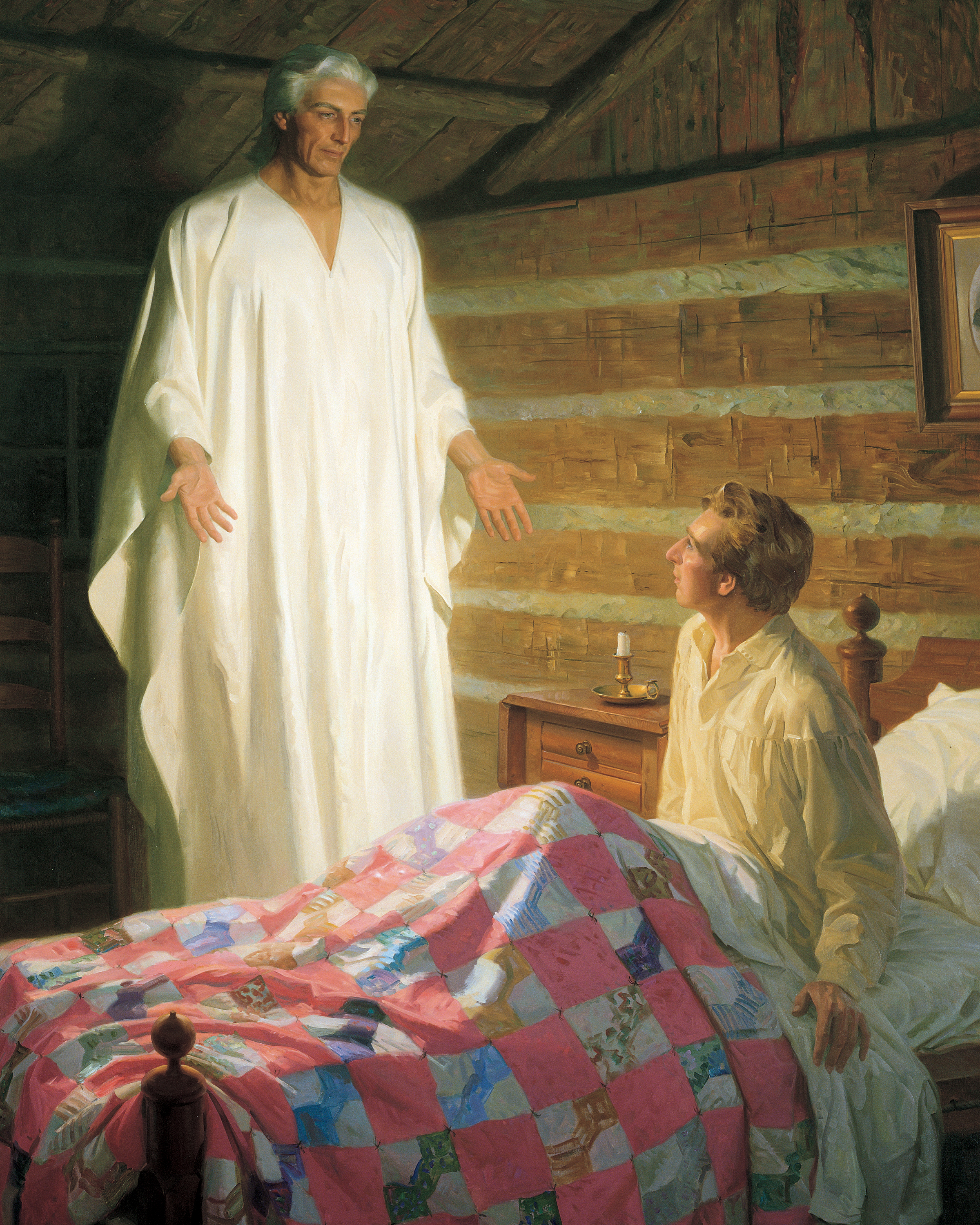
Question: Why are these six expansions on Malachi from the Aramaic Targum of interest to me? They are of interest because on September 21, 1823, Joseph Smith received a visitation from the Angel Moroni. In this visit Moroni taught Joseph of his upcoming prophetic call. Moroni then quoted passages from Malachi. (Joseph Smith History 1:36, 38-39)
1:36 After telling me these things, [Moroni] commenced quoting the prophecies of The Old Testament. He first quoted part of the third chapter of Malachi; and he quoted the fourth or last chapter of that prophecy, though with a little variation from how it reads in our Bibles. Instead of quoting the first verse as it reads in our books, he quoted it thus. 
1:38 ...Behold, I will reveal unto you the Priesthood, by the hand of Elijah the prophet, before the coming of the great and dreadful day of The Lord.
1:39 He also quoted the next verse differently: And he shall plant in the hearts of the children the promises made to the fathers, and the hearts of the children shall turn to their fathers. If it were not so, the whole earth would be utterly wasted at his coming. 
I remember reading this passage for the first time as a recently baptized nineteen-year-old member of the Church of Jesus Christ of Latter-day Saints. Joseph Smith's testimony of seeing God The Father and His Son Jesus Christ, both Men standing side by side, radiating powerful light and peace, had reached my heart. I had no doubts as to Joseph Smith's prophetic call. Still, I puzzled over these citations of Malachi, the divergence from the standard Biblical text, in particular to present the concepts of "revealing" the "Priesthood" so that the "promises" made to the fathers would become relevant to the children, otherwise the "whole" earth would be wasted at the coming of our Lord.

So imagine my astonishment at discovering this month, August, 2016, information about the ancient Aramaic translation of Malachi, information that scholars began writing about roughly 70 years after Joseph Smiths' encounter with Moroni, but information which clearly demonstrates that the ancient Jews believed that The Book of Malachi was oriented toward the corrupt priests, pointed to a day of renewal when the Temple of The Lord would be in operation with Priesthood officiation, when covenants ("promises to the fathers") would be renewed, and when there would be a great event of "revealing". Imagine my delight at reading that the ancient Aramaic Targum even added the word "whole" to earth (4:6), verbatim what Moroni did when he visited Joseph Smith.

The reader is at liberty to make of these passages what he or she will. As for me, I see linguistic evidence substantiating the veracity of Joseph Smith's angelic visitation and his prophetic ministry. More to the point, I must share this: Question: How did James come upon this find? I was reading Scripture last week and a clear and authoritative thought came to my mind: "James, look at the Targum of Malachi. Compare it to how Moroni quoted Malachi to Joseph Smith." Immediately I knew that The Father had spoken to my understanding, and I knew that there would emerge a further witness of Joseph Smith's prophetic calling.

But however the reader takes this information I ask one thing only: That you remember that the passages, at least, are actually textual.

Wednesday, August 17, 2016

Then and Now


In our mindset we are Western European. What does it mean that we are Western European in our mindset? It means that we arrange our logic linearly, orderly, from A-Z, formulaically, clearly expressing our points. Being Western European in our mindset we often explicitly state what our points are, and we provide our evidence. This system works wonderfully...for those of us who are of a Western European mindset.

But what about the old Patriarchs, the ancient prophets? They were not without moments of extraordinary clarity that immediately connect to our modern sense of "come out and say what you mean": 
"And Simon Peter answered and said, Thou art the Christ, the Son of the living God." (Matthew 16:16)
"Jesus answered, Verily, verily, I say unto thee, Except a man be born of water and of the Spirit he cannot enter the kingdom of God." (John 3:5)

However, there was another way ancient patriarchs taught: By narrative, arranging carefully selected details where principle was demonstrated rather than being explicitly stated. Both plainness and narrative were employed together. Want to see how? Let us see how both were used.
"Thus the heavens and the earth were finished, and all the host of them." (Genesis 2:1)
Throughout Genesis, chapters 1-2, God is described commanding that the earth and its atmosphere ("heavens") be formed, and God heeds each command and fashions the earth, placing flora and fauna on the orb, in stages, culminating in the emergence of Adam and Eve. The narrator then states that God had now finished the heavens and earth and all their hosts. This is an example of clarity, direct statement.

Move along the narrative:
"So [God] drove out the man; and he placed at the east of the garden of Eden Cherubims, and flaming sword which turned every way, to keep the way of the tree of life." (Genesis 3:24). 
Well, the garden we know of, the man, "Adam", here defined as husband and wife together as one, and the tree of life, all these we know of, for we were told how they came to be. Cherubims and the flaming sword? Nowhere in the creation account we were told anything about the formation of cherubims or of a flaming sword. We are also told nothing about the formation of the angels, be they Cherubims, Seraphims or any other rank or office, or of the creation of the heavens where God dwells. What are we to conclude? We are to conclude that the angels and such Divine implements as "the flaming sword" existed prior to the formation of the earth.

Want another example of the interweaving of explicit and implicit? I will provide one.
"And the LORD God formed man of the dust of the ground, and breathed into his nostrils the breath of life; and man became a living soul." (Genesis 2:7)
What do we have here? Moses related to us how The Lord God created Adam and, in relative terms, when The Lord God created Adam--The Lord God created Adam after preparing the earth and its atmosphere to sustain life. This much is explicitly clear in the narrative. Then The Lord God placed into this body that He had just formed "the breath of life", and when this "breath of life" entered the body Adam became a living soul. When did The Lord God create Adam's "breath of life"? 

What is clear are two things: (1) The breath of life existed prior to entering the body that The Lord God created for Adam, and (2) we are not told when The Lord God created this breath of life, but whenever it was that He fashioned the breath of life He fashioned it prior to the creation of the earth and its atmosphere.

This observation on "the breath of life" being older or having come into being prior to the creation of the physical body that houses it, a "premortal life" so to say, is revealed to us at the very beginning of the sacred record. Did the Hebrews follow through with this belief in the premortal nature of the spirit of man? The Hebrews absolutely followed through with this doctrine. I will offer a more precise translation from the Hebrew:
"Then shall the dust return to the earth as it was: and the spirit shall return unto The God who had given it." (Ecclesiastes 12:7)
Nowhere in the creation narrative or after it does Moses (or his successors) discuss when God created the spirits of mankind, but the writer of Ecclesiastes tells us that the spirit shall eventually return to The God who had given it. Let us see another example, again, with a more precise translation from the Hebrew:
"At before I had formed thee in the womb I had known thee; and at before thou hadst come forth out of the womb I had sanctified thee, and I had ordained thee a prophet unto the nations." (Jeremiah 1:6)
The Hebrew makes very clear, explicitly clear, what is somewhat clouded in most English translations, that The Lord told Jeremiah that He, The Lord, had already known Jeremiah at a time prior to forming Jeremiah's body in the womb. In fact, The Lord even states that at the time before Jeremiah emerged from the womb, was born, The Lord had already sanctified Jeremiah and ordained him a prophet to the nations. Consider this:
"And thou shalt sanctify them [the altar, its vessels, the laver, table, its vessels, the candlestick, incense, tabernacle, etc.], that they may be most holy: whatsoever toucheth them shall be holy." (Exodus 30:29)
This latter point on sanctification is important. Did we notice what we were taught? When the ark of the covenant was made, all its articles were then sanctified. The principle is clear: Sanctification occurs only after the item has come into being, not before. When The Lord told Jeremiah that He, The Lord, had sanctified Jeremiah before the child emerged from the womb and had ordained him, that sanctification and ordination occurred at that previous time when The Lord knew Jeremiah, and that was before physical conception.

The belief in premortal life continued even into the days of Jesus and His Apostles. There was an occasion when Jesus and His disciples passed by a blind man.
"And as Jesus passed by, he saw a man which was blind from his birth. And his disciples asked him, saying, Master, who did sin, this man, or his parents, that he was born blind? Jesus answered, Neither hath this man sinned, nor his parents; but that the works of God should be made manifest in him." (John 9:1-3)
What an interesting question. The belief that the parents had committed some sin for which an angry God took vengeance on their child rears its head of falsehood even today. The really curious part of the question was whether the blind man himself had sinned for which sin he was born blind. This is an instance where we can perceive the ancient Israelite belief in a premortal world, a world where we had agency, the ability to choose right from wrong. It was this perspective of the premortal existence of the spirit that, in the mind of the disciples, allowed for the understanding that a man could be punished for his own shortcomings through the condition of his birth. Jesus clarified, mercifully, that no one had sinned (physical shortcomings are not God's punishment), but that by turning to The Healer we would glorify God in our triumphs.

The belief continued through the Apostolic ministry.
"Blessed be the God and Father of our Lord Jesus Christ, who hath blessed us with all spiritual blessings in heavenly places in Christ. According as he hath chosen us in him before the foundation of the world, that we should be holy and without blame before him in love." (Ephesians 1:3-4)
What do we see here? We see Paul addressing the Ephesians and touching upon what was a common belief for both Jew and Christian, not only the premortal life of the spirit, but the spirit being chosen and sanctified for a great mortal work in the service of our Lord, Jesus Christ. Sometimes readers are tempted to see in this selection process God's omniscience rather than our antemortal existence. The reader would be counseled to seek definitions in Scripture. Indeed we have such a definition or exemplary instance. We modern folk conceive of being chosen as God merely exercising His omniscience to pick out someone He knows will be true to Him, and then He purposes to make that soul a great servant at some obscure future date. But what do we actually see in Scripture?
"Also I heard the voice of The Lord, saying, Whom shall I send, and who will go for us? then said I, Here am I; send me. And he said, Go, and tell this people, Hear ye indeed, but understand not; and see ye indeed, but perceive not." (Isaiah 6:8-9)
This powerful example of Isaiah's prophetic call shows us something: That God chooses His prophets in His very presence, in the presence of Father, Son and Holy Ghost ("..who will go for us?"), and that the selection process involves the prophet offering his service and The Lord then "choosing" to use that servant ("Here am I; send me...Go, and tell this people...").

But as the belief in the premortal nature of the spirit was lost in the first centuries after the Apostles had been rejected and therefore held back from the world, The Lord restored that knowledge through direct doctrine, that is, revelation:
"And now, verily I say unto you, I was in the beginning with the Father, and am the Firstborn;...Ye were also in the beginning with the Father...Man was also in the beginning with God." (Doctrine and Covenants 93:21,23,29)
This precious doctrine on the antemortal or premortal existence of man is affirmed in every book of Scripture: The Old Testament, The New Testament, The Book of Mormon: Another Testament of Jesus Christ, The Doctrine and Covenants, The Pearl of Great Price. This perspective is vital to our spiritual progression. When I believed I came to be in this life I never could reconcile the arbitrariness of my existence and the sacrifices God was calling on me to make. When I trusted The Lord enough to let His Spirit teach me that I had indeed lived before, this life came into greater focus. I now had purpose, a mission, I was and am on a continuum, one that will lead me back to The Father as greater than I was before, because this time I will be embodied, have enormous experience, and firsthand knowledge that it was through the merits of my Redeemer that I was enabled to make mortality a stage of advancement.

The reader is at liberty to make of these citations what he or she will. Always do bear in mind that the passages I cited, at least, are actually textual.

Sunday, August 14, 2016

Three Simple Definitions From Hebrew


Among the valuable lessons I learned in linguistics was this: To define words according to their usage.

Whoever first articulated this point was a genius. Consider, you may find an ancient document. You may decode the ancient document. You may read the ancient text. Before long you will ache for a glossary of terms wondering, "What did this word mean to that writer at that time?" However, the definition is right before us because usage is meaning. In addition, the more frequent the usage, the more detailed and nuanced the meaning we are presented with.

Having this in mind I wish to share with readers three simple definitions from Moses and the ancient patriarchs.

Definitions: "Image and Likeness" and God

When Elohim, translated as "God", saw Creation gloriously wrought according to His Word, Elohim pronounced a commandment. However, unlike the previous commands where He, Elohim, had commanded His Son to forge an earth in various stages, with each intermediate degree having flora and fauna placed here that would not only thrive but, through their cycles, prepare the biosphere to sustain a higher order of life, the culmination of the process being the biosphere's ability to sustain Human life, this crowning command that Elohim pronounced just when the earth had now reached its ultimate aim involved the direct participation of Himself:
Let-Us-make Adam in-image-of-Us, as-shape-of-Us, and let them rule over fish of the sea, over bird of the heavens, and over livestock, and over all the earth, and over all the crawler crawling along the ground. Elohim created the Adam in-image-of-Him, in-image of Elohim He-had-created him, male and female He-had-created them. (Genesis 1:26-27, from the Hebrew)
The word that gets translated "image" is "Tselem". Tselem can mean the shadow cast from something, but it often means "idol". Why idol? As the idol is meant to be a physical representation on earth of Him who dwells in Heaven, so Adam, "man", was declared to be God's representation on earth of Him, the God of Heaven. We are told that Adam was made by Elohim Himself, though not Alone, "Let-Us-make", and that Elohim made Adam in His image. That word "in" for Hebrews denotes more than "being inside". As in English, "in" denotes "by means of", for example, "Blessed are the poor in spirit". Elohim declared that They were to make Adam "by their own image"; Adam or man is in character, we might say our noblest character, a reflection or representation of what God is like: Equipped with ranges of thought and ranges of feelings.

The word that often gets translated "likeness" is "Dmut" and it means 'shape'. Now, scarcely could a better word have been chosen. When God made Adam, every physical aspect of the body of Adam was in the shape of the body of Elohim, the body of God. Though subsequent generations strayed from God's prophetic word and came to believe that God has no body or form, HE, Elohim, declared that He does indeed have a body, and our body is shaped, as He stated, "as His Body is shaped."

These two terms, "image" and "shape", were Elohim's objective in creating Adam or mankind. To be more specific, Elohim set out to make a mankind that would resemble Him, that is, we might say, resemble in character and attributes, but Elohim also determined that mankind would be "shaped" like Him.

The Name Elohim vs. The Name God

Why, you might ask, am I consistently writing "Elohim" rather than God? In English "God" is singular, and in our usage "God" is Male. In Hebrew, the Hebrew of the patriarchs, "Elohim" is plural, which for them denoted Three or more. God made Adam, 'Man', in His own image and shape/likeness, and declared that "Adam" subsumes male and female together on earth as a representation of how "Elohim" subsumes Male and Female Together in heaven.

"How or where did God say that man and woman on earth are a direct representation of Man and Woman in Heaven?", you may ask. When He said, "Let us make man in our image, after our likeness, and let them have dominion...over all the earth" and "In the image of God created He him: male and female created He them."  This is how God was able to create Adam in His own image and shape/likeness and claim that He, Elohim, had created male and female. Did we actually see what the Hebrew told us? That when Elohim made Adam in His own Godly image and shape/likeness, there stood man and woman, because the making of the Adam was the product of Man and Woman Together?

I hear it said, I see it written, "Why should God be a Man? Why not a Woman?", "Why doesn't the Church of Jesus Christ of Latter-day Saints modernize speech and write 'Heavenly Parents' in place of Heavenly Father?'" Actually, the need, as I see it, is not for the Brethren to fix Scriptural language to the English speech of the early 21st century, but for me (and others) to rely on God and study His Word through His Spirit, receiving from God the understanding of what His words meant and mean. The Father and The Mother are One, United, just as God declared Adam and Eve, them, to be "Adam", one. Never was there a father without a mother, and we were made in the glorious image and likeness of God, Elohim. That mankind is a direct representation of Elohim is something to ponder and, more to the point, live to, today and going forward.

Some may be tempted to conclude that "Heavenly Mother" is "hidden in plain sight" or "encoded" in Scripture. I believe that God does not hide things from me, but that my sight is not purely physical but also mental. To the extent that I do not understand something, I do not perceive it when I see it. But The Father can lift my understanding and open my eyes wider to perceive His Truth, as long as I keep trying to do His will and rely on the Atonement of His Son, which Sacrifice The Father prepared so that I, and others, could draw closer to Him and eventually return to Him, in His image, as His likeness.

The reader is at liberty to consider or discard what I have keyed in; as always, please remember that the passages and words cited herein are, in the very least, actually textual. Have a blessed Sabbath Day, The Lord's Day!