Monday, March 13, 2017

Recitation upon Examination


On Fast Sunday of September, 1984, I sat across from two elderly missionaries. They read to me the First Vision of Joseph Smith. Conviction and joy overcame me, and from that moment on I knew that Joseph Smith had seen both The Father and The Son, Both Holy Beings, and that the great work of the Restoration of the Gospel had begun. I felt blessed to live in a time when a knowledge of these events was made known.

Many years later I discovered that Joseph Smith had related his experience on two other occasions where his recitation of the event was recorded in writing. Now, some Latter-day Saints have taken not only the accounts but the explanation of their significance from sources who are antagonistic to our faith. These Saints believe the portrayal that essentially states that since Joseph Smith’s three recitations are not identical, Joseph Smith clearly lied. Since the second and third recitations got longer (as the antagonists claim), it is clear that Joseph Smith was embellishing the story as time went on until he produced a version powerful enough to dupe.

But here I wish to issue a call to reason and discernment. Question: Is it true that if a man (or woman) relates an event and does not relate the event in its entirety on, for example, three occasions, the variation in length and detail indicates dishonesty? Likewise, is it true that if the putative (supposed) witness’ length of recitation grows that the witness is embellishing?

I will be frank, most people will respond based on common sense. Clearly many Saints have rushed to the judgement that Joseph Smith lied about seeing God The Father and His Son…because Joseph dictated three recitations. I will be franker: In many instances our common sense is strongly influenced by naïve unfamiliarity.

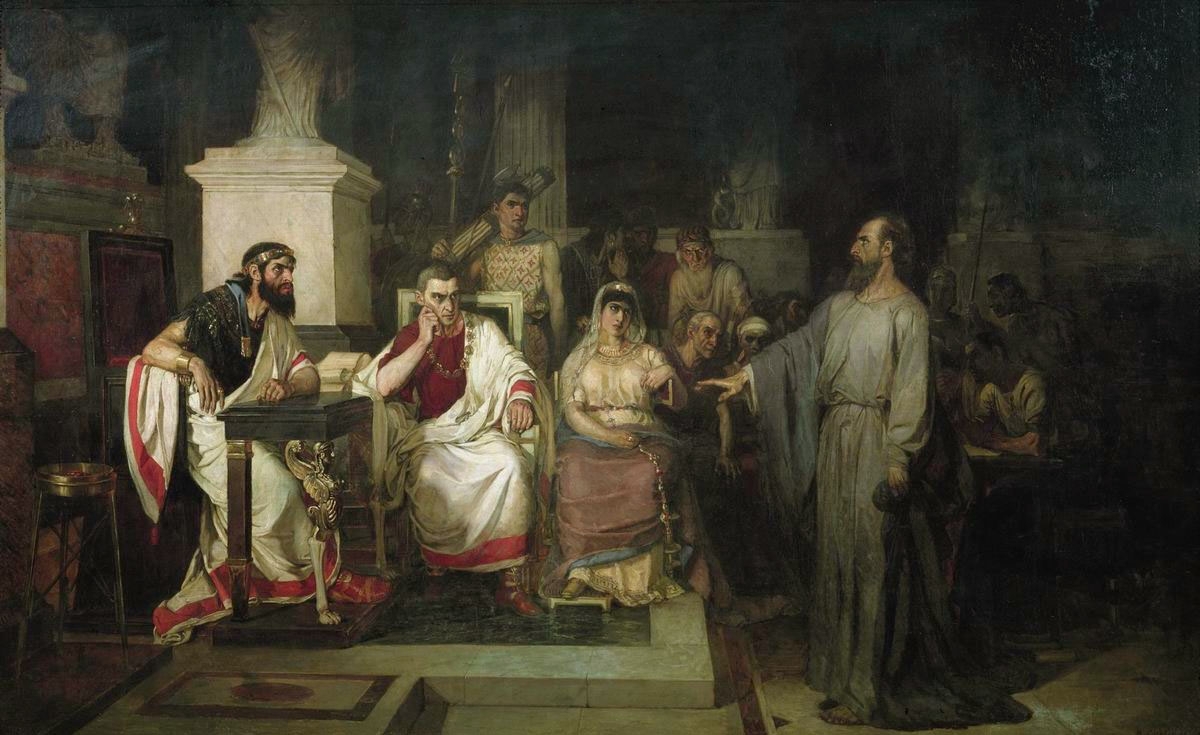
So let us run an experiment. Rather than assuming that variations in length and detail in a recitation indicate mendacity (lying), let us examine recitations of the same event, told by the same witness, and then judge what actual behavior is when a witness to an event shares his (or her) experience with others on three occasions. And since Joseph Smith’s account is putative (alleged) Scripture, how about examining two examples from Scripture where the first-hand witness relates his event on three occasions to three different audiences? Let us begin with Paul on the road to Damascus.

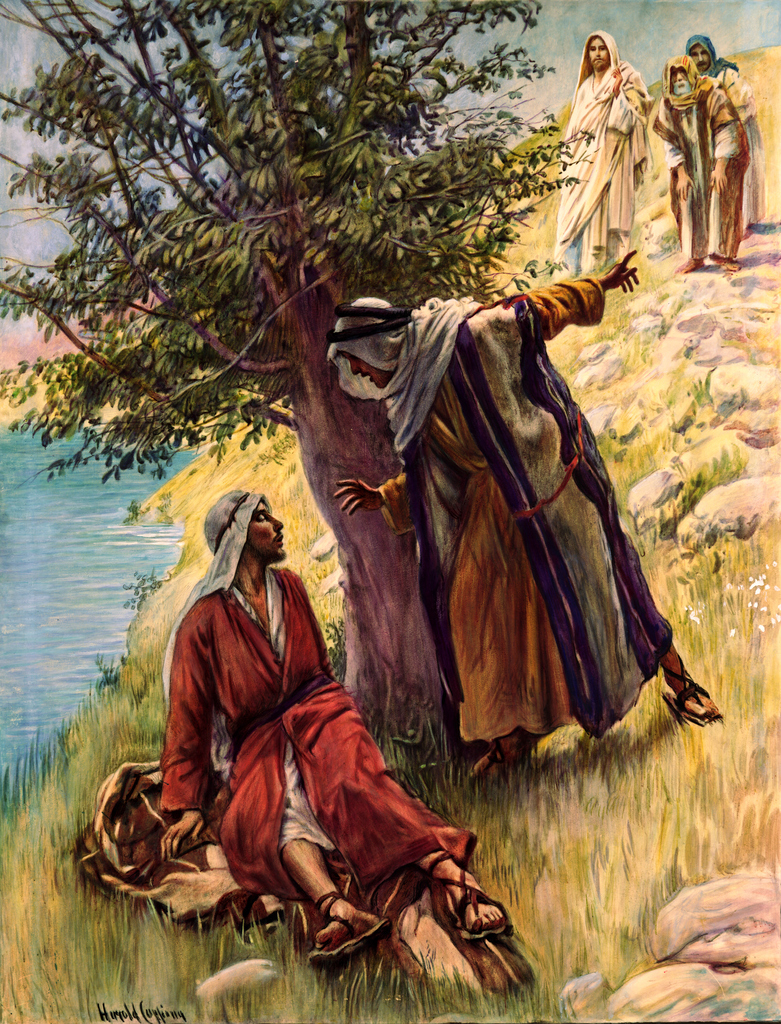
You will recall that Saul (later renamed “Paul”) was on a mission to destroy Christians for their alleged heresy of believing that a Man whom the Sanhedrin condemned to death, Jesus Christ, was The Messiah, The Son of God. Saul had a vision, and Saul converted in this experience. For ease and convenience I have placed the recitations side by side, and I have grouped the verses so that we can view the way Paul related the similar points.

     Acts 9:3-8
Acts 22:6-11
Acts 26:12-19
And as he journeyed, he came near Damascus: and suddenly there shined round about him a light from heaven:
And it came to pass, that, as I made my journey, and was come nigh unto Damascus about noon, suddenly there shone from heaven a great light round about me.
12 Whereupon as I went to Damascus with authority and commission from the chief priests,
And he fell to the earth, and heard a voice saying unto him, Saul, Saul, why persecutest thou me?
And I fell unto the ground, and heard a voice saying unto me, Saul, Saul, why persecutest thou me?
13 At midday, O king, I saw in the way a light from heaven, above the brightness of the sun, shining round about me and them which journeyed with me.
And he said, Who art thou, Lord? And the Lord said, I am Jesus whom thou persecutest: it is hard for thee to kick against the pricks.
And I answered, Who art thou, Lord? And he said unto me, I am Jesus of Nazareth, whom thou persecutest.
14 And when we were all fallen to the earth, I heard a voice speaking unto me, and saying in the Hebrew tongue, Saul, Saul, why persecutest thou me? it is hard for thee to kick against the pricks.

And they that were with me saw indeed the light, and were afraid; but they heard not the voice of him that spake to me.

And he trembling and astonished said, Lord, what wilt thou have me to do? And the Lord said unto him, Arise, and go into the city, and it shall be told thee what thou must do.
10 And I said, What shall I do, Lord? And the Lord said unto me, Arise, and go into Damascus; and there it shall be told thee of all things which are appointed for thee to do.
15 And I said, Who art thou, Lord? And he said, I am Jesus whom thou persecutest.
16 But rise, and stand upon thy feet: for I have appeared unto thee for this purpose, to make thee a minister and a witness both of these things which thou hast seen, and of those things in the which I will appear unto thee;
17 Delivering thee from the people, and from the Gentiles, unto whom now I send thee,
18 To open their eyes, and to turn them from darkness to light, and from the power of Satan unto God, that they may receive forgiveness of sins, and inheritance among them which are sanctified by faith that is in me.
And the men which journeyed with him stood speechless, hearing a voice, but seeing no man.

19 Whereupon, O king Agrippa, I was not disobedient unto the heavenly vision:
And Saul arose from the earth; and when his eyes were opened, he saw no man: but they led him by the hand, and brought him into Damascus.
11 And when I could not see for the glory of that light, being led by the hand of them that were with me, I came into Damascus.


Well, what do we have here? We may make the following observations:

1. It appears that the speaker, in this case Paul (Saul), conveys the sense of a message but not always the precise wording each time. Notice that Paul said that Jesus identified Himself saying “I am Jesus” but then “I am Jesus of Nazareth”. In the first recitation Paul states that he said, “Lord, what wilt thou have me do?”, but in the second recitation Paul states that he said, “What shall I do, Lord”. The sense is the same but the wording is not identical.

2. In his first and third recitations Paul mentions “kicking against the pricks”, but not in his second recitation. So the recitations may not always contain every detail.

3. The speaker may relate more details as time goes on. In the first recitation Paul states that he was told “It shall be told thee what thou shalt do.” In the second recitation Paul states that he was told “It shall be told thee of all things which are appointed for thee to do.” And in the third recitation Paul reveals an entire directive he was given to take this message to the Gentiles, open their eyes to turn them from Satan to God, and to lead to their sanctification through faith in Jesus Christ.

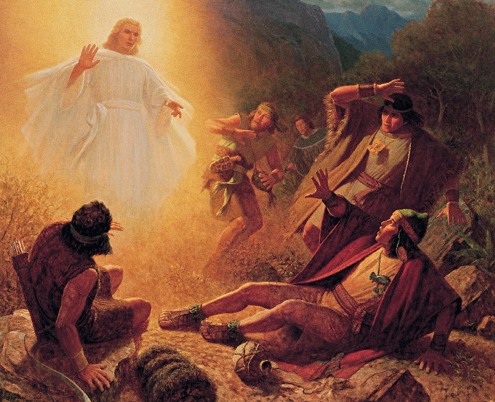
But okay, I was told in graduate school that when you present evidence, if you have only one example, one example is as good as none. So let us see a second example of a man who had a vision, a man who relates that vision three times, and let us analyze the content of the three recitations. In this case I will refer the reader to The Book of Mormon: Another Testament of Jesus Christ, the story of Alma the younger’s conversion. Alma the younger was the son of a prophet, but Alma the younger rebelled. He not only forsook the faith of his father, he sought to destroy the entire Church of God. An angel appeared unto Alma the younger, and in this experience Alma the younger converted. Let us see his three recitations:


Mosiah 27:23-32
Alma 36:15-23
Alma 38:5-8 
23 And it came to pass after they had fasted and prayed for the space of two days and two nights, the limbs of Alma received their strength, and he stood up and began to speak unto them, bidding them to be of good comfort:
24 For, said he, I have repented of my sins, and have been redeemed of the Lord; behold I am born of the Spirit.
15 Oh, thought I, that I could be banished and become extinct both soul and body, that I might not be brought to stand in the presence of my God, to be judged of my deeds.

And now my son, Shiblon, I would that ye should remember, that as much as ye shall put your trust in God even so much ye shall be delivered out of your trials, and your troubles, and your afflictions, and ye shall be lifted up at the last day.


Now, my son, I would not that ye should think that I know these things of myself, but it is the Spirit of God which is in me which maketh these things known unto me; for if I had not been born of God I should not have known these things.


But behold, the Lord in his great mercy sent his angel to declare unto me that I must stop the work of destruction among his people; yea, and I have seen an angel face to face, and he spake with me, and his voice was as thunder, and it shook the whole earth.

16 And now, for three days and for three nights was I racked, even with the pains of a damned soul.
17 And it came to pass that as I was thus racked with torment, while I was harrowed up by the memory of my many sins, behold, I remembered also to have heard my father prophesy unto the people concerning the coming of one Jesus Christ, a Son of God, to atone for the sins of the world.
And it came to pass that I was three days and three nights in the most bitter pain and anguish of soul; and never, until I did cry out unto the Lord Jesus Christ for mercy, did I receive a remission of my sins. But behold, I did cry unto him and I did find peace to my soul.

18 Now, as my mind caught hold upon this thought, I cried within my heart: O Jesus, thou Son of God, have mercy on me, who am in the gall of bitterness, and am encircled about by the everlasting chains of death.

25 And the Lord said unto me: Marvel not that all mankind, yea, men and women, all nations, kindreds, tongues and people, must be born again; yea, born of God, changed from their carnal and fallen state, to a state of righteousness, being redeemed of God, becoming his sons and daughters;
26 And thus they become new creatures; and unless they do this, they can in nowise inherit the kingdom of God.


27 I say unto you, unless this be the case, they must be cast off; and this I know, because I was like to be cast off.
28 Nevertheless, after wading through much tribulation, repenting nigh unto death, the Lord in mercy hath seen fit to snatch me out of an everlasting burning, and I am born of God.

19 And now, behold, when I thought this, I could remember my pains no more; yea, I was harrowed up by the memory of my sins no more.


29 My soul hath been redeemed from the gall of bitterness and bonds of iniquity. I was in the darkest abyss; but now I behold the marvelous light of God. My soul was racked with eternal torment; but I am snatched, and my soul is pained no more.
20 And oh, what joy, and what marvelous light I did behold; yea, my soul was filled with joy as exceeding as was my pain!
21 Yea, I say unto you, my son, that there could be nothing so exquisite and so bitter as were my pains. Yea, and again I say unto you, my son, that on the other hand, there can be nothing so exquisite and sweet as was my joy.
22 Yea, methought I saw, even as our father Lehi saw, God sitting upon his throne, surrounded with numberless concourses of angels, in the attitude of singing and praising their God; yea, and my soul did long to be there.

30 I rejected my Redeemer, and denied that which had been spoken of by our fathers; but now that they may foresee that he will come, and that he remembereth every creature of his creating, he will make himself manifest unto all.
31 Yea, every knee shall bow, and every tongue confess before him. Yea, even at the last day, when all men shall stand to be judged of him, then shall they confess that he is God; then shall they confess, who live without God in the world, that the judgment of an everlasting punishment is just upon them; and they shall quake, and tremble, and shrink beneath the glance of his all-searching eye.
23 But behold, my limbs did receive their strength again, and I stood upon my feet, and did manifest unto the people that I had been born of God.
And now, my son, I have told you this that ye may learn wisdom, that ye may learn of me that there is no other way or means whereby man can be saved, only in and through Christ. Behold, he is the life and the light of the world. Behold, he is the word of truth and righteousness.
32 And now it came to pass that Alma began from this time forward to teach the people, and those who were with Alma at the time the angel appeared unto them, traveling round about through all the land, publishing to all the people the things which they had heard and seen, and preaching the word of God in much tribulation, being greatly persecuted by those who were unbelievers, being smitten by many of them.
24 Yea, and from that time even until now, I have labored without ceasing, that I might bring souls unto repentance; that I might bring them to taste of the exceeding joy of which I did taste; that they might also be born of God, and be filled with the Holy Ghost.


What do we see in the three recitations of Alma the younger? Let us make a small list.

1. Alma the younger does not reveal all details in every recitation. In fact, only in the first one does he relate that God The Father spoke to him and what God the Father told him. Only in the second recitation does Alma the younger relate what he said when he cried out to Jesus for mercy. Also critically important is that only in the second recitation does Alma the younger mention that he thought he saw God sitting on His throne, surrounded by angels, as Lehi saw. And only in the third recitation does Alma mention his “remission of sins”, though Alma did in effect describe that in each recitation.

2. Alma sometimes summarizes details rather than relaying them as a dialogue each time. In the first recitation Alma states what The Father told him about all mankind needing to be born again. In the second recitation Alma the younger summarizes the message without saying that The Father told him that very message, and in the third recitation Alma the younger counsels his son Shiblon apparently in a manner similar to how The Father counseled him in the vision.


So what have we seen in these two examples, one from Paul and the other from Alma the younger? We have seen that, contrary to common sense, witnesses of events do not reveal all the details during every recitation. Sometimes a witness reveals more details as time goes on, and sometimes a witness will summarize and thereby reveal less details as time goes on. We also learn that the witness may even quote others, for example, the witness may quote The Lord, but quote The Lord’s sense rather than precise wording every single time.

But if the recitations will vary in length and amount of details, how can we know whether the witness testimony is true? Well, what did Jesus say about witnesses? I can share a beautiful Scripture on this concept, but one key detail was lost in translation. I will compensate for that. Did you know that in Hebrew and in Aramaic, unlike in Greek or English, the word for “spirit” and “wind” are one and the same, they are identical? So in Hebrew and Aramaic, you only know whether you are speaking of the wind or the Spirit based on the context because the word “spirit” also means “wind” (and “breath”, for that matter). Now I share John 3:8:

The spirit/wind bloweth where it listeth, and thou hearest the sound thereof, but canst not tell whence it cometh, and whither it goeth: so is every one that is born of the Spirit.

What is the application of this verse? It is clear. That just as the wind (Spirit) comes on us and we feel it’s presence, and we understand it’s voice, but we cannot see the Spirit descending from the Presence of God, nor can we see the Spirit ascending to return to the Presence of God, (therefore we cannot know let alone prove the past or know and prove the future), we still know what we felt and we know what we understood. THAT is what being born of The Spirit is. That rebirth, that witness is not based on anything we saw or could show to the world any more than we can see where the wind blows from. Nor is that witness based on any future event we saw and could show the world any more than we saw where the wind blows to. But we do feel the Spirit and we do understand what the Spirit tells us, its voice--THAT is the witness of the Spirit. We felt it and we understood it in the present, in the now.

With a sense now more grounded in truth rather than naïve unfamiliarity, let us see Joseph Smith’s recitations side by side:


1832 Recital
1835 Recital
1838 Recital, JS History 1:14-20, 25
Therefore, I cried unto the Lord for mercy, for there was none else to whom I could go and obtain mercy, and the Lord heard my cry in the wilderness.
Being thus perplexed in mind I retired to the silent grove, and there bowed down before the Lord, under a realizing sense, (if the Bible be true), ask, and you shall receive; knock, and it shall be opened; seek, and you shall find. And again, if any man lack wisdom, let of God, who giveth to all men liberally and upbraideth not.
14 So, in accordance with this, my determination to ask of God, I retired to the woods to make the attempt. It was on the morning of a beautiful, clear day, early in the spring of eighteen hundred and twenty. It was the first time in my life that I had made such an attempt, for amidst all my anxieties I had never as yet made the attempt to pray vocally.
And while in the attitude of calling upon the Lord, in the sixteenth year of my age, a pillar of light above the brightness of the sun at noon day come down from above and rested upon me, and I was filled with the Spirit of God.
Information was what I most desired at this time, and with a fixed determination to obtain it, I called on the Lord for the first time in the place stated.


Or in other words, I made a fruitless attempt to pray—my tongue seemed to be swollen in my mouth, so that I could not utter. I heard a noise behind me like someone walking towards me. I strove again to pray, but could not. The noise of walking seemed to draw nearer, and I sprang upon my feet and looked around, but saw no person or thing that was calculated to produce the noise of walking. I kneeled again, my mouth was opened and my tongue loosed. I called on the Lord in might prayer.
15 After I had retired to the place where I had previously designed to go, having looked around me, and finding myself alone, I kneeled down and began to offer up the desires of my heart to God. I had scarcely done so, when immediately I was seized upon by some power which entirely overcame me, and had such an astonishing influence over me as to bind my tongue so that I could not speak. Thick darkness gathered around me, and it seemed to me for a time as if I were doomed to sudden destruction.
And the Lord opened the heavens upon me, and I saw the Lord, and he spake unto me saying, Joseph, my son, thy sins are forgiven thee. Go thy way, walk in my statutes, and keep my commandments.  Behold, I am the Lord of glory. I was crucified for the world, that all those who believe on my name may have eternal life. Behold, the world lieth in sin at this time and none doeth good, no not one. They have turned aside from the gospel, and keep not my commandments; they draw near to me with their lips while their hearts are far from me. And mine anger is kindling against the inhabitants of the earth to visit them according to this ungodliness, and to bring to pass that which hath been spoken by the mouth of the prophets and Apostles. Behold and lo, I come quickly, as it is written of me, in the cloud clothed in the glory of my Father.
A pillar of fire appeared above my head, which presently rested down upon me, and filled me with unspeakable joy. A personage appeared in the midst of this pillar of flame, which was spread all around, and yet nothing consumed. Another personage soon appeared like unto the first; he said unto me, Thy sins are forgiven thee. He testified also unto me that Jesus Christ is the Son of God. I saw many angels in this vision.
16 But, exerting all my powers to call upon God to deliver me out of the power of this enemy which had seized upon me, and at the very moment when I was ready to sink into despair and abandon myself to destruction—not to an imaginary ruin, but to the power of some actual being from the unseen world, who had such marvelous power as I had never before felt in any being—just at this moment of great alarm, I saw a pillar of light exactly over my head, above the brightness of the sun, which descended gradually until it fell upon me.
17 It no sooner appeared than I found myself delivered from the enemy which held me bound. When the light rested upon me I saw two Personages, whose brightness and glory defy all description, standing above me in the air. One of them spake unto me, calling me by name and said, pointing to the other—This is My Beloved Son. Hear Him!
18 My object in going to inquire of the Lord was to know which of all the sects was right, that I might know which to join. No sooner, therefore, did I get possession of myself, so as to be able to speak, than I asked the Personages who stood above me in the light, which of all the sects was right (for at this time it had never entered into my heart that all were wrong)—and which I should join.
19 I was answered that I must join none of them, for they were all wrong; and the Personage who addressed me said that all their creeds were an abomination in his sight; that those professors were all corrupt; that: “they draw near to me with their lips, but their hearts are far from me, they teach for doctrines the commandments of men, having a form of godliness, but they deny the power thereof.”
And my soul was filled with love, and for many days I could rejoice with great joy. And the Lord was with me, but [I] could find none that would believe the heavenly vision.
I was about 14 years old when I received this first communication…
20 He again forbade me to join with any of them; and many other things did he say unto me, which I cannot write at this time. When I came to myself again, I found myself lying on my back, looking up into heaven. When the light had departed, I had no strength; but soon recovering in some degree, I went home…
25 So it was with me. I had actually seen a light, and in the midst of that light I saw two Personages, and they did in reality speak to me; and though I was hated and persecuted for saying that I had seen a vision, yet it was true; and while they were persecuting me, reviling me, and speaking all manner of evil against me falsely for so saying, I was led to say in my heart: Why persecute me for telling the truth? I have actually seen a vision; and who am I that I can withstand God, or why does the world think to make me deny what I have actually seen? For I had seen a vision; I knew it, and I knew that God knew it, and I could not deny it, neither dared I do it; at least I knew that by so doing I would offend God, and come under condemnation.


We see that like Alma the younger, Joseph Smith shared a direct message from The Lord to him only in his first recitation. We also see that like Paul before King Agrippa, Joseph Smith relayed instructions from The Lord to him regarding his future mission, but relayed those details only in the third recitation. As with both Paul and Alma the younger, the length and amount of details varied, but, interestingly enough, all three men—Paul, Alma the younger and Joseph Smith—gave their richest details in that occasion that they perceived to be the most formal setting: In the case of Alma the younger, before the High Priest of the Church (his father) and other leaders; in the case of Paul before King Agrippa, and in the case of Joseph Smith, for publication to all the world.

Now, the reader may contend for alternative interpretations. You are certainly at liberty so to do. I ask always only one thing—that you remember that the passages quoted, at least, are actually textual.


Monday, February 27, 2017

The Lord Above and The Lord Below


I have commented before on the Biblical experience called "Jacob's Ladder". First, bear in mind that the word "ladder"and "staircase" in Hebrew (as in some modern languages: Russian, Spanish, et al.) are one and the same. The King James translators rendered "a ladder" but "a staircase" would have been more correct. The event is described in Genesis 28. Here is a brief summary:


  1. Jacob, the son of Isaac, grandson of Abraham, is alone and lies down to sleep in a desert location called "Luz", which means "almond tree". The almond tree, having gnarly branches, was a symbol of corruption or wickedness. 
  2. Jacob uses a long rock as a pillow.
  3. Jacob has a prophetic dream in which he sees a ladder (actually a "staircase") which rises to heaven. 
  4. Jacob sees an unspecified number of the angels of God ascending and descending on the staircase. By Hebrew grammar there had to be a minimum of 3 angels present.
  5. At the top of the staircase stands Jehovah.
  6. When Jacob awakes he realizes that he has seen a vision. He changes the name of this place from "Luz" to "Beth-El", 'The House of God', and states that "this is the gate of heaven." The Hebrew word for the Temple is "Beth-El", 'the House of God'.
  7. Jacob takes the rock, his pillow, the stone used to support and give rest to his head, and props the stone up like a pillar. Jacob then anoints the top of the pillar with oil. This means that the pillar has now been "anointed". The Hebrew word for "anointed" translates to 'Messiah' or 'Christ'.
  8. Jacob covenants with God to have God provide him with bread to eat and clothes to wear, which two items, bread and clothes, are the recurrent Hebrew symbols for Temple officiation.
  9. Jacob states that this pillar, which he has anointed and thus made "Messiah" or "Christ", shall be the House of God. Jacob, covenanting to return to "his father's house", or maybe "his (Heavenly) Father's house", vows to pay a tithe of all he has.
You may refer to the chapter yourself, Genesis 28:10-22. Latter-day Saints will recognize this encounter that Jacob had as the Endowment. 

The passage says much more than first meets the eye. I have already pointed out a couple of factors, namely, that once Jacob anointed the pillar the pillar became "Messiah" or "Christ" because in Hebrew "Messiah" or in Greek "Christ" means 'anointed'. I also pointed out how the bread and clothes refer to officiating in the Temple. I also indicated how per Hebrew grammar Jacob would have seen 3 angels ascending and descending on the staircase or ladder, at a minimum.

Allow me to point out one other factor: Since the angels were ascending and descending on the staircase (ladder) upon which Jehovah stood, the angels would have been ascending to Jehovah in order to report to Him on the completion of whatever errand He had sent them on. The angels would then have descended the staircase (ladder) again on whatever errand Jehovah would next have sent them on.

I never tire of rehearsing this great event, one of the clearest descriptions of the Endowment in Scripture. 

But may I offer one extra point? Bearing in mind that the angels were ascending and descending to Jehovah, what do you think of what Jesus had to say to His Apostles on the occasion that Jesus called Nathanael to follow Him?


John 1:47-51
  • 47: Jesus saw Nathanael coming to him, and saith of him, Behold an Israelite indeed, in whom is no guile!
  • 48: Nathanael saith unto him, Whence knowest thou me? Jesus answered and said unto him, Before that Philip called thee, when thou wast under the fig tree, I saw thee.
  • 49: Nathanael answered and saith unto him, Rabbi, thou art the Son of God; thou art the King of Israel.
  • 50: Jesus answered and said unto him, Because I said unto thee, I saw thee under the fig tree, believest thou? thou shalt see greater things than these.
  • 51: And he saith unto him, Verily, verily, I say unto you, Hereafter ye shall see heaven open, and the angels of God ascending and descending upon the Son of Man.
So what do we have here? In The Old Testament times the angels of God would ascend and descend the staircase or gate to heaven in order to return to Jehovah, report back to Him, and receive from Him their next mission. But in The New Testament times the angels of God ascend and descend from open heaven upon The Son of Man, even Jesus Christ. So why the change from Jehovah to Jesus?

There really was no change other than moving from the premortal stage in eternal progression to the mortal stage: Jehovah is pre-mortal Jesus. Jesus is mortal Jehovah.

Jesus is Jehovah, and whether before or after His birth from a virgin, He is The Son of God our Redeemer, the only way, truth and life by which we can reach our Father in Heaven again.

It is helpful to ponder these points. Not only are The Old Testament and The New Testament truly linked in a beautiful way, so are the modern Scriptures and the Restoration of the Priesthood including most importantly the Temple ordinances.

The reader is, of course, at liberty to dispute, refute or otherwise repute anything I have written. I ask always that the reader remember one thing: That the passages I made reference to are actually textual.


Sunday, February 26, 2017

The Parity of Similarity (Missionary Encounters in Ancient America and Colonial Nicaragua)


Dedicated to a dear friend.

I told a dear friend of mine that the combination of (a) similar background, (b) similar current situation, and (c) similar objective would yield (d) a similar result.

So what prompted such a discussion with my friend? It seems that those of my brethren who choose to discount the hand of God and His inspiring of Scripture in general but The Book of Mormon: Another Testament of Jesus Christ specifically, focus their attention on any similarity between The Book of Mormon and The Bible or any other known text and, having established parallels, raise the charge of plagiarism: "Aha! You see! The Book of Mormon has X,Y and Z and this other text has X and Z or X and Y or X,Y, and Z, and therefore Joseph Smith lifted X,Y and Z out of this known text and used those themes to create this portion of The Book of Mormon. And if Joseph Smith has now been proven a fraud in this portion, he was a fraud with the rest of The Book of Mormon. And if a fraud with The Book of Mormon, Joseph Smith was a fraud with all of the Restoration. Case closed!"

Really? Does a similarity really prove plagiarism? Is the establishment of a parallel truly proof conclusive of fraud?

I tell my dear friend that two of the most valuable lessons I came across through research in graduate school were these insights:

  1. The obvious answer is usually the wrong one. If one applies himself to doing research, one will often discover that what initially appeared to be the obviously correct solution was naively incorrect, and what initially appeared to be the absurd option proves to be the correct one.
  2. That if you actually research a problem, if you painstakingly carefully investigate its factors (antecedents, current points, likely and known possible explanations, the strengths and weakness of these posited explanations) and follow the path of reason and cautious inquiry, you will often discover that the combination of (a) similar antecedents, (b) similar current circumstances, and (c) similar objectives leads to (d) a similar result. 

SIMILARITY NUMBER 1


So what if similarities in such factors lead to similar results? Well, once you have established that the similarity between two texts (to use only one example) may not be a case of plagiarism, you are prepared to further your investigation and determine the real cause.

I will cite two such examples. 

Years ago, during my Michigan days, my Sunday School teacher came to me with a grave concern. Though he did not tell me where the concern came from, and at the time I took it to mean that the concern simply arose within him, he had actually been fishing around anti-Mormon websites and thus came upon this concern that was jolting his testimony or deep conviction of the Restored Gospel. As a side note, I am not opposed to fishing around anti-Mormon websites as long as one takes his concerns to The Lord and receives the witness of The Holy Ghost as his answer.

Anyway, my Sunday School teacher's concern. It was this, "Why does Lehi in The Book of Mormon quote Shakespeare if Shakespeare came over two thousand years later? This has me really scared."

In addressing death in Hamlet Shakespeare wrote: "...from whence no traveler returns." The Prophet Lehi, in The Book of Mormon, on the subject of his own impending death (from old age) said to his children, "...from whence no traveler can return."  

I told my Sunday School teacher that as a linguist this parallel between Lehi and Shakespeare did not concern me. Why? Because, again, the combination of (a) similar backgrounds, (b) similar current circumstances, and (c) similar objectives can naturally lead to (d) similar results.

But as quotes are by nature misleading, no matter how good the intentions (let alone when nefarious intentions are at play), let us see the wider passages.

Shakespeare (Hamlet Act 3, Scene 1, Page 4)

The undiscovered country from whose bourn
no traveler returns puzzles the will
and makes us rather bear those ills we have
than fly to others that we know not of?
Then conscience does make cowards of us all.

The Book of Mormon: Another Testament of Jesus Christ, 2 Nephi 1:14

Awake! And arise from the dust,
and hear the words of a trembling parent,
whose limbs ye must soon lay down in the cold and silent grave
from whence no traveler can return;
a few more days and I go the way of all the earth.

The two striking similarities of "traveler" and "cannot return" are, one must confess, far less potent when their actual contexts are provided. Notice also how skeptics always say that both Lehi and Shakespeare state "from whence", though it was only Lehi who did (Shakespeare wrote "from whose bourn" 'from whose boundary/limit'). But as the argument still is made, "But the choice of word of traveler and return is too strong, I feel, to be mere coincidence", I shall say a bit more on the subject. 

First, notice that in both Shakespeare and The Book of Mormon the speakers were (a) Christian, (b) facing near certain or suspected death, (c) had deep misgivings about the state of those loved ones who would survive them and (d) felt impelled to accomplish something before death because they would not be able to return from death to further their work on earth. In texts as they stand, if we assume nothing more, both go on to make the statement about the inability of the traveler to return. The concern for some is the combination of these two terms.

Second, if we agree with the first point I made, that the similar circumstances and background as well as similar objectives could naturally be reflected in a similar choice of expression, then we can conclude that the case for plagiarism is far from being established: Similar backgrounds and circumstances can account for the choice of these two words. If we wish to satisfy our concerns over possible plagiarism, we will have to study the matter out beyond the scope of Shakespeare and Lehi because at the level of Shakespeare and Lehi we may just be dealing with a universal, that is, something that would naturally occur anywhere given the confluence of points (a) through (d) as noted above. And just what might be a superior alternative explanation for the similar expressions of Lehi and Hamlet? How about the Prophet Job?

The Holy Bible, Job 10:21-22

Are not my days few?
cease then, and let me alone,
that I may take comfort a little.
Before I go whence I shall not return,
even to the land of darkness,
and the shadow of death.

The Holy Bible, Job 16:22

When a few years are come,
then I shall go the way
from whence I shall not return.

Well, well, well, what do we have here? It now appears that both Shakespeare and Lehi may have been drawing inspiration from the Biblical Prophet Job. The parallel of traveler and return (which is two words, in all honesty, hardly a point that could withstand litigation in court) has just collapsed because Lehi used both "whence" and "not return", apparently drawing influence from Job, and Shakespeare (who often cites The Bible) may have drawn his use of "not return" from the same source. Thus the real case for plagiarism that remains is that both Lehi and Shakespeare used a single word traveler. Do we say that every time an airline uses the word "traveler" the airline has plagiarized Hamlet? No. I put it to the reader that since The Book of Mormon and Hamlet are in English, there are thousands of similar word choices between the two texts. The case for plagiarism based on "whence/traveler/returns" has collapsed. For further reading on this topic (and there is much more that is astonishing to be said here), see http://actuallytextual.blogspot.com/2014/09/from-whence-no-traveler-can-return.html, if I do say so myself.


SECOND SIMILARITY


This second case is now ready for presentation. I would like to reiterate the two points I made earlier about dealing with similarities between texts, to use one example, but add a third:

  1. The obvious answer is usually the wrong one. If one applies himself to doing research, one will often discover that what initially appeared to be the obviously correct solution was naively incorrect, and what initially appeared to be the absurd option proves to be the correct one.
  2. That if you actually research a problem, if you painstakingly carefully investigate its factors (antecedents, current points, likely and known possible explanations, the strengths and weakness of these posited explanations) and follow the path of reason and cautious scrutiny, you will often discover that the combination of (a) similar antecedents, (b) similar current circumstances, and (c) similar objectives leads to (d) a similar result
  3. A situation where two separate events across cultures and time spans yielded similar outcomes is supporting evidence that the first situation described may have happened. Obviously. If one text posits (proposes) that given certain circumstances X was the result, and if elsewhere in time and place similar circumstances and factors came together and X was the result there too, then the situation described in the first text can be seen as realistic. Mind you, the situation described in the first text is not "proven" by the fact that the same situation played out elsewhere, but the situation of the first text can now and should now be seen as plausible or reasonably possible. 
To be more brief I will outline what the circumstances of this next case were:
  • (a) A Christian missionary has set out to convert a hostile people.
  • (b) The hostile audience consists of American Indians who have their own set of beliefs.
  • (c) The Christian missionary wants to understand those beliefs so that he can draw parallels to his own beliefs and persuade his audience, in a one-on-one personal encounter, to believe in his Christian faith.
  • (d) The result is a conversation that includes the discussion of who God is, the nature of heaven, the Creation of the earth and man, and other topics from the Scriptures. 

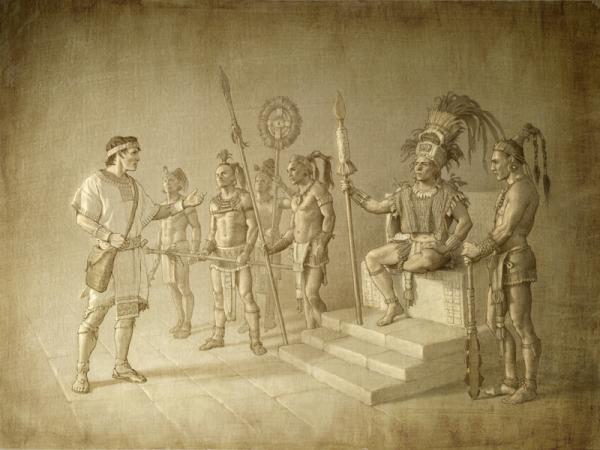
From The Book of Mormon: Another Testament of Jesus Christ, Alma 18:22-36:

  • 22: Now Ammon being wise, yet harmless, he said unto Lamoni: Wilt thou hearken unto my words if I tell thee by what power I do these things? And this is the thing that I desire of thee.
  • 23: And the king answered him, and said: Yea, I will believe all thy words. And thus he was caught with guile.
  • 24: And Ammon began to speak unto him with boldness, and he said unto him: Believest thou that there is a God?
  • 25: And he answered, and said unto him: I do not know what that meaneth.
  • 26: And then Ammon said: Believest thou that there is a Great Spirit?
  • 27: And he said, Yea.
  • 28: And Ammon said: This is God. And Ammon said unto him again: Believest thou that this Great Spirit, who is God, created all things which are in heaven and in the earth?
  • 29: And he said: Yea, I believe that he created all things which are in the earth; but I do not know the heavens.
  • 30: And Ammon said unto him: The heavens is a place where God dwells and all his holy angels.
  • 31: And king Lamoni said: Is it above the earth?
  • 32: And Ammon said: Yea, and he looketh down upon all the children of men; and he knows all the thoughts and intents of the heart; for by his hand were they all created from the beginning.
  • 33: And king Lamoni said: I believe all these things which thou hast spoken. Art thou sent from God?
  • 34: Ammon said unto him: I am a man; and man in the beginning was created after the image of God, and I am called by His Holy Spirit to teach these things unto this people, that they may be brought to a knowledge of that which is just and true;
  • 35: And a portion of that Spirit dwelleth in me, which giveth me knowledge, and also power according to my faith and desires which are in God.
  • 36: Now when Ammon had said these words, he began at the creation of the world, and also the creation of Adam, and told him all the things concerning the fall of man, and rehearsed and laid before him the records and the holy scriptures of the people, which had been spoken by the prophets, even down to the time that their father, Lehi, left Jerusalem.


Here are some of the more salient (potent, stand-out) points from this encounter between Ammon, a Christian missionary, and King Lamoni, both of whom were Native Americans but from opposing nations, circa 90 B.C.:

  1. God
  2. Unfamiliarity with the term for "God" that Ammon used.
  3. The missionary goes on to use the native expression for God of the target audience, here translated as "Great Spirit".
  4. The Creation of the earth.
  5. Uncertainty about the nature or location of Heaven.
  6. The Creation of man.
  7. Introduction to other basic teachings and doctrines from Scripture.

Now, flash forward to the Americas at the time of the Spanish Conquest. In 1528, a Spanish priest by the name of Fray Francisco Bobadilla visted Nicaragua. Fray Bobadilla wanted to assess the extent of the influence of the Catholic faith on the native population of Nicaragua. Fray Bobadilla understood that many Indians converted only nominally, so in assessing the extent of the influence of Catholicism on the Indians Fray Bobadilla desired to further their understanding or outright convert them. To accomplish his objectives Fray Bobadilla interviewed Indian chiefs, royalty, one by one, in personal interviews. A record was prepared of this encounter, which is how I am able to report on it now, on February 26, 2017, nearly 500 years later:


  • Friar: Do you know who made heaven and earth?
  • Indian: My parents told me, when I was a child, that it was Famagostad  and Zipaltonal, the first male and the second female.
  • Friar: What are they, men or animals?
  • Indian: I do not know; my parents never saw them; nor do I know whether they dwell in the air or elsewhere.
  • Friar: Who created man, and all things?
  • Indian: As I have already said, Famagostad and Zipaltonal, a younger named Ecalchot, a Guegue ("Elder", very old personage), and the little Ciagot.
  • Friar: Where are they?
  • Indian: I do not know, except that they are our great gods, whom we call Teotes.
  • Friar: Have they parents or ancestors?
  • Indian: No; for they are gods.
  • Friar: Do the Teotes eat?
  • Indian: I do not know; but when we make war, we do so that they may eat the blood of our enemies whom we have slain or taken prisoners. We scatter the blood on all sides, in order that the Teotes may make sure of it; for we know not on which side they dwell, nor even that they do really consume it.
  • Friar: Do you know, or have you even heard, that the world has been destroyed since the creation?
  • Indian: I have heard our fathers say that it was destroyed by water, a very long time ago.
  • Friar: Were all men drowned?
  • Indian: I do not know; but the Teotes rebuilt the world, and placed upon it men and animals again.
  • Friar: How did the Teotes escape? upon a mountain or a canoe?
  • Indian: They are gods, how could they drown?
  • Friar: Were all animals and the birds drowned?
  • Indian: Those now existing were created anew by the Teotes, as well as men and all things.
  • Friar: Are all the Indians acquainted with what you have just told me?
  • Indian: The priests of the temples and the caziques (chiefs, princes) know it. 
  • Friar: By whom are the Teotes served?
  • Indian: The old men say that those who are slain in battle serve the Teotes, and that those who die in the natural way, go under the earth.
  • Friar: Which is most honorable, to go under the earth, or to serve the Teotes?
  • Indian: By far to serve the Teotes, because we shall then meet with our fathers.
  • Friar: But if your fathers have died in their beds, how can you meet them?
  • Indian: Our fathers are themselves Teotes.
  • Friar: Can the Teotes bring the dead to life, and if so, where are the reawakened dead?
  • Indian: All that I know is that infants who die before they are weaned, and before they have tasted maize, will be raised again, and return to their fathers' houses, where their fathers will recognize and provide for them; whilst, on the other hand, those who die at a more advanced age will never come to life again.
  • Friar: But if the father should die before his children come to life again, how can he recognize or provide for them?
  • Indian: If the fathers die, I know not what becomes of the children.
  • Friar: Finally what is their destiny?
  • Indian: I know only what I have told you; and it must be true, because our fathers have told us so.

This encounter is fascinating for a good many reasons. First of all, the opportunity to listen in as it were on a conversation between a European priest and an American Indian on the topic of religion, in the contact region of Catholicism and an ancient Native American belief system, is singular. The concepts that are addressed are also fascinating, both the questions and the answers.  And notice some of the topics addressed:

  1. God
  2. Greater facility with the native term for "God", "Teote".
  3. On occasion the Friar himself uses the native term for God, "Teote".
  4. The Creation of the earth.
  5. Uncertainty about the nature or location of Heaven.
  6. The Creation of man.
  7. Introduction to other basic teachings and doctrines from Scripture, namely, the Great Flood and the Resurrection.

Clearly the case of Ammon, the Priest and missionary after the Holy Order of God and of the House of Israel, is different from the case of Friar Bobadilla, Roman Catholic Priest, but notice how (a) their similar backgrounds as Christians, (b) the similar circumstance, namely, of encountering royalty of the hostile opposing nation, and (c) that the encounter taking place in the context of evangelization, yielded (d) the addressing of similar concepts, through similar questions and even some degree of similar wording. 

The record of Friar Bobadilla dates to the 1500s, though portions were only translated to English and published in English in 1852 by the famed American archaeologist Ephraim G. Squier, whose research and expeditions took him from upstate New York through Mexico down to South America. He visited and wrote extensively on Nicaragua, and it is from volume II, "Nicaragua; its People, Scenery, Monuments, and the Proposed Interoceanic Canal with Numerous Original Maps and Illustrations:, pages 349-350 that I extracted the above passage. 


So what is the great point I wish to make here today? It is simply this: When scrutinizing an issue regarding Scripture in general (or any topic really) but The Book of Mormon: Another Testament of Jesus Christ in particular, do not fall prey to "easy" or "obvious" allegations or attacks; the obvious answers are often untrue. Instead prayerfully analyze the issue studying the source texts for yourself (quotes are by nature misleading even when the intentions are good let alone when the intentions are nefarious). Remember that similarities do not prove plagiarism or fraud, that similar outcomes can result from the confluence (coming together) of similar backgrounds, similar current circumstances and similar objectives.

But also remember that if the formula (a) + (b) + (c) may equal or lead to (d) plays out in two or more instances which are separated both by time and location, then the event described in the text under scrutiny (which invariably is The Book of Mormon), though not proven by the parallel example, should be viewed as realistic, as plausible (it could have actually happened). If you ask me, Ammon really did address King Lamoni much as Friar Bobadilla really addressed Nicaraguan Chieftains. Both encounters were priceless, the difference being that Ammon had the gift of the Holy Ghost within him such that his encounter with Lamoni was not only a priceless window into ancient native beliefs but a window into the priceless eternal truths that lead to salvation.

Sure, the reader is at liberty to draw any conclusions or simply to discard what I have laid out as irrelevant. I ask only that you all remember that what I have shared here is actually textual.


Monday, February 6, 2017

Thou : The Target Audience of the Ten Commandments


I was reading in Exodus recently and I read the Ten Commandments. Here I had an insight and understood something that had escaped my notice up to now: The Ten Commandments are addressed to a specific audience. 


To whom are the Ten Commandments addressed?


It is not immediately evident. However, for starters, we can tell that the Ten Commandments are addressed to a single person, at least, grammatically they are addressed an individual:

20:2 I am the LORD thy God, which have brought thee out of Egypt, out of the house of bondage. 
20:3 Thou shalt have no other gods before me.

The pronouns "thou", "thee", and "thy" all refer to a single person. If plural were intended, "ye", "you" and "your" would have been used.

The LORD would address all of Israel as "thou" in the sense that all of Israel united was His son, His child. But in verse 10 we get the real clue who the target audience of the Ten Commandments is:

20:10 But the seventh day is the sabbath of the LORD thy God: in it thou shalt not do any work, thou, nor thy son, nor thy daughter, thy manservant, nor thy maidservant, nor thy cattle, nor thy stranger that is within thy gates.

So what are we told here about the target audience of these commandments at this point?

This person, the target audience, has 


a son
a daughter
a manservant
a maidservant
cattle
maybe strangers (foreigners, visitors)


The first two descriptive clauses seal the identification: The target audience is a parent (thy son, thy daughter). Because the Hebrew verbal forms that accompany "thou", unlike English, convey gender, the Hebrew forms of "thou shalt" are clearly masculine singular. So the target audience appears to be a father.


But what or who is missing?


But notice what we are not told: "thy wife". What man ever became a father but by a woman? And what is the only form of union that The Lord commanded of His children? Marriage in the Temple (originally the Garden of Eden) for all eternity.

So where was the woman? In Hebrew The Lord would address the married couple as if they were a single being, because they were meant to be "one flesh". To be fully informative, it is true that The Lord would also address couples in the plural ("ye") and addressed Israel in the plural ("ye"), but the singular seems to have been used to convey the intended "oneness" and unity. Might this not be the reason that "thou" is used here, to convey the idea that man and woman are one, married in His covenant, and this unity, husband and wife, are to raise their children and even their servants (to some extent cattle) and foreign sojourners to keep the commandments of The Lord? 

So in short: The target audience of the Ten Commandments is a married couple, husband and wife, a man and a woman, bonded in the unity of the covenant of God, and this couple, this unity, is to convey the commandments to their children and raise the children to serve The Lord. 

Pretty sweet, no? The Lord's ways really do build up the family. The Lord's ways really do restore balance to any soul who will receive them. The Proclamation on the Family really is a modern reaffirmation of eternal truths.

I understand that readers may diverge from what I have posted. I only ask that the reader bear in mind that the passages cited are actually textual.


Have a blessed day!

Sunday, November 13, 2016

The Lord's House and Homosexuality in The Bible


People often ask what The Bible says about homosexuality. Some clever antagonists are quick to point out that "Nowhere in Scripture (usually meaning The Bible, though the same is often said of The Book of Mormon: Another Testament of Jesus Christ as well as The Doctrine and Covenants and Pearl of Great Price) does it even mention the word homosexual or homosexuality. Therefore, it must be alright to engage in homosexual intimate activity." So their rationale goes.


The Term "Homosexual" in English


Did you know that the term "homosexual" entered English in the 1890's? Think about that. There already were gays in America and England (everywhere in the world), but English had no specific clinical term to denote attraction to one's gender. So as the term homosexual or homosexuality appeared fairly recently in English would we expect to find the term in ancient Scripture? No. Such an expectation would be groundless.


The question is, therefore, not whether the word "homosexuality" appears in Scripture. It does not. Does the term "heterosexual" ever appear in Scripture, for that matter? No, it does not either. Being that that there had to be homosexuals among the Hebrews, and there had to be heterosexuals as well, the question is how the subject was treated.


How Did The Lord Treat the Subject of Human Intimacy?


First, The Lord never called the experiencing of attraction a sin. It is not a sin to be attracted, be it to one's gender or the opposite sex.

The Lord's pattern for guiding His children is consistent: He teaches the path to come unto Him. Period. And thus the ancient Prophets and the people of God understood that any other alternative would not lead to The Lord. A Book of Mormon prophet-king, Benjamin, taught that there are diverse ways and means to sin, so many he could not number them, but the way to live was to keep the commandments of God. (Mosiah 4:29-30)


  • 29: And finally, I cannot tell you all the things whereby ye may commit sin; for there are divers ways and means, even so many I cannot number them.
  • 30: But this much I can tell you, that if ye do not watch yourselves, and your thoughts, and your words, and your deeds, and observe the commandments of God, and continue in the faith of what ye have heard concerning the coming of our Lord, even unto the end of your lives, ye must perish. And now, O man, remember, and perish not.

That was the Hebrew way of teaching: Teach the right path, the one path to salvation, and all deviations from that path lead to spiritual death, the separation of us from God. When needed, due to the intransigence (stubbornness) of the people, the prophets would make lists of prohibitions. They were not exhaustive lists, though, because as King Benjamin said, the number of ways in which a person can sin cannot be numbered by a mortal.


What Did The Lord Say About Gays if Not By Addressing Gays as "Gays"?


So what did God actually instruct about homosexuality? After Heavenly Parentage brought Adam and Eve to life, raised them, taught them, Deity married them in the first Temple and prototype of all Temples of God: The Garden of Eden. God married Adam and Eve, by His authority, with no built-in separation at death because there was no death yet, and because God is God of the living and of eternity. From the Hebrew text God said, as reported by Moses:

  • 24: Like that shall a man leave father and mother and cleave unto his wife: and they shall be one flesh. (Genesis 2:24)

"Like that" says the Hebrew. "That" is the way that people shall become one flesh, as man and woman only.

Now, most Christians get that The Lord prescribed marriage for man and woman only, but most Christians fail to see that the only marriage He prescribed was marriage in the Temple, by His power, "coeh" 'Priesthood', for all time and eternity.


So What About Gays?


But what about gays? What about us?

Folks ask about The Bible and homosexuality, and when they ask me they are asking a linguist who studies the Word of God and who knows God lives. I can answer for myself.

The term "eunuch" was used to refer not only to men born without genitalia, but to men whose genitalia was (always brutally) removed. These men either would not marry, for various reasons, or would marry for companionship, though with no coitus. Daniel, Shadrach, Meshach and Abednego were made eunuchs through violence, and probably never married. Potiphar, the Egyptian who bought Joseph the visionary son of Jacob, was probably born a eunuch, and he did marry. His inability to perform intimately is the back story to his wife's hitting on Joseph.

The Lord, as did the Hebrews, included righteous homosexuals under the term eunuch. 

  • 12: For there are some eunuchs, which were born from their mother's womb: and there are some eunuchs, which were made eunuchs of men: and there be eunuchs, which have made themselves eunuchs for the kingdom of heaven's sake. He that is able to receive it, let him receive it. (Matthew 19:12)


In what sense would a man make himself a eunuch? Such a man would not marry or experience intimacy, just as eunuchs would usually forgo marriage, but these men would forgo marriage with a woman (and intimacy with those of their gender) for their love of The Lord, in order to inherit the Kingdom of Heaven.


Is Chastity in the Form of Lifelong Abstinence Fair?


But how is it fair that a man or woman who is healthy, normal in all physical regards, who has the capacity to fall in love, experience passion, should choose not to act on it? Well, what did Jesus say we should do when faced with all those wonderful experiences if we face the choice of either them or Him? He said to choose Him, forgo the rest, and He would reward us many times what we forwent:

  • 19:29 And every one that hath forsaken houses, or brethren, or sisters, or father, or mother, or wife, or children, or lands, for my name's sake, shall receive an hundredfold, and shall inherit everlasting life. (Matthew 19:29)
  • 5:29 And if thy right eye offend thee, pluck it out, and cast it from thee: for it is profitable for thee that one of thy members should perish, and not that thy whole body should be cast into hell.
  • 5:30 And if thy right hand offend thee, cut it off, and cast it from thee: for it is profitable for thee that one of thy members should perish, and not that thy whole body should be cast into hell. (Matthew 5:29-30)

One need not already have something in hand in order to forsake it for our Lord. One may have the opportunity to have obtain something, but choose not to pursue the option, opting instead to follow The Lord.

The Lord had even addressed this issue in what later came to be known as The Old Testament. In eternally consistent style, The Father addresses His children who face these challenges with enormous tenderness, affection and love. Let us examine this step by step. (Isaiah 56)

  • 1: Thus said the LORD, Keep ye judgment, and do justice: for my salvation is near to come, and my righteousness be revealed.
  • 2: Blessed is the man that doeth this, and the son of man that layeth hold on it; that keepeth the sabbath from polluting it, and keepth his hand from doing any evil.

This passage has universal application. Though the entire chapter has universal application, it will become apparent that there is a specific and special target audience.

  • 3: Neither let the son of the stranger, that hath joined himself to the LORD, speak, saying, The LORD hath utterly separated me from his people: neither let the eunuch say, Behold, I am a dry tree.

This verse is touching. Due to apostate actions undertaken by rebellious factions among the Jewish ecclesiastical leadership, Gentile converts were no longer welcome in the Temple, and eunuchs were similarly barred from entry. These eunuchs bore the hard burden also of having no posterity, "a dry tree".

  • 4: For thus saith the LORD unto the eunuchs that keep my sabbaths, and choose the things that please me, and take hold of my covenant;
  • 5: Even unto them will I give in mine house and within my walls a place and a name better than of sons and daughters: I will give them an everlasting name, that shall not be cut off.

The Lord addresses the eunuchs directly and tells them that for choosing the things that please Him, and for taking hold of His covenant, He would (a) bring them into His House and within His own walls and there give them a name, His Name, better than what so many of the sons and daughters of the kingdom had, and His Name will be everlasting and not "cut off", that is, they will have posterity after all. As Jesus would later say, they would receive an hundred fold of what they forsook for His sake. The Lord continued:

  • 7: Even them will I bring to my holy mountain, and make them joyful in my house of prayer: their burnt offerings and their sacrifices shall be accepted upon mine altar; for mine house shall be called an house of prayer for all people.
  • 8: The LORD GOD which gathereth the outcasts of Israel saith, Yet will I gather others to him, beside those that are gathered unto him.

The Lord states that He will lead these eunuchs to His Holy Mountain, His Temple and habitation, Zion, make them joyful in His House of Prayer, and in the highest blessing yet, He will accept their offerings on the altar, which is the expression The Lord uses for exaltation and eternal life. In one of the most beautiful utterances of all Scripture: "For mine house shall be called an house of prayer for all people."


Some, Indeed Many, May Object


I can anticipate howls of objections from some scholars and readers with considered opinions to the effect that homosexuals are not to be classed among eunuchs. Perhaps. I am simply sharing inspiration that The Lord gave to me.


Before our births The Father already knew what physical challenges He would subject us to. He knew this before He sent our spirits down to earth. He chose these challenges to teach us humility by subjecting us to the choice between Him and the very aspects of our being where we would be most vulnerable. Why would a loving Father in Heaven do this? He did this in order to give us the experience of rising above the greatest difficulties and challenges through His Son, Jesus Christ. Like in weightlifting (though I am no weightlifter, though I would like to be, I digress), the more weight we lift, the stronger the muscles become. By overcoming these challenges we would learn the nature of Godliness and come to resemble Him more. Therein lies the fullness of eternal happiness.

  • 136:31 My people must be tried in all things, that they may be prepared to receive the glory that I have for them, even the glory of Zion; and he that will not bear chastisement is not worthy of my kingdom. (Doctrine and Covenants 136:31)
  • 12:27 And if men come unto me I will show unto them their weakness. I give unto men weakness that they may be humble; and my grace is sufficient for all men; for if they humble themselves before me, and have faith in me, then will I make weak things become strong unto them. (The Book of Mormon: Another Testament of Jesus Christ, Ether 12:27)
  • 121:7 My son, peace be unto thy soul; thine adversity and thine afflictions shall be but a small moment;
  • 121:8 And then, if thou endure it well, God shall exalt thee on high; thou shalt triumph over all thy foes. (Doctrine and Covenants 121:7-8)

The Father already knows our actions, He loves us dearly, and His Son already paid for all shortcomings so that we could forsake our sins and follow Him, be blessed by wisdom wrought in experience, but not be burdened and held back by our mistakes.

The readers, I am certain, will come to formulate various opinions about what I have shared. You certainly are at liberty so to do. I ask always that you remember one thing: The passages I shared, they really are actually textual.

Thursday, November 3, 2016

And Here's to You, Mrs. Potiphar


Through the miracle of studying the Word I learned something, and for days the lesson has been sinking in. 

Many of us are familiar with Joseph and Potiphar's wife. She made a series of passes at young Joseph, and when he resisted her, even by fleeing, she landed him in prison for, she alleged, attempting to assault her. 

In Genesis 39:1 we are given the following background information on Potiphar:

1: And Joseph was brought down to Egypt; and Potiphar, an officer of Pharaoh, captain of the guard, an Egyptian, bought him of the hands of the Ishmeelites, which had brought him down thither.

One single word in Hebrew was translated to what the term implicated rather than what the term actually denotes. Let me give that verse a more careful translation from Hebrew:

1: And Joseph was brought down to Egypt; and Potiphar, a eunuch of Pharaoh, captain of the guard, an Egyptian, bought him of the hands of the Ishmeelites, which had brought him down thither.

Anciently, and as late as the early twentieth century, some people allege even today, men were kidnapped and brutally castrated in order to render them not just slaves, but strong and cheap labor who had no possibility of violating women or procreating. Some men were also (are also) born without genitalia. Women too. Potiphar was an Egyptian, which makes me suspect he may have been born a eunuch. That Potiphar was "a eunuch of Pharaoh" means that Potiphar was an "officer", and in his capacity as "captain of the guard" Potiphar may have been in charge of protecting royal women. 

This makes me suspect that Potiphar showed mercy to Joseph by not having Joseph castrated. Joseph was his slave, and complete removal of genitalia was common practice, as I said, up until the twentieth century, so possibly as far back as then. Perhaps Potiphar, being in that state himself, could not bring himself to afflict another man the same way. Also, upwards of 80-90% of men would die from the procedure, so maybe Potiphar preferred not risking the loss of his investment. However, Potiphar's tender treatment of Joseph gives me to suspect that mercy was more likely the motivating factor.

But the main lesson is that Potiphar was married. As captain of the guard he had risen in rank, risen in authority, risen in wealth and status. He could offer a woman a very comfortable life, enviable social status, and they could enjoy affection and company. But as a eunuch Potiphar could not offer his wife physical intimacy, nor could he offer her children. 

Mrs. Potiphar made her decision to marry Potiphar, knowing the limitation on their conjugal closeness. It is also possible that Potiphar arranged for his marriage, and arranged marriages were the norm back then. Still, some arrangements were between an elderly man and a maiden, and others, apparently, with a man of means who lacked certain physical abilities. Either way, marriage was considered sacred.

As time went on, being physically normal in all regards, Mrs. Potiphar had needs that were going unfulfilled. This is the critical background to her attraction to the (per other attesting records) attractive young Joseph. 

Joseph knew that his lord was a eunuch, and Joseph had to know that Mrs. Potiphar was legitimately starved for real physical intimacy. 

Therein is the great lesson: We all have backgrounds, circumstances, unmet hungers, unanswered needs, unrequited passions. Joseph understood one thing perfectly: That all circumstances notwithstanding, there is one factor or circumstance that outlives all others--The Lord God and His holiness (Genesis 39:7-9):

7: And it came to pass after these things, that his master's wife cast her eyes upon Joseph; and she said, Lie with me. 8: But he refused, and said unto his master's wife, Behold, my master wotteth [knew] not what is with me in the house, and he hath committed all that he hath to my hand; 9: There is  none greater in this house than I; neither hath he kept back anything from me but thee, because thou art his wife: how then can I do this great wickedness, and sin against Elohim

The lesson that is (rightfully) offered, "when in temptation, run away like Joseph did", is easy enough, though simplistic. Sometimes we have nowhere to run physically because Potiphar's wife, figuratively speaking, is within us. 

The lesson I want to offer is that we all have our reasons why entreaties work on us, why certain sins appeal to us, why these mistakes either pull on us or why we turn to them. I realized or am realizing that it is hard to become Joseph, but to grow into spiritual maturity I must accept that some unions have limitations similar to how Mr. and Mrs. Potiphar had a limitation in their relationship. Having such limitations is normal, and the limitations cause tensions within, which tensions are normal. These tensions expose us to temptations, which is also a normal process. But none of these reasons, however legitimate, is reason enough to betray trust and sin against Elohim, against God.

Fortunately, The Lord forgives. He wants to forgive. He wants to wash us in the blood of His Son, and set us back on the right path. 

In 1968 Simon and Garfunkel recorded a song for a movie called "The Graduate". The song was enormously popular. I will wind up this post with the opening stanza changing one name out for another:

And here's to you, Mrs. Potiphar,
Jesus loves you more than you will know.
God bless you, please, Mrs. Potiphar.
Heaven holds a place for those who pray.

Learning to marshal one's passions and kinky kicks is hard. I make no light of this. But it is true that Jesus loves us more than we will know, and that Heaven holds a place for those who pray. So let us unravel the snare that is "my reasons for doing it" and "my unmet needs" and choose not to break trust with The Father but confirm it, and not to sin against Him, but to embrace His peace. 

I have been Mrs. Potiphar, focusing on my reasons and hungers. And I am Mr. Potiphar as well, well-meaning, but woefully inadequate in certain arenas. I have it in me to be Joseph, and thanks to the Atonement by which The Lord forgives and the Mercy of God who lets me advance decades into the process, I am working on bringing out my inner Joseph. Time to give the hero within a chance to play his part. 

(If you don't know the song, Mrs. Robinson, you're in for a treat!

I imagine the readers will exercise their prerogative to draw different conclusions. I would expect nothing else. Though do remember that the passages that I showed are, if nothing else, actually textual.